
This post contains affiliate links. As an Amazon Associate I earn from qualifying purchases. This costs you nothing extra. See our affiliate disclosure for details.
Yes, for many dogs covering the crate at night is a good idea. A cover blocks light and movement, which helps a lot of dogs settle faster and sleep later in the morning. It is not a must, though. Should you cover a dog crate at night? It depends on your dog: covering helps light sleepers and dogs who react to noise, but it is the wrong choice for dogs who chew fabric, run hot or feel trapped when they cannot see out.
This guide walks through how to decide, how to cover a crate safely, and the signs that tell you whether your dog likes it. If you are still setting up the crate itself, our crate training schedule by age covers the routine around it.
Quick Answer: When a Cover Helps and When It Doesn’t
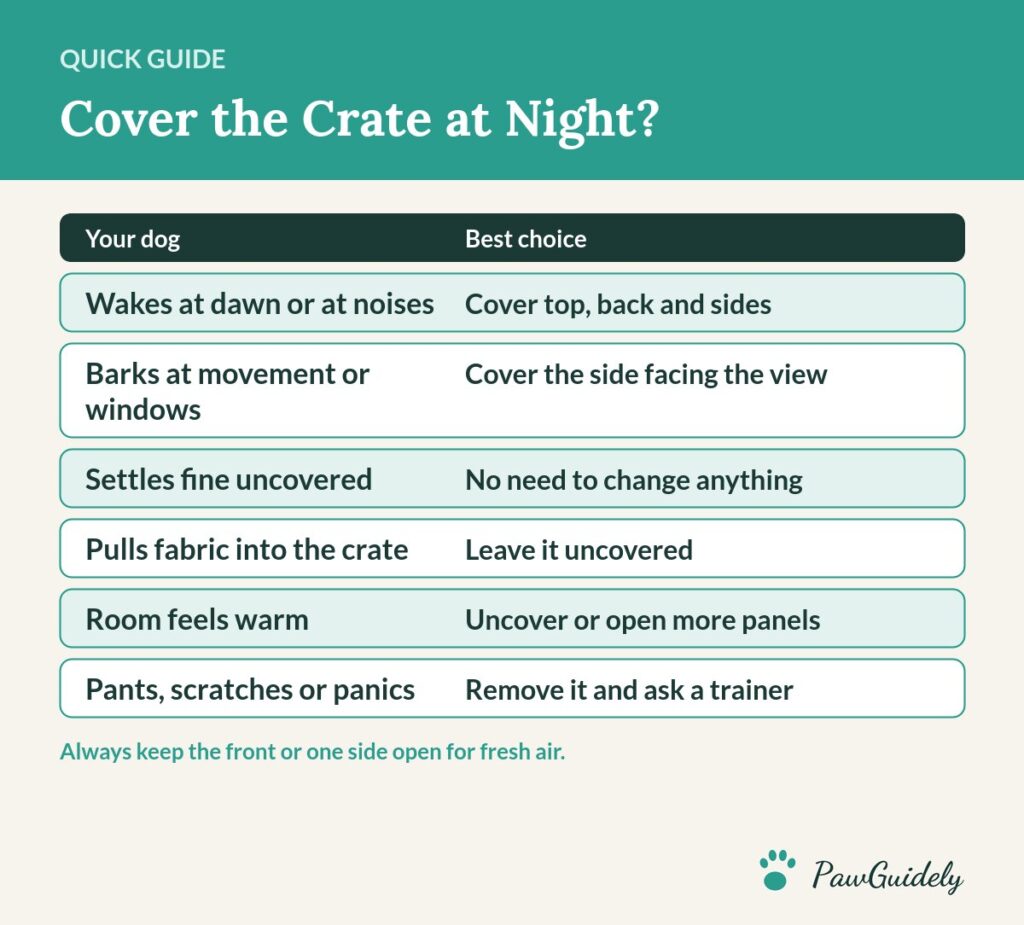
| Situation | Cover at night? |
|---|---|
| Puppy or new dog still settling in | Usually yes, partly covered |
| Dog wakes early when the room gets light | Yes, cover the top and sides |
| Dog barks at windows, cars or other pets | Yes, cover the side facing the view |
| Dog already sleeps well uncovered | Optional, no need to change |
| Dog pulls fabric through the bars | No, skip the cover |
| Warm room or a dog that runs hot | No, or open most panels |
| Dog pants, scratches or panics under a cover | No, remove it |
Why a Cover Can Help a Dog Sleep
Wire crates are open on every side. That is great for airflow, but it also means your dog can see every light, shadow and movement in the room. A cover turns the crate into something closer to a den, and many dogs find that easier to relax in.
- Less visual stimulation. A dog that cannot see the hallway, the window or the cat walking past has fewer reasons to get up and react.
- A darker sleeping space. Early sunrise in summer wakes a lot of dogs. A cover can buy you a little more sleep in the morning.
- A clear bedtime cue. When the cover goes down at the same time each night, it becomes part of the routine, much like turning off a lamp.
- Some sound softening. Fabric will not block noise, but it can soften it a little, and the den feeling helps more than the fabric itself.
None of this replaces the basics. A dog who has had a walk, some play and a last potty break before bed will settle far better than one with energy to burn, covered or not.
When to Leave the Crate Uncovered
A cover is a comfort tool, not a requirement. Leave it off, or take it away, in these situations:
- Your dog chews fabric. If your dog pulls the cover through the wire and chews it, remove it straight away. Swallowed fabric can cause a blockage that needs a vet.
- The room is warm. A cover traps some heat. In summer, in a room without good airflow, or for thick-coated dogs, open most panels or skip it.
- Your dog is flat-faced. Breeds like Bulldogs, Pugs and Frenchies can struggle more in the heat. Be extra careful with airflow and ask your vet if you are unsure.
- Your dog seems more anxious covered. Some dogs want to see you. If your dog settles better with a clear view of your bed, respect that.
- The crate is in a car or in direct sun. Never cover a crate in a hot car or a sunny spot, even for a short time.
How to Cover a Dog Crate Safely at Night
- Start during the day. Drape the cover over the top and back only while your dog naps or chews something in the crate. Watch how they react.
- Add the sides slowly. Over a few days, cover more of the crate as long as your dog stays relaxed.
- Keep the front or one side open. At night, leave at least one panel rolled up so fresh air can move through the crate.
- Check the temperature. Put your hand inside the crate before bed. If it feels warmer than the room, open more panels.
- Use a fitted cover if you can. A cover made for your crate size sits flat and does not hang into the crate where it can be pulled and chewed.
- Keep the routine the same. Potty break, crate, cover down, lights off. Repeating the same order each night helps your dog know it is time to sleep.
- Check on your dog in the morning. Look for chewed edges or fabric pulled inside, and for signs your dog was too warm, such as heavy panting.
Blanket or Fitted Crate Cover?
A blanket works for a quick trial. It is free and tells you within a few nights whether your dog likes a covered crate. It is not ideal long term, because it slips, bunches up and often has loose edges that hang through the bars.
| Blanket | Fitted cover | |
|---|---|---|
| Cost | Free | Extra purchase |
| Fit | Slips and bunches | Sized to the crate |
| Airflow control | Hard to adjust | Roll-up panels |
| Chew risk | Loose edges hang inside | Sits outside the bars |
| Washing | Easy | Most are machine washable |
If your dog takes to a covered crate, a fitted cover is the tidier option. Our roundup of the best dog crate covers compares fit, fabric and airflow, and the dog crate size chart helps you match the cover to your crate.
Signs Your Dog Likes (or Dislikes) the Cover
Good signs
- Goes into the covered crate on their own
- Lies down and sleeps soon after the cover goes on
- Wakes later in the morning or barks less at night
- Uses the covered crate for daytime naps too
Warning signs
- Heavy panting, especially when the room is not hot
- Scratching or pulling at the fabric
- Whining or barking that gets worse after covering
- Damp bedding from drool or a hot, stuffy crate in the morning
If you see warning signs, take the cover off and go back to what worked before. If your dog is very distressed in the crate whether it is covered or not, talk to your vet or a certified trainer. Panic in a crate can point to confinement or separation anxiety, and that needs a proper plan rather than more crate time.
Puppies, Adult Dogs and Seniors
Puppies often settle faster in a partly covered crate placed beside your bed, so they can still hear and smell you. Leave the side facing your bed open at first. Remember that young puppies still need night potty breaks, so you will be lifting the cover at least once in the early weeks. Our guide on how to stop a puppy crying in the crate has more on those first nights.
Adult and rescue dogs may have their own history with crates. Introduce the cover slowly, just like the crate, and follow the steps in how to crate train an adult dog.
Senior dogs may feel the cold more, so a cover can make the crate cozier in winter. They may also need to go out more often at night, so keep an easy-to-open panel by the door.
Gear That Helps
1. MidWest Quiet Time Defender Crate Cover — Best Fitted Cover
A fitted cover made to match MidWest wire crates, with a sturdier fabric than basic covers and roll-up panels on the door and sides. Rolling up the front panel at night is an easy way to keep airflow while the rest of the crate stays dark.
- Sized for common wire crate lengths
- Roll-up door and side panels
- Tougher fabric than thin polyester
- Machine washable
Worth knowing: Check your crate’s exact dimensions. Fit on other brands can be looser.
2. PETSFIT Wire Dog Crate Cover — Best for Warm Rooms
This cover is built around ventilation, with a mesh window, a detachable top and a back flap that opens. It is a sensible pick if your dog runs warm or the crate sits in a room that heats up at night.
- Mesh window for airflow
- Detachable top and back flap
- Works with double-door crates
Worth knowing: The lighter fabric is not chew-proof, so it is not for dogs that pull fabric into the crate.
3. K&H Self-Warming Crate Pad — Best for Cold Nights
For dogs who feel the cold, this thin pad reflects body heat back to your dog with no electricity. Paired with a cover in winter, it makes a chilly crate much cozier.
- Self-warming, no cords
- Non-slip bottom
- Machine washable
Worth knowing: It is thin, so larger or older dogs may want a thicker bed as well.
Related Guides
- 4 Best Dog Crate Covers for a Calmer, Den-Like Crate
- Crate Training Schedule by Age: A Puppy Plan From 8 Weeks to Adult
- How to Stop a Puppy Crying in the Crate (Night and Day)
- How to Crate Train an Adult Dog: A Calm, Step-by-Step Plan
- 5 Best Dog Crate Pads and Beds: Washable, Chew-Resistant and Orthopedic
- Dog Crate Sizes: Size Chart by Breed & Weight
- Crate Training a Puppy at Night: A Calm Routine
- Why Is My Dog Peeing in the Crate?
Frequently Asked Questions
Is it OK to cover a dog crate at night?
Yes, as long as your dog is relaxed under it, at least one side stays open for air, and the room is not warm. Remove the cover if your dog chews it or seems more anxious.
Should I cover my puppy’s crate at night?
Many puppies settle better with the top and back covered. Leave the side facing your bed open so your puppy can still sense you, and plan for night potty breaks.
Can a dog overheat under a crate cover?
It is possible in a warm room or with a fully covered crate. Keep panels open, check that the crate does not feel warmer than the room, and skip the cover in hot weather.
Can I use a blanket instead of a crate cover?
A blanket is fine for a short trial. For long-term use, a fitted cover is safer because it does not bunch up or hang inside the crate where it can be chewed.
Should I uncover the crate in the morning?
Yes. Lifting the cover when you get up is a simple cue that the day has started, and it lets fresh air and light back in.
This guide is general advice. If your dog shows signs of panic, breathing trouble or distress in the crate, speak to your vet or a certified trainer.