
This post contains affiliate links. As an Amazon Associate, PawGuidely earns from qualifying purchases at no extra cost to you. See our affiliate disclosure for details.
A leash is the one piece of dog gear you touch every single day, so it pays to get it right. The best dog leashes are comfortable in your hand, strong enough for your dog’s weight, easy to see at dusk and suited to the way you actually walk, whether that is a slow sniff around the block, a busy city sidewalk or a morning run. Below we compare five popular, well-reviewed leashes on Amazon, explain who each one suits, and walk you through the length, width, material and clip details that separate a great leash from a frustrating one.
Best Dog Leashes Compared
| Leash | Type | Length | Best For |
|---|---|---|---|
| BAAPET Padded Dog Leash | Standard nylon, padded handle | 2-6 ft options | Everyday walks on a budget |
| Ruffwear Front Range Leash | Standard webbing, padded handle | 5 ft | Daily walks and hikes |
| Max and Neo Double Handle Leash | Traffic handle leash | 4-6 ft options | City walks and strong dogs |
| Tuff Mutt Hands-Free Leash | Waist belt with bungee | About 4 ft stretched | Running and hiking |
| FLEXI New Classic Tape | Retractable tape | 16 ft | Open, quiet areas only |
1. BAAPET Dog Leash with Padded Handle — Best Budget
The BAAPET leash is a simple nylon lead done well. It comes in several lengths and widths, so you can match it to anything from a small puppy to a large adult dog, and the soft neoprene-style padding on the handle makes a real difference if your dog pulls or you walk for long stretches. Reflective threads woven into the webbing help drivers spot you on early-morning and evening walks. It is not fancy, but for most owners it is all the leash they need.
- Many length and width options
- Padded handle reduces rope burn
- Reflective stitching for low light
- Very affordable, easy to keep a spare
Worth knowing: Pick the 1/2-inch width for small and medium dogs and the wider versions for big, strong dogs.
2. Ruffwear Front Range Dog Leash — Best Overall
Ruffwear’s Front Range leash is a step up in build quality. The 5-foot length is the sweet spot trainers often recommend for loose-leash walking, the handle is padded, and the Crux clip locks so it cannot accidentally open. There is also a secondary traffic handle near the clip and an accessory loop for a poop-bag holder. If you already use the matching Front Range harness from our no-pull harness guide, the two pair nicely.
- Locking clip for extra security
- Padded main handle plus a traffic handle
- Durable webbing that softens with use
- Accessory loop for bags or keys
Worth knowing: It costs more than basic nylon leashes; you are paying for hardware and longevity.
3. Max and Neo Double Handle Traffic Leash — Best for City Walks
A second handle close to the clip lets you shorten the leash instantly when a bike zips past, you cross a road or another dog approaches. Max and Neo’s version is reflective, comes in 4- and 6-foot lengths, and the brand donates a leash to a dog rescue for every one sold. It is a smart choice for strong or reactive dogs, where quick, close control matters.
- Traffic handle for instant close control
- Reflective webbing
- Available in 4 and 6 ft
- Brand donates leashes to rescues
Worth knowing: The extra handle adds a little weight, which tiny dogs may notice.
4. Tuff Mutt Hands-Free Dog Leash — Best for Running
If you jog or hike with your dog, a hands-free leash clips around your waist and uses a bungee section to absorb sudden tugs. The Tuff Mutt has an adjustable belt, reflective stitching and two handles so you can still grab it when you need more control. Your arms stay free to swing naturally, and your dog’s pull goes to your core instead of your shoulder.
- Waist belt leaves both hands free
- Bungee absorbs sudden pulls
- Two handles for extra control
- Adjustable to most waist sizes
Worth knowing: Hands-free leashes work best with dogs that already walk politely. A dog that lunges can pull you off balance.
5. FLEXI New Classic Tape Retractable Leash — Best Retractable
Retractable leashes are controversial, and for good reason: they teach dogs that pulling earns more line, and a thin cord can burn skin. If you still want one for open fields, beaches or quiet trails, a tape-style Flexi is the one most owners trust. The flat tape is more visible and less likely to cut than cord, and the brake button is easy to reach. Choose the size by your dog’s weight.
- Flat tape is safer than thin cord
- Reliable one-button brake and lock
- Sized by dog weight
- Lets dogs explore in open spaces
Worth knowing: Not for sidewalks, busy parks, training or dogs that bolt. Lock it short near roads and other dogs.
How We Chose These Leashes
We focused on leashes that are widely available on Amazon, backed by a large number of owner reviews, and made by brands with a track record in dog gear. We compared hardware quality (especially the clip), handle comfort, visibility features, size options and how well each leash suits a specific walking style. We avoid listing prices because they change often; use the buttons to see the current price and reviews.
Types of Dog Leashes
| Type | How It Works | Good For | Watch Out For |
|---|---|---|---|
| Standard (4-6 ft) | Fixed-length webbing or rope | Everyday walks and training | Choose a width that suits your dog’s size |
| Traffic / double handle | Second handle near the clip | Cities, strong or reactive dogs | Slightly heavier |
| Hands-free | Belt around your waist, often with bungee | Running, hiking, pushing a stroller | Needs a dog that already walks well |
| Retractable | Cord or tape on a spring reel | Open, quiet spaces | Encourages pulling, poor control |
| Long line (15-50 ft) | Long fixed lead | Recall training in open areas | Tangles easily; use with a harness |
| Slip lead | Loop tightens around the neck | Brief vet or shelter use | Not for pullers or daily walks |
How to Choose the Right Dog Leash
Length
For most dogs, a 5- or 6-foot leash is ideal: long enough for your dog to sniff and walk comfortably beside you, short enough to keep control. A 4-foot leash suits busy sidewalks and dogs you want close. Long lines of 15 feet or more are training tools for practicing recall in open spaces, not for everyday neighborhood walks.
Width and Strength
Width is a good shorthand for strength. A 3/8-inch leash is plenty for toy breeds, 1/2 to 5/8 inch suits most small and medium dogs, and 3/4 to 1 inch is better for large, strong dogs. An overly heavy leash and clip can bother a small dog, while a thin leash on a big puller can hurt your hand.
Material
- Nylon webbing: affordable, light, easy to wash and available everywhere.
- Rope: round and comfortable to grip, very strong, often reflective.
- Biothane: waterproof and wipe-clean, great for muddy hikes and swimming dogs.
- Leather: softens beautifully with age and lasts for years with care.
Clip and Hardware
The clip is the most likely point of failure. Look for a sturdy swivel clip that does not twist the leash and, for strong dogs, consider a locking carabiner-style clip. Check the clip every few weeks for rust, a weak spring or sharp edges.
Leash Walking Tips
- Pair the leash with a well-fitted harness or flat collar; for dogs that pull, a front-clip harness helps more than any leash.
- Hold the handle with your thumb through the loop and a fold of leash in the same hand, never wrapped around your wrist.
- Reward your dog for walking with a loose leash, and stop moving when the leash goes tight.
- Use the traffic handle or shorten your grip at crossings, near bikes and when passing other dogs.
- Carry a poop-bag holder and a small treat pouch so your hands stay free for the leash.
Care and Replacement
Most nylon and rope leashes can be hand-washed in warm, soapy water and air-dried; remove any metal parts from the washing machine to prevent damage. Inspect the stitching near the handle and clip regularly. Replace a leash if you see fraying, chewed sections, a clip that sticks, or rust. A spare leash in the car or by the door is cheap insurance.
Our Verdict
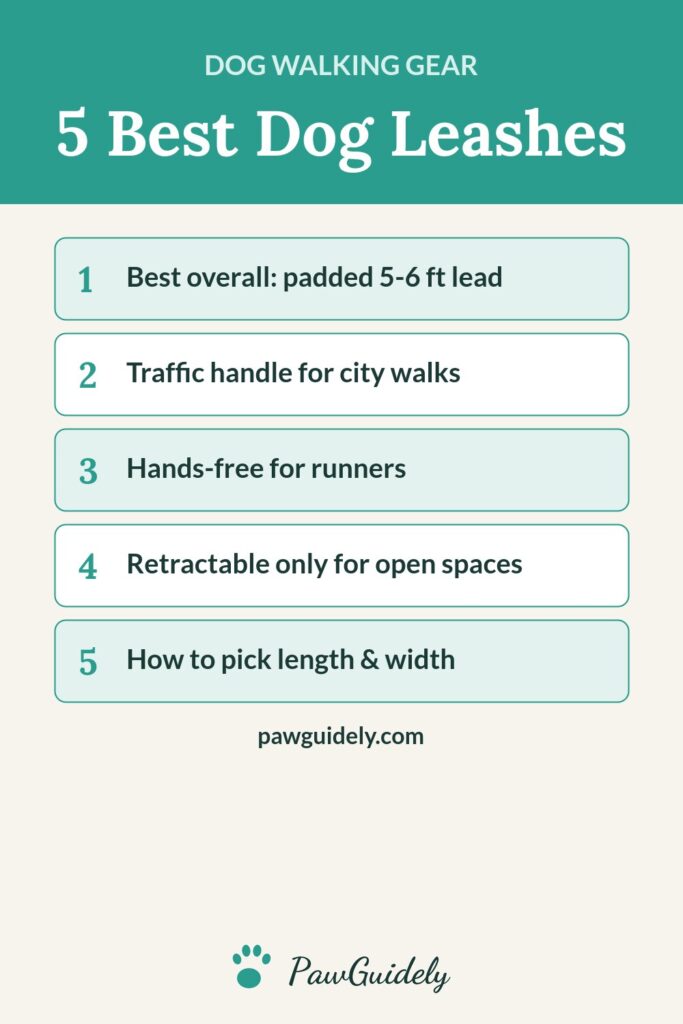
For most owners, the Ruffwear Front Range is the best dog leash overall thanks to its locking clip, padded handle and traffic handle. On a budget, the BAAPET padded leash covers everyday walks perfectly. Pick the Max and Neo Double Handle for city walks and strong dogs, the Tuff Mutt if you run with your dog, and reserve the Flexi for open, quiet places.
Related Guides
- 4 Best No-Pull Dog Harnesses in 2026 (and How to Fit One Properly)
- Dog Harness vs Collar: Which Is Better for Your Dog?
- New Puppy Checklist: 25 Essentials to Buy Before You Bring Your Puppy Home
- 3 Best Dog Life Jackets in 2026 for Swimming, Boating and Paddleboarding
- Retractable Leash vs Standard Leash: Which Should You Use?
- 4 Best Dog Treat Pouches for Training and Walks
- 4 Best Dog Poop Bag Holders (Dispensers and Used-Bag Carriers)
- 4 Best Dog Raincoats to Keep Walks Dry and Visible
Frequently Asked Questions
What is the best leash length for a dog?
A 5- or 6-foot leash suits most dogs and walking situations. Use 4 feet for crowded sidewalks and long lines only for recall practice in open areas.
Are retractable leashes bad for dogs?
They are not ideal for everyday walks. They reward pulling, give you less control near traffic and thin cords can cause burns. Use a tape-style retractable only in open, quiet spaces.
What leash is best for a dog that pulls?
A standard 5- or 6-foot leash with a traffic handle, attached to a front-clip no-pull harness, gives the most control. Training loose-leash walking matters more than the leash itself.
Is a rope or flat leash better?
Both work well. Rope leashes are round and easy to grip, while flat webbing is lighter and folds neatly in your hand. Choose the one that feels comfortable to you.
How often should I replace my dog’s leash?
Replace it whenever you see fraying, chewing damage, weak stitching or a sticking or rusty clip. A leash used daily often needs replacing every year or two.