
This post contains affiliate links. As an Amazon Associate, PawGuidely earns from qualifying purchases at no extra cost to you. See our affiliate disclosure for details.
A no-pull harness won’t train your dog by itself, but it makes pulling far less effective, which gives you a calmer walk and a better chance to teach loose-leash walking. Most work the same way: the leash clips to a ring on the chest, so when your dog pulls, it’s turned gently sideways instead of powering forward. We compared four popular options on Amazon using manufacturer specs and hands-on testing reports.
Quick Comparison
| Harness | Best For | Leash Points | Standout Feature |
|---|---|---|---|
| Ruffwear Front Range | Best overall, all-day comfort | Front + back | Foam padding, four adjustment points |
| rabbitgoo No Pull Harness | Best budget | Front + back | Vest style with handle, reflective |
| PetSafe Easy Walk | Fast results for strong pullers | Front | Martingale loop tightens slightly on pull |
| 2 Hounds Design Freedom | Two-point control | Front + back | Comes with a double-clip leash |
1. Ruffwear Front Range — Best Overall
The Front Range is the harness many trainers and outdoor-dog owners default to. It has a front clip for pull reduction and a back clip for relaxed walks, four points of adjustment for a precise fit, and foam padding that’s comfortable enough for all-day wear. Reflective trim and an ID pocket round it out, and it’s available in sizes from very small to large breeds.
- Front and back leash points
- Four adjustment points for a precise fit
- Foam-padded chest and belly panels
- Reflective trim and ID pocket
Worth knowing: it costs more than budget harnesses, it goes over the head (some dogs dislike that), and there’s no grab handle on this model.
2. rabbitgoo No Pull Dog Harness — Best Budget
rabbitgoo is one of Amazon’s best-selling harnesses, and it offers most of what the premium options do at a much lower price: front and back leash clips, soft padding, reflective strips and a handle on the back for quick control. It comes in sizes from small to large dogs.
- Front and back leash clips
- Padded vest with back handle
- Reflective material
- Very good value
Worth knowing: expect to spend some time fine-tuning the straps for a snug fit, and the handle is on the small side.
3. PetSafe Easy Walk — Best for Strong Pullers
The Easy Walk has been around for years and is a staple in training classes. The leash clips to a martingale loop on the chest that tightens slightly when your dog pulls, steering it back toward you. Many owners see a difference on the first walk. It’s lightweight and quick to put on without going over the head.
- Front chest leash attachment
- Martingale loop limits pulling
- Lightweight, easy on and off
- Widely available in many sizes
Worth knowing: it has only a front ring, and the strap across the chest can rub on some dogs or limit shoulder movement if it sits too low. Check the fit carefully.
4. 2 Hounds Design Freedom No-Pull Harness — Best Two-Point Control
The Freedom comes with a double-ended leash so you can clip to the front and back rings at once, giving you steering from the chest and balance from the back, similar to reins. That makes it a good fit for strong or reactive dogs. It’s made in the USA and has a soft lining on the chest strap.
- Front and back rings
- Includes a double-connection leash
- Made in the USA
- Soft-lined chest strap
Worth knowing: testers found the straps thinner than premium options and the adjustments a bit fiddly.
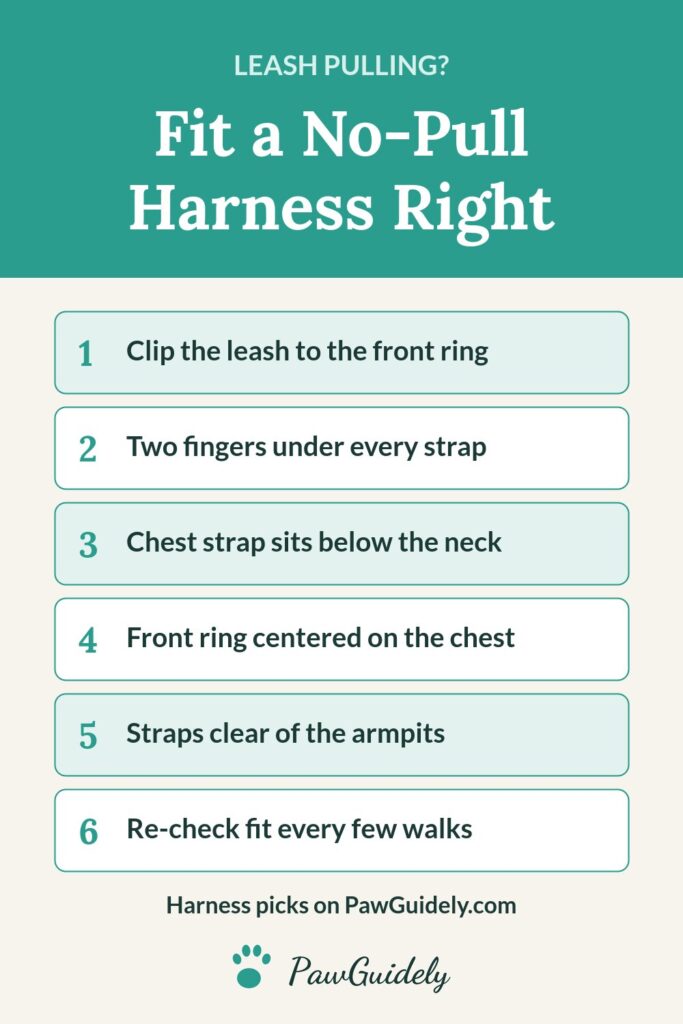
How to Fit a No-Pull Harness
- Measure the girth. Measure around the widest part of the rib cage, just behind the front legs, and use the brand’s size chart.
- Check the two-finger rule. You should be able to slide two fingers under every strap, no more, no less.
- Position the chest ring. The front ring should sit in the center of the chest, not down between the legs or up at the throat.
- Keep straps clear of the armpits. Straps too close behind the front legs can rub and cause sores.
- Clip to the front ring for pulling. Use the back ring for relaxed walks once your dog walks nicely.
Pair the harness with reward-based training: stop when the leash goes tight, reward when your dog comes back to your side. Our training guides cover the basics.
Related Guides
- 5 Best Dog Car Seat Covers and Hammocks in 2026 (Waterproof, Scratch-Resistant)
- Crate Training Schedule by Age: A Puppy Plan From 8 Weeks to Adult
- 6 Best Deshedding Tools for Dogs in 2026, Matched to Coat Type
Frequently Asked Questions
Do no-pull harnesses really work?
They reduce how effective pulling is, and many owners notice a difference right away. For lasting results, combine the harness with consistent loose-leash training.
Are no-pull harnesses bad for dogs?
A well-fitted harness is generally considered safer than pulling on a collar, which puts pressure on the neck. Poor fit is the main problem, so follow the fit steps above and check for rubbing.
Should I use the front or back clip?
Use the front clip while your dog is learning not to pull. Switch to the back clip for relaxed walks, hikes or when your dog is already walking nicely.
What size harness does my dog need?
Go by chest girth, not weight. Measure behind the front legs at the widest point and compare with the brand’s chart. If your dog is between sizes, many brands recommend sizing up and adjusting.