
This post contains affiliate links. As an Amazon Associate I earn from qualifying purchases. This costs you nothing extra. See our affiliate disclosure for details.
The best escape-proof dog harness for most escape artists is a three-strap design with a second belly strap that sits behind the rib cage, such as the Ruffwear Web Master. Dogs slip ordinary harnesses by backing up and pulling their shoulders out of the chest loop; a strap around the narrow waist blocks that exit. No harness is truly escape-proof if it is the wrong size or fitted loosely, so the fit checks below matter as much as the brand.
How Dogs Get Out of a Harness
Knowing the escape route tells you which design to buy. Most escapes fall into one of these patterns:
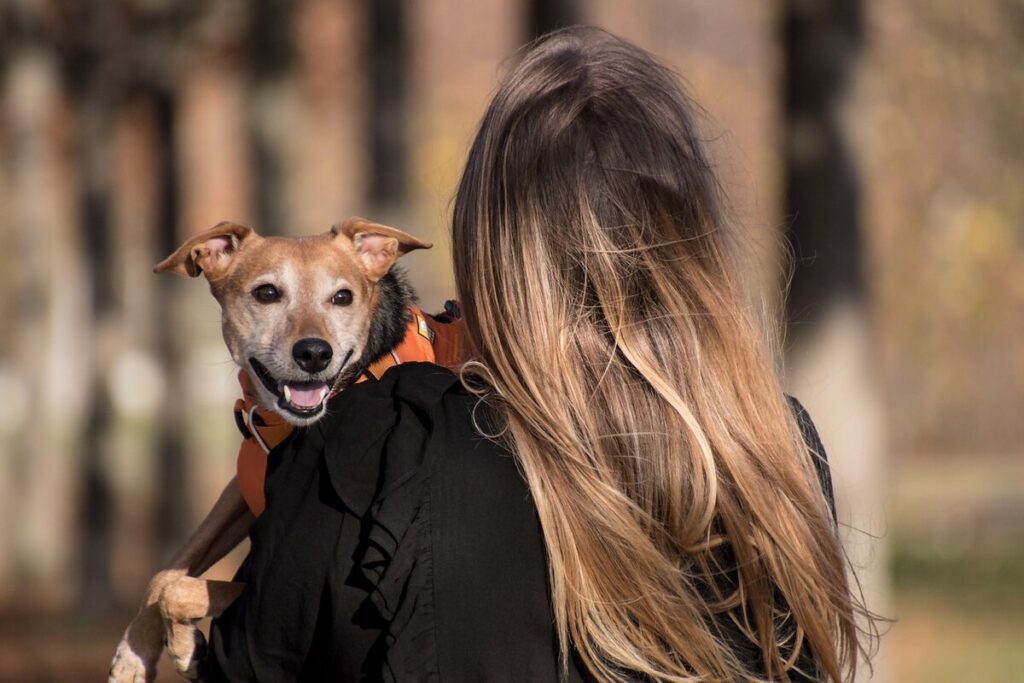
- The reverse slip. The dog plants its feet, backs up and drops its head. A two-strap harness rides forward over the shoulders and off. This is the most common escape and the one a third strap is built to stop.
- The shoulder wriggle. Narrow-chested dogs (greyhounds, whippets, many shepherd mixes) can fold a front leg back through a loose chest strap.
- The step-in collapse. Basic step-in harnesses have no strap over the neck, so a panicked dog can pull straight out once it backs up.
- The chew-through. Some dogs simply bite through webbing or a buckle while tied or left unsupervised. A harness design does not fix this; supervision does.
Escape-Proof Harnesses Compared
| Harness | Design | Best for | Main trade-off |
|---|---|---|---|
| Ruffwear Web Master | Three straps, neck buckle, padded handle | Medium to large escape artists, hiking | Costs more; bulkier in hot weather |
| rabbitgoo Escape Proof Harness | Three straps, two quick-release buckles | Budget pick for most sizes | More straps to adjust and loosen over time |
| Gooby Escape Free Easy Fit | Step-in frame that tightens when the dog backs out | Small dogs that hate things over the head | Small-dog sizing only; not for strong pullers |
1. Ruffwear Web Master Harness — Best Overall
Ruffwear describes the Web Master as a three-strap harness for “houdini” dogs, and that is the reason it shows up on almost every list of secure harnesses. The extra strap wraps around the waist behind the rib cage, so a dog that backs up meets resistance at the narrowest part of its body instead of sliding out. It has a buckle at the neck (no pulling it over the head), a padded handle on the back for lifting over obstacles, and three leash points: an aluminum V-ring and a webbing loop on the back plus a webbing loop on the chest.
- Third strap behind the rib cage blocks the reverse slip
- Neck buckle suits head-shy dogs
- Back handle for lifting and close control
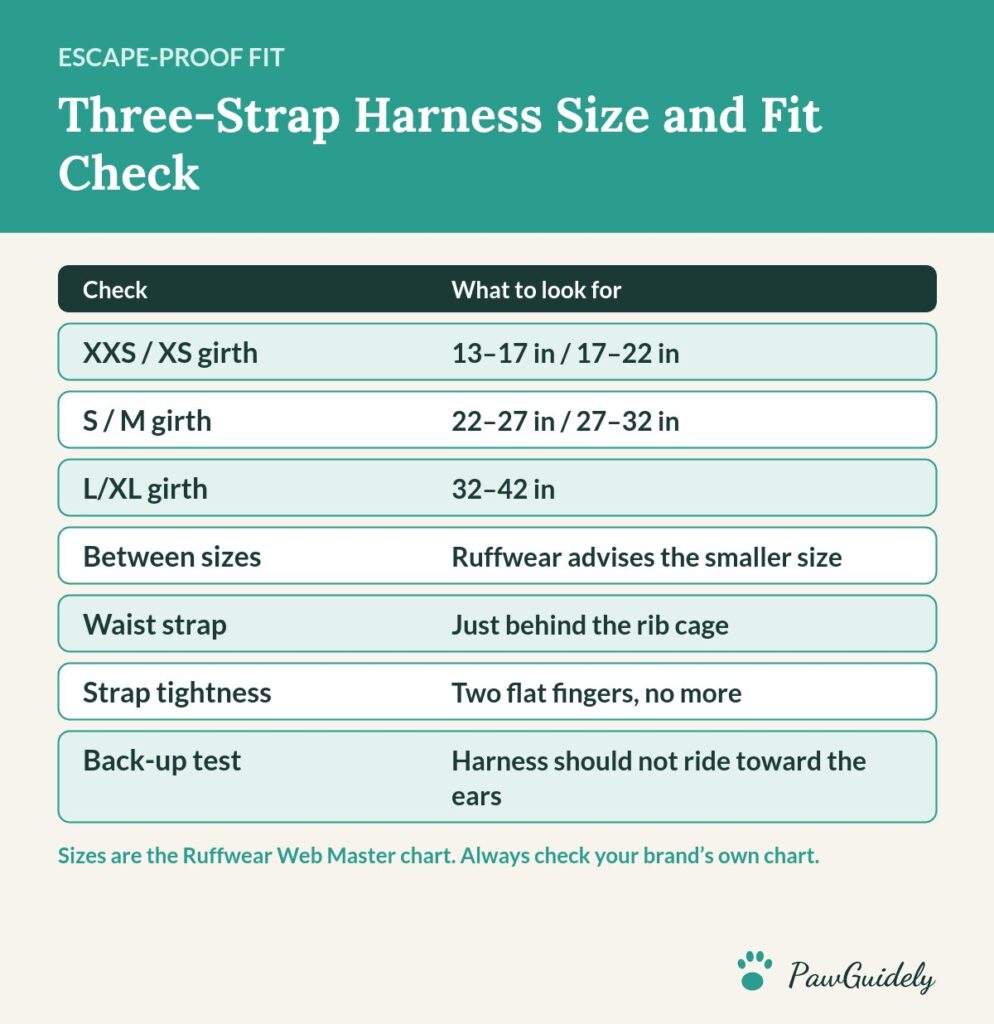
- Five sizes, from 13 in to 42 in chest girth
Worth knowing: it is pricier than most harnesses, the extra padding is warm for summer walks, and Ruffwear advises choosing the smaller size if your dog falls between two. Getting the fit right takes a few minutes of strap adjustment the first time.
2. rabbitgoo Escape Proof Dog Harness — Best Budget
rabbitgoo’s escape-proof model copies the three-strap layout at a much lower price. The waist strap does the same job as on the Web Master, and quick-release buckles mean you are not wrestling a panicky dog into it. Owner feedback generally praise how secure it feels for the money, while the most common complaints are about straps that need retightening after a few walks and sizing that runs a little differently from the chart.
- Three-strap design at a budget price
- Quick-release buckles for fast on and off
- Back handle for control
- Reinforced metal leash clip points
Worth knowing: it uses more plastic hardware than premium options, and adjustable sliders can creep loose on long walks. Check the straps every time you put it on, not just the first day.
3. Gooby Escape Free Easy Fit Harness — Best for Small Dogs
Gooby’s Escape Free line takes a different approach. Instead of a third strap, the harness frame contracts around the chest when the dog backs away and the leash goes tight, then opens back up when the leash is slack. Gooby says the design limits how far it tightens so it does not squeeze a dog that pulls, and how far it opens so it does not slip off. It is a step-in-style harness, which makes it a good match for toy and small breeds that duck away from anything going over their heads.
- Tightens only when the dog backs out against the leash
- Easy step-in fitting for head-shy dogs
- Lightweight for toy and small breeds
- Several versions in the Escape Free line, including padded ones
Worth knowing: it is made for small dogs, so medium and large escape artists need a three-strap harness instead. The anti-escape action depends on leash tension, so it is not a substitute for supervision in the yard.
Which Type Fits Your Dog? A Quick Decision Rule
- Your dog backs out of every harness and weighs over about 20 lb: get a three-strap harness with the waist strap snug.
- Toy or small breed that panics at things over its head: a step-in design that tightens on backing, like the Gooby Escape Free.
- Deep-chested sighthound with a tiny waist: three-strap harness, and add a martingale collar as a second clip point.
- Dog bolts at loud noises (fireworks, traffic): secure harness plus a leash clipped to both the harness and a well-fitted collar, and an up-to-date ID tag.
- Dog chews through gear: no harness solves this; never leave it tied or unsupervised in any harness.
Fitting an Escape-Proof Harness So It Actually Works
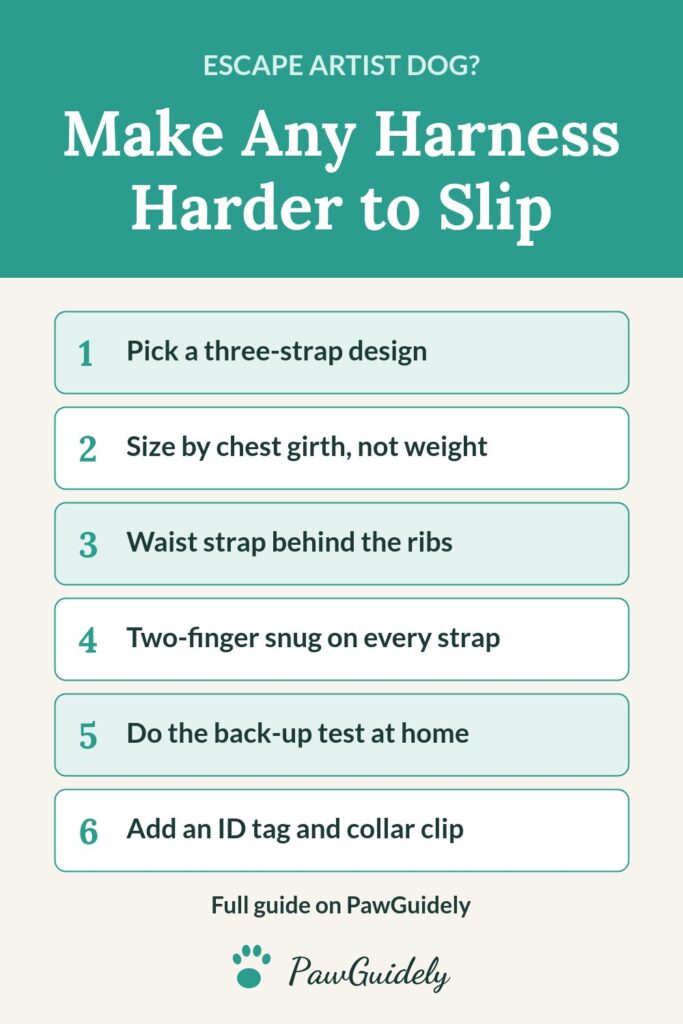
- Measure the girth around the widest part of the rib cage, just behind the front legs. Use that number against the brand’s chart, not your dog’s weight. The Web Master, for example, runs XXS 13–17 in, XS 17–22 in, S 22–27 in, M 27–32 in and L/XL 32–42 in.
- Position the waist strap just behind the end of the rib cage, where your dog’s body narrows. If it sits on the ribs, it can slide forward and stop doing its job.
- Snug every strap so you can slide two flat fingers underneath, no more. Loose straps are the number one reason a “secure” harness fails.
- Run the back-up test at home: hold the leash, call or lure your dog backward and watch whether the harness rides up toward the ears. If it moves more than an inch or two, tighten and test again.
- Recheck after a week. Webbing relaxes and sliders creep, and puppies and dogs gaining or losing weight change size fast.
Backup Safety for Flight-Risk Dogs
A good harness lowers the odds of an escape; it does not make them zero. For dogs with a history of bolting, layer protection: keep an ID tag with your phone number on the collar, keep microchip details current, and consider a GPS tracker for dogs that run when spooked. On high-risk walks, clip a second leash or a coupler to the collar so you have two points of contact. Rescue and newly adopted dogs are especially prone to slipping out in the first weeks, so treat every door and car opening as a risk until you know the dog.
When an Escape-Proof Harness Is Overkill
If your dog walks calmly and has never wriggled free, a regular well-fitted harness is fine, and the extra strap only adds time to every walk. Escape-proof designs earn their place for rescues, anxious or reactive dogs, sighthounds, and any dog that has already slipped a harness once. If the real problem is pulling rather than escaping, a front-clip no-pull harness and loose-leash training will help more.
Care and Inspection Schedule
- Every walk: tug each buckle to confirm it is fully latched and glance at the waist strap position.
- Weekly: recheck strap snugness with the two-finger test.
- Monthly: look for frayed stitching, cracked buckles and chew marks; replace hardware that shows stress.
- After washing: hand wash or follow the maker’s care label, air dry fully, then refit, because washing can shift sliders.
Related Guides
- 4 Best Harnesses for Small Dogs (Comfortable and Escape-Resistant)
- 5 Best Harnesses for Large Dogs: Strong, Comfortable and Secure
- 4 Best No-Pull Dog Harnesses in 2026 (and How to Fit One Properly)
- Dog Harness vs Collar: Is a Harness Better for Your Dog?
- 5 Best GPS Dog Trackers: Find Your Dog Fast If They Get Loose
- 4 Best Escape-Proof Dog Crates for Strong Dogs and Escape Artists
Frequently Asked Questions
Is any dog harness 100% escape-proof?
No. “Escape-proof” is a marketing term. A three-strap harness that is sized by girth and fitted snugly makes escapes much harder, but a determined dog in a loose harness can still get out.
How do I stop my dog backing out of its harness?
Switch to a harness with a strap behind the rib cage, tighten every strap to a two-finger fit, and practice the back-up test at home. Keep a second leash clipped to a collar while you build confidence.
Is a martingale collar better than an escape-proof harness?
They solve slightly different problems. A martingale tightens a limited amount to stop a dog slipping its collar and suits narrow-headed breeds. A three-strap harness spreads pressure across the body. Many owners of flight-risk dogs use both.
Should a rescue dog wear an escape-proof harness?
It is a sensible choice for the first weeks, when newly adopted dogs are most likely to bolt. Pair it with an ID tag and a collar clip until the dog is settled.