
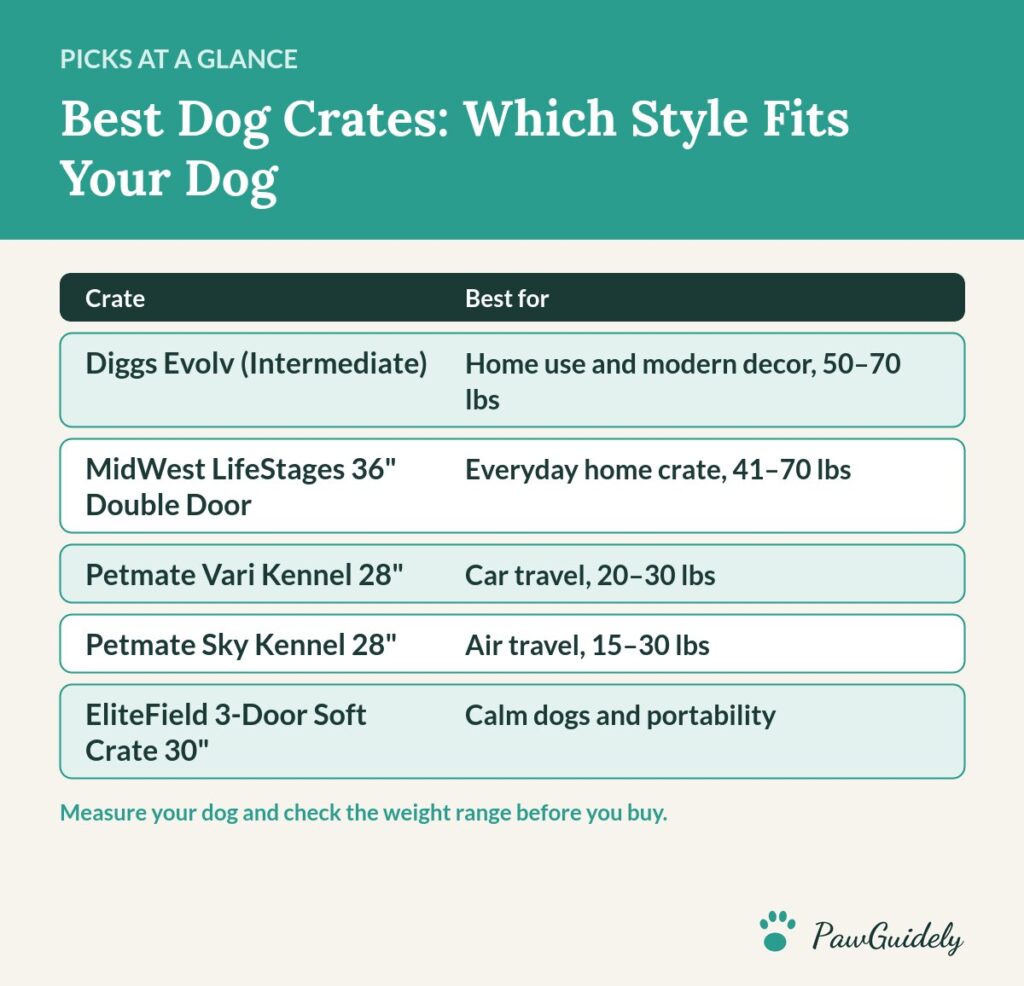
The best dog crate for most homes is a folding wire crate sized for your dog’s adult length, like the MidWest LifeStages 36″ (41–70 lb dogs). Choose a hard plastic kennel instead for car trips or flying, and a soft crate only for calm dogs that are already crate trained.
Below, five crates are matched to where the crate will live: at home, in the car, on a plane or packed for a trip. Sizes, weight ratings and features come from each manufacturer’s published specs, linked under the comparison table. PawGuidely has not tested these crates in person; see our editorial policy.
This post contains affiliate links. As an Amazon Associate I earn from qualifying purchases. This costs you nothing extra. See our affiliate disclosure for details.
How to Choose the Right Dog Crate
Size first. Measure your dog standing: nose to base of tail, and floor to the top of the head (or ear tips if they stand up). Add 2–4 in to both numbers to get the minimum inside length and height. Your dog should be able to stand without ducking, turn around fully and lie down stretched out. Too much extra space can actually work against house-training, since a dog can use one end as a bathroom and still have room to avoid it. Most brands list a suggested weight range (see our dog crate size chart by breed), but if your dog is between sizes or still growing, size up and use a divider panel instead of sizing down.
Then match the style to how you’ll use it. Wire crates offer the best airflow and visibility and are usually the most affordable for the size. Hard plastic crates give a more enclosed, den-like feel that can help anxious dogs settle, and they’re the standard for car and air travel. Soft-sided crates are the lightest and most portable but rely on zippers and mesh, which isn’t a match for a dog that chews or paws at barriers. Modular designs like the Evolv sit between a wire crate and furniture, worth the extra cost if the crate is staying in a main living space long-term.
Our Quick Picks
- Best Everyday CrateMidWest LifeStages 36" Double DoorCheck Price on Amazon
- Best Modern DesignDiggs Evolv (Intermediate)Check Price on Amazon
- Best for Car TravelPetmate Vari Kennel 28" (Medium)Check Price on Amazon
Short on time? These are our top choices. Full reviews and comparisons are below.
Best Dog Crates Compared
| Crate | Style | Outside size (L × W × H) | Rated dog weight | Divider | Best for |
|---|---|---|---|---|---|
| Diggs Evolv (Intermediate) | Modular steel | 38.1 × 24.9 × 25.6 in (inside 35.5 × 22.3 × 23.8) | 50–70 lb, or 18–22 in tall | Sold separately | Living rooms |
| MidWest LifeStages 36″ Double Door | Folding wire | About 37.4 × 25.5 × 26.4 in | 41–70 lb | Included | Everyday home crate, puppies |
| Petmate Vari Kennel 28″ | Hard plastic | 28 × 20.5 × 21.5 in | 25–30 lb | No | Car trips |
| Petmate Sky Kennel 28″ | Hard plastic, IATA-compliant | 28 × 20.5 × 21.5 in (inside 24.25 × 18.25 × 19.5) | 25–30 lb | No | Flying cargo |
| EliteField 3-Door Soft Crate 30″ | Soft-sided | 30 in long | Not rated by weight; calm medium dogs | No | Travel, second crate |
1. Diggs Evolv (Intermediate) — Best Modern Design
The Evolv is a slim, modular wire crate built for dog owners who don’t want a crate to dominate the room. The Intermediate size measures 35.5″ x 22.3″ x 23.8″ inside (38.1″ x 24.9″ x 25.6″ outside) and suits dogs in the 50–70 lb range. A coated steel frame and diamond-shaped mesh are designed to avoid pinching paws or jaws, and the crate’s dual lock doors can be repositioned to fit the layout of a room. The empty crate weighs 36 lb. A puppy divider is sold separately, so add it to the cost if you are buying for a puppy.
- Repositionable, dual-lock doors
- Diamond mesh designed to protect paws and jaws
- Front and side doors, each with dual locks
- No-tool assembly, removable tray for cleaning
Worth knowing: the Evolv is premium-priced and the puppy divider is an extra purchase, and it’s a home crate, not built for air travel. If budget or portability matter more than looks, one of the picks below will serve better.
2. MidWest LifeStages 36″ Double Door — Best Everyday Crate
This is the classic folding wire crate most people picture when they think “dog crate,” and the 36″ double-door size is built for dogs in the 41–70 lb range, about 37.4″ × 25.5″ × 26.4″ outside. Two doors (front and side) make it easier to place in a room without boxing the opening against a wall. It comes with a free divider panel so it can be sized down for a growing puppy, a removable plastic pan for cleanup, and slide-bolt latches with rounded corners. The whole crate folds flat for storage or transport.
- Two doors (front + side) for flexible placement
- Free divider panel, adjusts as a puppy grows
- Folds flat, no tools needed to set up
- Removable, easy-clean plastic pan
Worth knowing: wire crates offer the most airflow and visibility, but they’re the least private option. Some dogs settle better with the den-like enclosure of a plastic or soft-sided crate.
3. Petmate Vari Kennel 28″ (Medium) — Best for Car Travel
The Vari Kennel is a hard-sided plastic crate rated by Petmate for dogs of 25–30 lb, measuring 28″ × 20.5″ × 21.5″ outside. Its enclosed design gives anxious dogs a more den-like, secure feel than a wire crate, which many find calming in the car. It has an interior moat to keep pets dry from spills or accidents, side ventilation, an easy-open squeeze latch, and tie-down strap holes for securing it during travel. It’s made in the USA and assembles without tools.
- Enclosed, den-like design for calmer travel
- Interior moat keeps pets dry
- Tie-down strap holes for secure car transport
- Easy-open squeeze latch, no tools to assemble
Worth knowing: this is built primarily for car travel and home use; if you need a crate that meets airline cargo requirements specifically, the Sky Kennel below is the better fit.
4. Petmate Sky Kennel 28″ — Best for Air Travel
The Sky Kennel is Petmate’s airline-focused crate, built to meet most airline cargo requirements (always confirm with your specific airline before flying). The 28″ size is rated for dogs of 25–30 lb, weighs 12.5 lb empty with interior dimensions of about 24.25″ x 18.25″ x 19.5″. Petmate states it complies with the 2025 (51st) edition of the IATA Live Animals Regulations. It has a wire door with an easy-squeeze latch for extra security, and 360-degree ventilation. It comes with “Live Animal” stickers, a food and water cup and absorbent material, so it’s ready to travel out of the box.
- Built to meet most airline cargo requirements
- Interlocking door latch for extra security
- 360-degree ventilation
- Includes a food and water cup and “Live Animal” stickers
Worth knowing: “airline approved” isn’t an official designation. Always check your airline’s pet travel requirements before you fly, since they vary by carrier.
5. EliteField 3-Door Soft Crate 30″ (Medium) — Best for Portability
This soft-sided crate trades hard-shell durability for light weight and packability. The 30″ medium size is 30″ long and suits calm medium-size dogs; EliteField does not give a weight rating, so measure your dog against the listing. A lightweight steel-tube frame supports a polyester and mesh shell, with three mesh doors (front, side, and top) for airflow and easy access. Front and side doors have locking zippers, and it includes a carrying case and a fleece bed. It sets up and folds flat in seconds with no tools.
- Lightweight, folds into an included carry bag
- Three mesh doors for airflow and easy access
- Includes a fleece bed
- Sets up in seconds, no tools required
Worth knowing: soft-sided crates work best for calm, already crate-trained dogs. Determined chewers or escape artists can work through the mesh, so this isn’t the best pick for a dog still learning to settle in a crate.
Crates for Puppies: Buy the Adult Size and Add a Divider
Buy the crate your puppy will need as an adult, then use a divider panel to shrink the space now. A puppy given the whole adult crate often uses the far end as a toilet, which slows house training. The iCrate and LifeStages wire crates both ship with a divider; plastic kennels like the Vari Kennel do not, so they suit puppies only once they fit the kennel snugly.
| Expected adult weight | Crate length to buy | Divider setting now |
|---|---|---|
| Up to 25 lb | 24 in | About half the length |
| 25–40 lb | 30 in | Move it back every few weeks |
| 40–70 lb | 36 in | Room to stand, turn and lie down only |
| 70–90 lb | 42 in | Expect several moves as they grow |
| 90–110 lb | 48 in | Start small; growth is fast |
Move the divider back whenever your puppy can no longer stand up straight or turn around without bumping it. Take collars and tags off inside the crate so they can’t snag on the wire, and check that the divider sits flush so small paws can’t slip through the gap.
Two Dogs: Separate Compartments, Not a Shared Crate
Give each dog its own compartment, even if they get along. Confined dogs can’t walk away from a squabble over a chew, and a shared crate hides which dog is anxious or had the accident. Side-by-side compartments let a bonded pair see and smell each other while each keeps its own space.
- Size each compartment, not the whole crate. Measure each dog standing (nose to base of tail, floor to top of head) and add 2–4 in. A 48-in crate with a center divider gives two spaces of about 24 in each.
- Stacked units save floor space and suit small or medium dogs. Put the lighter, calmer dog on top and lock the wheels.
- Side by side is easier to load and clean and safer for heavy or senior dogs.
- Two separate crates are the most flexible choice when the dogs differ a lot in size or one needs time apart.
Soft-Sided Crates: Good for Calm Dogs, Not for Chewers
A soft crate like the EliteField above works well for a dog that already settles in a crate. It weighs far less than wire or plastic, folds flat and feels enclosed, which makes it handy for hotels, family visits and a second crate in the bedroom. It is the wrong choice for puppies in the chewing stage and for any dog that has escaped or panicked in a crate, because mesh can be chewed and zippers nosed open.
- Introduce it at home with the doors open before relying on it away from home.
- Keep it out of hot cars and direct sun; fabric walls trap heat.
- Don’t treat it as car crash protection. For the car, use a crash-tested car harness or a secured hard crate.
- Retire it when a panel tears or a zipper fails.
Which Crate Fits Your Situation?
The five picks above cover the main crate styles. If your dog or your setup has a specific need, these quick rules point you to the right type, and to the guide that goes deeper on it.
| Your Situation | Crate Type to Look For | Why |
|---|---|---|
| New puppy | Wire crate sized for the adult dog, with a divider | One crate lasts from 8 weeks to adulthood; the divider keeps the space small for house-training |
| Dog over 70 lbs | 42″ or 48″ heavy-gauge wire or plastic | Thin wire doors on big crates bend under a strong dog |
| Escape artist or chewer | Heavy-duty steel crate with secured latches | Standard wire and soft crates are the easiest to bend, chew or unzip |
| Anxious dog | Plastic crate, or a wire crate with a cover | Enclosed sides block what the dog can see and cut down on stimulation |
| Car trips | Snug plastic kennel you can strap down | A smaller crate moves the dog around less in a sudden stop |
| Flights | Rigid plastic kennel that meets your airline’s rules | Airlines check size, hardware and ventilation at the counter |
| Living room, long term | Furniture-style or modular crate | Costs more, but it can double as an end table |
| Calm dog on the move | Soft-sided crate | Light and folds into a bag, but not for chewers |
Go deeper: dog crate size chart, crates for medium dogs and large dogs, escape-proof crates, car travel crates, airline carriers and furniture-style crates. Still torn between the two most common types? Read wire vs plastic dog crates.
Buy or Skip: Quick Verdict on Each Crate
| Crate | Buy it if | Skip it if |
|---|---|---|
| Diggs Evolv | The crate stays in a main room for years and looks matter | You need a divider included, or a crate to travel with |
| MidWest LifeStages 36″ | You want one crate from puppy to adult | Your dog bends wire or panics in an open crate |
| Petmate Vari Kennel 28″ | You drive with a 25–30 lb dog and want a den-like crate | Your dog is still growing past 30 lb |
| Petmate Sky Kennel 28″ | Your dog flies in the cargo hold | You only need a car or home crate; the Vari Kennel is simpler |
| EliteField 30″ Soft Crate | Your dog is calm, crate trained and travels with you | Your dog chews, paws at mesh or has escaped before |
Why These Five
Each pick covers one job a crate has to do: living-room crate, everyday home crate, car crate, flight crate and travel crate. For each we checked the manufacturer’s size and weight rating, the door and latch design, whether a divider is included, and what the crate is and isn’t built for. Where owners commonly run into a problem, such as soft crates being chewed or thin wire bending under a strong dog, we say so in the “Worth knowing” note. These picks come from published specs, not hands-on testing. Brands cannot pay to be included.
Our Verdict
For most homes, the MidWest LifeStages 36″ is the pick: it’s the most versatile of the five, the two doors make placement flexible, the divider lets it grow with a puppy, and it folds flat when you need the space back. If the crate is going to sit in a main living space and looks matter, the Diggs Evolv is the upgrade — a slim, modular design that reads more like furniture — but it’s premium-priced, and it’s a home crate, not one for air travel.
For the car, take the Petmate Vari Kennel: hard-sided, den-like, and built to tie down. For flying, the Petmate Sky Kennel is the one built for airline cargo requirements — confirm the rules with your specific airline before you book, since “airline approved” isn’t an official designation. And if you need the lightest option for travel, the EliteField soft crate packs into its own carry bag — but only for a calm dog that’s already crate-trained, since determined chewers can work through mesh.

Related Guides
- How to Crate Train a Puppy: Step by Step
- How Long Can a Dog Stay in a Crate? (By Age)
- Best Dog Crate Pads and Beds
- Best Dog Crate Covers
- MidWest iCrate vs LifeStages
- Petmate Sky Kennel vs Vari Kennel
Frequently Asked Questions
What size dog crate do I need?
Measure your dog from nose to base of tail and add 2–4 inches for length, and measure shoulder height for crate height. When between two sizes, or if your dog is still growing, choose the larger crate and use a divider panel to section it down.
Is a wire or plastic crate better?
Neither is universally “better”. It depends on your dog and how you’ll use the crate. Wire crates suit dogs that want visibility and airflow and work well for home use. Plastic crates suit dogs that settle better in an enclosed, den-like space, and they’re the standard choice for air travel and a common pick for car trips.
Can I leave my dog in a crate all day?
Crates are meant for shorter stretches, not all-day confinement. As a general guideline, adult dogs shouldn’t be crated for more than about 6–8 hours, and puppies need much more frequent breaks. Always provide water access appropriate to the length of time crated, and consult your vet for guidance specific to your dog.
Should I put a bed or a cover in my dog’s crate?
A washable pad makes most crates more comfortable, but skip soft beds for puppies or dogs that shred them, and use a chew-resistant pad instead. A cover helps dogs that settle better in a dark, den-like space. Leave the front or one side open for airflow. See our guides to crate pads and crate covers.
What is the best dog crate for a puppy?
A wire crate sized for your puppy’s expected adult weight, with a divider panel, like the MidWest LifeStages above. Move the divider back as your puppy grows so you only buy one crate. Our dog crate size chart shows which size to buy by breed and weight.
Pingback: Dog Playpen Size Guide: Height and Square Feet
Pingback: Crate Training a Puppy at Night: A Calm Bedtime Routine
Pingback: 3 Best Puppy Teething Toys (2026) + Teething Timeline
Pingback: How to Crate Train a Puppy: 7 Simple Steps
Pingback: MidWest iCrate vs Life Stages Crate (2026): Key Differences