
This post contains affiliate links. As an Amazon Associate, PawGuidely earns from qualifying purchases at no extra cost to you. See our affiliate disclosure for details.
A walk tires out your dog’s legs, but a puzzle tires out its brain, and for many dogs 15 minutes of sniffing and problem-solving is as tiring as a long walk. Puzzle toys are great for rainy days, high-energy breeds, dogs on crate rest and anyone who needs their dog to settle. The best dog puzzle toys match your dog’s skill level, so they’re challenging without being frustrating. We ranked five popular options on Amazon from easiest to hardest, based on manufacturer details and owner reviews.
Best Dog Puzzle Toys Compared
| Toy | Difficulty | Type | Best For |
|---|---|---|---|
| Nina Ottosson Dog Smart | Level 1 (easy) | Lift-the-cover puzzle | Beginners and puppies |
| Snuffle Palz Snuffle Mat | Easy | Sniffing mat | Sniffers, calming |
| KONG Wobbler | Easy to medium | Wobbling treat dispenser | Replacing a food bowl |
| Nina Ottosson Dog Tornado | Level 2 (medium) | Spinning layers | Dogs ready for more |
| Nina Ottosson Dog Brick | Level 2 (medium) | Sliding and lifting | Clever dogs, wet or dry food |
1. Nina Ottosson Dog Smart — Best for Beginners
Swedish designer Nina Ottosson’s puzzles, sold by Outward Hound, are the best-known dog puzzles, graded from level 1 to level 4. Dog Smart is the classic starter: nine compartments with bone-shaped covers your dog nudges or lifts to find treats underneath. It holds about a cup of kibble, so it can double as a slow feeder.
- Easy level 1 introduction
- Nine treat compartments
- Holds about a cup of kibble
- Easy to clean
Worth knowing: clever dogs solve it quickly. Think of it as the first step, not the last.
2. Snuffle Palz Snuffle Mat — Best for Sniffing
Snuffle mats hide kibble among fabric strips so your dog has to use its nose to forage. Sniffing is naturally calming and tiring for dogs, which makes snuffle mats a favorite for anxious or high-energy dogs. This one is a plush animal design with a non-slip base.
- Uses your dog’s nose, very calming
- Slows down eating
- Non-slip base
- Easy for any dog to start
Worth knowing: fabric mats aren’t for chewers. Supervise, and put it away when empty.
3. KONG Wobbler — Best Bowl Replacement
The Wobbler is a weighted, wobbling treat dispenser: fill it with kibble, and your dog has to nudge and paw it to release food. It’s tough enough for everyday use and can replace a food bowl entirely at mealtimes. See our slow feeder guide for more feeding puzzles.
- Replaces a bowl for dry food
- Durable KONG construction
- Unscrews for cleaning
- Good for solo play
Worth knowing: it’s noisy on hard floors and only works with dry food.
4. Nina Ottosson Dog Tornado — Best Intermediate Puzzle
The Tornado has three stacked, spinning layers with 12 hidden treat compartments. Your dog spins the layers with its nose or paw to reveal treats, and you can add the bone-shaped blockers for extra difficulty. It’s a level 2 puzzle, a good next step once Dog Smart is too easy.
- Three spinning layers
- 12 treat compartments
- Adjustable difficulty with blockers
- Compact size
Worth knowing: small pieces can be chewed by determined dogs. Supervise and remove the blockers if needed.
5. Nina Ottosson Dog Brick — Best for Clever Dogs
The Dog Brick combines sliding panels and lift-off covers across 20 compartments, and holds about one and a half cups of food, wet or dry. Mixing two types of moves makes it more challenging than single-action puzzles.
- 20 treat compartments
- Combines sliding and lifting
- Holds wet or dry food
- Level 2 challenge
Worth knowing: the removable bone pieces can be chewed. Supervise, and use it on a non-slip surface.
How We Chose These Toys
We picked toys that cover a range of difficulty levels and puzzle types, from easy lift-and-find to spinning and sliding puzzles, plus a snuffle mat and a treat dispenser. We compared durability, ease of cleaning and how many treats each holds, and checked owner reviews for toys dogs solved in seconds or chewed apart.
Types of Dog Puzzles
| Type | How It Works | Good For |
|---|---|---|
| Lift-the-cover | Nudge or lift covers to find treats | Beginners |
| Sliding | Slide panels to reveal treats | Intermediate |
| Spinning | Rotate layers to uncover compartments | Intermediate |
| Snuffle mat | Forage for food with the nose | Calming, all dogs |
| Treat dispenser | Roll or wobble to release food | Solo play, mealtimes |
| Multi-step (level 3–4) | Several moves in a set order | Clever, experienced dogs |
How to Teach Your Dog to Use a Puzzle
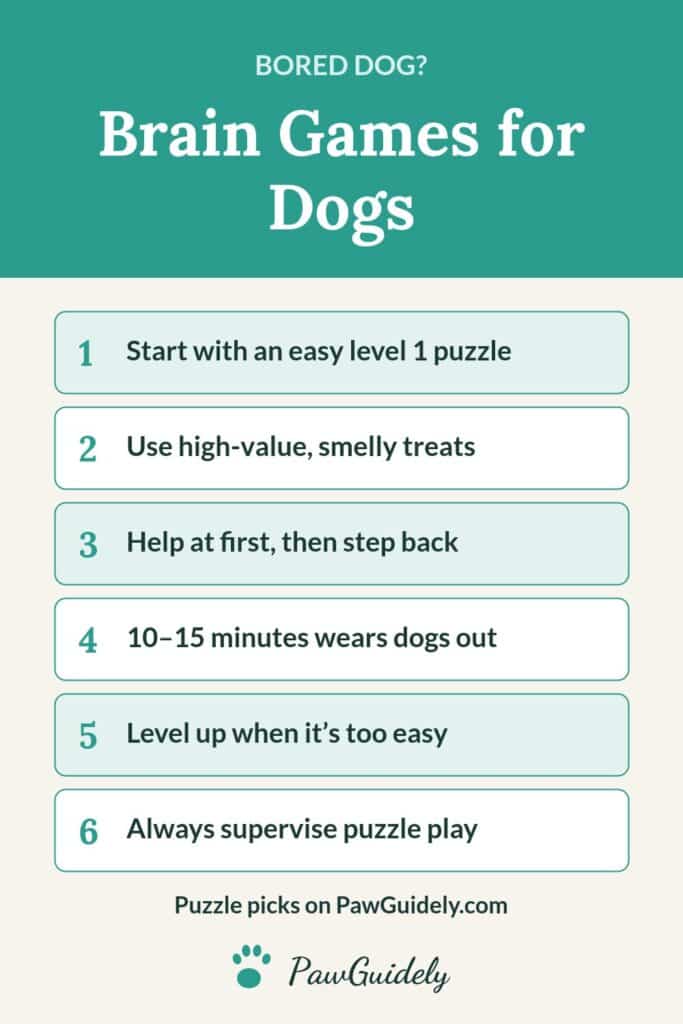
- Start easy. Leave some compartments uncovered so your dog wins straight away.
- Use smelly, high-value treats for the first sessions.
- Show, then step back. Help with the first few moves, then let your dog figure it out.
- Praise effort, not just success, to keep your dog engaged.
- Stop while it’s fun, before your dog gets frustrated or starts chewing the toy.
- Level up once your dog solves a puzzle quickly and confidently.
Safety and Care
- Always supervise puzzle play. Most puzzles aren’t chew toys.
- Put puzzles away after use so they stay special and don’t get chewed.
- Count treats and kibble as part of your dog’s daily food allowance.
- Wash puzzles regularly, especially after wet food.
Puzzle toys are part of a good enrichment routine alongside walks, training and chewing. For tough chew options, see our chew toy guide.
Our Verdict
Start with the Nina Ottosson Dog Smart or a snuffle mat, which are easy wins for any dog. Use the KONG Wobbler to turn mealtimes into a game, and move up to the Dog Tornado and Dog Brick once your dog is ready for a real challenge.
Signs Your Dog Needs More Mental Stimulation
- Chewing furniture, shoes or door frames.
- Barking, whining or pacing when there’s nothing going on.
- Digging, getting into the trash or “inventing” games you don’t like.
- Struggling to settle even after a walk.
- Mouthy, overexcited play, especially in young dogs.
Working breeds such as Border Collies, Australian Shepherds, German Shepherds and many terriers often need more brain work than walks alone provide. Adding a daily puzzle, a snuffle session or a short training game is one of the easiest ways to help them switch off. If your dog is anxious when left alone, ask your vet or a qualified trainer for a tailored plan.
Related Guides
- 5 Best Chew Toys for Aggressive Chewers in 2026 (Tough but Tooth-Safe)
- 4 Best Slow Feeder Dog Bowls in 2026 for Dogs That Eat Too Fast
- New Puppy Checklist: 25 Essentials to Buy Before You Bring Your Puppy Home
- 4 Best Snuffle Mats for Dogs (and How to Use Them)
Frequently Asked Questions
Are puzzle toys good for dogs?
Yes. Puzzle toys provide mental stimulation, which can reduce boredom behaviors like chewing and barking, and many dogs find them as tiring as exercise.
How often should I give my dog a puzzle toy?
A short session most days works well. Many owners feed one meal a day from a puzzle or snuffle mat.
Can puppies use puzzle toys?
Yes, start with easy level 1 puzzles and snuffle mats, and supervise closely.
What if my dog chews the puzzle?
Stop the session, put it away and try again when your dog is calmer, or choose a sturdier toy like the KONG Wobbler.
What are Nina Ottosson puzzle levels?
Nina Ottosson puzzles are graded from level 1 (easy) to level 4 (expert). Most dogs start at level 1 and progress to level 2 within a few weeks.