
This post contains affiliate links. As an Amazon Associate, PawGuidely earns from qualifying purchases at no extra cost to you. See our affiliate disclosure for details.
Buying the wrong size crate is the most common crate mistake. Too small and your dog can’t stand or stretch out. Too big and a puppy can use one end as a bathroom, which slows down house-training. This guide gives you a quick size chart by weight, a breed-by-breed lookup for 24 popular breeds, and a two-minute way to measure your own dog so you can confirm the fit.
Dog Crate Size Chart by Weight
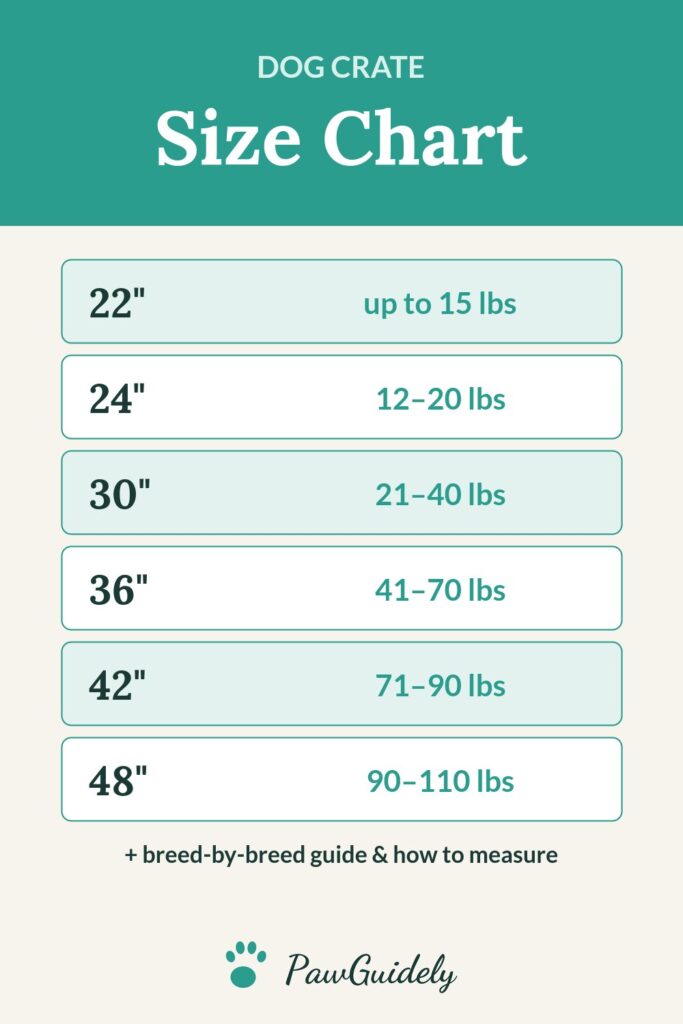
Crates are sold by length in inches. The weight ranges below are the manufacturer’s guidance for the MidWest LifeStages line, one of the most widely sold wire crates on Amazon, and they line up closely with most other brands.
| Crate Size | Size Name | Dog Weight | Example Breeds |
|---|---|---|---|
| 22″ | Extra Small | Up to 15 lbs | Chihuahua, Yorkie, Pomeranian, Maltese |
| 24″ | Small | 12–20 lbs | Shih Tzu, Pug, Boston Terrier |
| 30″ | Medium | 21–40 lbs | Beagle, French Bulldog, Cocker Spaniel, Corgi |
| 36″ | Intermediate | 41–70 lbs | Border Collie, Australian Shepherd, Husky, Bulldog |
| 42″ | Large | 71–90 lbs | Labrador, Golden Retriever, Boxer, German Shepherd |
| 48″ | Extra Large | 90–110 lbs | Rottweiler, Doberman, Bernese Mountain Dog |
| 54″+ | Giant | 110+ lbs | Great Dane, Mastiff, Saint Bernard |
Weight is only a starting point. Two dogs of the same weight can be built very differently. A lean, long-legged dog needs more height than a stocky dog of the same weight, so always check height too (see how to measure below).
Crate Size by Breed
Weights are typical adult ranges from the breed standards. Where a breed spans two sizes, males and larger individuals usually need the bigger crate.
| Breed | Typical Adult Weight | Recommended Crate |
|---|---|---|
| Chihuahua | Up to 6 lbs | 22″ |
| Pomeranian | 3–7 lbs | 22″ |
| Yorkshire Terrier | About 7 lbs | 22″ |
| Maltese | Under 7 lbs | 22″ |
| Shih Tzu | 9–16 lbs | 24″ |
| Pug | 14–18 lbs | 24″ |
| Boston Terrier | 12–25 lbs | 24″ (30″ for larger dogs) |
| Dachshund (Standard) | 16–32 lbs | 30″ |
| French Bulldog | Under 28 lbs | 30″ |
| Beagle | 20–30 lbs | 30″ |
| Cocker Spaniel | 20–30 lbs | 30″ |
| Pembroke Welsh Corgi | Up to 30 lbs | 30″ |
| Border Collie | 30–55 lbs | 36″ |
| Siberian Husky | 35–60 lbs | 36″ |
| Bulldog | 40–50 lbs | 36″ |
| Australian Shepherd | 40–65 lbs | 36″ |
| Labrador Retriever | 55–80 lbs | 42″ |
| Golden Retriever | 55–75 lbs | 42″ |
| Boxer | 50–80 lbs | 42″ |
| German Shepherd | 50–90 lbs | 42″ (48″ for large males) |
| Doberman Pinscher | 60–100 lbs | 42″–48″ |
| Bernese Mountain Dog | 70–115 lbs | 48″ |
| Rottweiler | 80–135 lbs | 48″ (54″ for large males) |
| Great Dane | 110–175 lbs | 54″ or giant-breed crate |
How to Measure Your Dog for a Crate
A tape measure and a treat are all you need. Measure your dog standing, not curled up.
- Length: measure from the tip of the nose to the base of the tail (not the tip of the tail).
- Height: with your dog sitting or standing tall, measure from the floor to the top of the head, or the tips of the ears if they stand up.
- Add 2–4 inches to both numbers. That’s your minimum interior length and height.
- Compare against the crate’s interior dimensions, not the outside dimensions or the size name. Interior space is always a little smaller than the listed size.
The fit test: your dog should be able to stand without ducking its head, turn around easily, and lie down on its side with legs stretched out.
Buying for a Puppy? Size for the Adult Dog
Puppies outgrow crates fast. Instead of buying two or three crates, buy the crate your dog will need as an adult and use a divider panel to block off the extra space. Move the divider back as your puppy grows. Most wire crates, including the MidWest LifeStages, include a divider in the box. If you don’t know your puppy’s adult size (common with mixed breeds), ask your vet for an estimate, or use the larger parent breed as your guide.
Between Two Sizes? Here’s How to Decide
- Size up if your dog is still growing, is long-bodied or long-legged, or will spend longer stretches in the crate.
- Size down only for car travel, where a snugger crate is safer in a sudden stop, and only if your dog can still stand and turn around.
- For air travel, follow your airline’s own crate rules. They set minimum sizes and check them at the counter.
The Crate We’d Start With at Each Size
If you want a no-fuss wire crate, the MidWest LifeStages comes in every standard size, folds flat, and includes a divider panel and leak-proof pan. Here are the sizes matched to the chart above:
- MidWest LifeStages 22″ Double Door (up to 15 lbs)
- MidWest LifeStages 24″ Single Door (12–20 lbs)
- MidWest LifeStages 30″ Single Door (21–40 lbs)
- MidWest LifeStages 36″ Double Door (41–70 lbs)
- MidWest LifeStages 42″ Double Door (71–90 lbs)
- MidWest LifeStages 48″ Double Door (90–110 lbs)
Want to compare styles first, like plastic travel kennels, soft-sided crates, or furniture-style designs? See our full guide to the 5 best dog crates.
Related Guides
- 5 Best Dog Crates in 2026: Wire, Plastic, Soft-Sided, and Modular Picks Compared
- 5 Best Dog Crate Pads and Beds in 2026: Washable, Chew-Resistant and Orthopedic
- Crate Training Schedule by Age: A Puppy Plan From 8 Weeks to Adult
Frequently Asked Questions
What size crate does a 50 lb dog need?
Most 50 lb dogs fit a 36″ crate (rated for 41–70 lbs). If your dog is tall or long for its weight, like a lanky Lab mix, check its measurements against a 42″ crate.
Is a bigger crate better?
Not always. A crate that’s much too large can make house-training harder, and some dogs feel more secure in a snug, den-like space. Aim for enough room to stand, turn, and stretch out, plus a few inches, not more.
Can I use a divider in any crate?
Most wire crates either include a divider or sell one that fits. Plastic and soft-sided crates usually don’t support dividers, so for a growing puppy, a wire crate with a divider is the most economical choice.
Breed weights reflect typical adult ranges. Individual dogs vary, so measure your own dog before you buy.