
This post contains affiliate links. As an Amazon Associate, PawGuidely earns from qualifying purchases at no extra cost to you. See our affiliate disclosure for details.
A good self-cleaning litter box means no daily scooping and a lot less odor. A bad one means a pricey machine your cat refuses to use. We compared five popular automatic litter boxes on Amazon using manufacturer specs and hands-on testing reports from experienced reviewers, focusing on what matters day to day: litter type, odor control, safety sensors, noise, and how much ongoing upkeep each one needs.
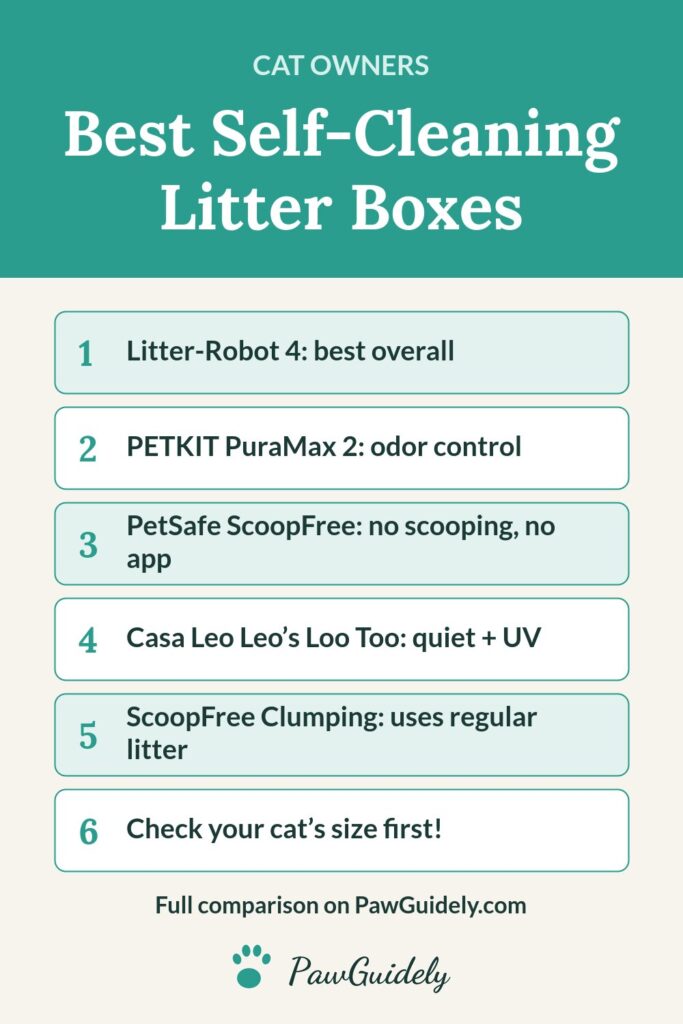
Quick Comparison
| Litter Box | Best For | Litter Type | App |
|---|---|---|---|
| Whisker Litter-Robot 4 | Best overall, most proven | Any clumping litter | Yes |
| PETKIT PuraMax 2 | Odor control, multi-cat homes | Most clumping litters | Yes (2.4 GHz WiFi) |
| PetSafe ScoopFree (Original) | Lowest upfront cost, no scooping | Crystal litter in disposable trays | No |
| Casa Leo Leo’s Loo Too | Quiet operation, UV odor control | Clumping litter | Yes, plus voice control |
| PetSafe ScoopFree Clumping | Owners who want to keep regular litter | Clumping litter | No |
1. Whisker Litter-Robot 4 — Best Overall
The Litter-Robot 4 is the model most reviewers measure everything else against. It works with any standard clumping litter, sifts waste into a sealed drawer after each visit, and uses multiple sensors to detect when a cat is inside so a cycle never runs while it’s in use. The Whisker app tracks visits and your cat’s weight, which helps you spot changes in bathroom habits early. It has been on the market for years, so it has a long track record for reliability and customer support.
- Works with any clumping litter
- Multiple safety sensors and cat detection
- App tracking for visits and weight
- Long reliability record and 1-year WhiskerCare warranty
Worth knowing: it’s one of the most expensive options, and some reviewers note the interior can feel snug for very large cats. Measure your cat before buying.
2. PETKIT PuraMax 2 — Best for Odor Control
The PuraMax 2 focuses on keeping smells in. Waste goes into a sealed drawer with deodorizer options, and the anti-leakage design helps protect floors. A low entrance makes it easier for older or smaller cats to step in, the entrance stays open during cleaning, and anti-pinch design plus a set of safety sensors stop the drum when a cat is detected. It connects to the PETKIT app over 2.4 GHz WiFi for scheduling and usage tracking.
- Sealed waste drawer with deodorizing options
- Low entrance, always-open design
- Anti-pinch and multiple safety sensors
- Suitable for multi-cat homes
Worth knowing: reviewers find deep cleaning more fiddly than on simpler boxes, and it’s designed to sit on hard floors rather than carpet.
3. PetSafe ScoopFree (Original) — Best Budget, No Scooping
The ScoopFree takes a different approach: an automatic rake pushes waste into a covered compartment inside a disposable tray filled with crystal litter. The crystals absorb urine and dry out solid waste, which keeps odor down, and when the tray is full you simply close it and throw the whole thing away. There’s no app and very little to set up, which is exactly why many owners like it.
- Lower upfront cost than drum-style robots
- No scooping and no litter to pour
- Crystal litter is good at controlling odor
- Simple, no WiFi or app required
Worth knowing: it only works with PetSafe’s crystal litter trays, so you’re committed to buying replacement trays, which adds up over time, especially with more than one cat.
4. Casa Leo Leo’s Loo Too — Best Quiet Option
Leo’s Loo Too is built for homes where the litter box sits near a bedroom or living space. It’s rated at around 30 dB, adds UV odor control, and includes safety sensors that pause cleaning when a cat is detected. The app tracks weight and visits, and it supports voice control if you use a smart assistant.
- Very quiet operation (around 30 dB)
- UV odor control function
- App weight tracking and voice control
- Safety sensors
Worth knowing: as with most globe-style boxes, check the entry size against your cat. Larger breeds may find the opening tight.
5. PetSafe ScoopFree Clumping Self-Cleaning Litter Box — Best for Regular Litter
If you like the ScoopFree idea but don’t want to switch to crystal litter, this version works with standard clumping litter. It handles the scooping automatically, is designed for single or multi-cat homes, and puts odor control front and center, without requiring an app.
- Uses the clumping litter you already buy
- Hands-free automatic cleaning
- Works for single or multi-cat homes
- No app setup needed
Worth knowing: without an app you won’t get visit or weight tracking, which some owners use to catch health changes early.
How to Choose a Self-Cleaning Litter Box
- Check your cat’s size. The most common complaint across all models is an entrance or interior that’s too small for large cats. Compare your cat’s length and weight against the manufacturer’s specs.
- Check the minimum cat weight. Safety sensors need a cat above a certain weight to register. Most automatic boxes aren’t meant for young kittens, so check the minimum before buying.
- Decide on litter. Drum-style robots use regular clumping litter. Rake-and-tray systems like the ScoopFree Original need proprietary trays, which are convenient but cost more over time.
- Look at ongoing costs. Factor in liners, filters, trays or deodorizer refills, not just the price of the box.
- Think about placement. Noise, floor type (some are hard-floor only) and access to a power outlet all matter.
Helping Your Cat Switch
Place the new box next to the old one and leave it switched off for the first few days, so it’s just another litter box. Once your cat is using it, turn on automatic cleaning, then remove the old box. Rushing this is the main reason cats reject automatic litter boxes.
Related Guides
- 5 Best Cat Water Fountains in 2026: Quiet, Easy-Clean and Cordless Picks
- 5 Best Automatic Cat Feeders in 2026: Timed, WiFi, Wet Food and Microchip
- 5 Best Cat Carriers in 2026 for Vet Trips, Car Rides and Flights
Frequently Asked Questions
Are self-cleaning litter boxes safe for cats?
Reputable models use weight and motion sensors to stop or delay cleaning when a cat is inside. Follow the manufacturer’s minimum cat weight and supervise the first few uses.
Do self-cleaning litter boxes work with multiple cats?
Many do, and they’re often most useful in multi-cat homes because they clean after every visit. Check the waste drawer capacity and whether the app can tell cats apart if you want individual tracking.
Can kittens use an automatic litter box?
Most manufacturers don’t recommend them for young kittens, because light cats may not trigger the safety sensors. Use a regular box until your kitten meets the minimum weight.
How often do you empty a self-cleaning litter box?
Typically every few days to about a week for one cat, depending on the drawer size and how many cats use it.