
This post contains affiliate links. As an Amazon Associate I earn from qualifying purchases. This costs you nothing extra. See our affiliate disclosure for details.
The best cat litter scoop is the one whose slots suit your litter. Fine clumping clay needs narrow, close slots so small clumps don’t slip through, while natural and pellet litters need wider gaps or the scoop clogs on every pass. For most clumping litter the iPrimio metal scoop is the best all-rounder, the DuraScoop suits large boxes and multi-cat homes, and the Litter Lifter is the light plastic option that sifts fastest.
Start With Your Litter, Not the Scoop
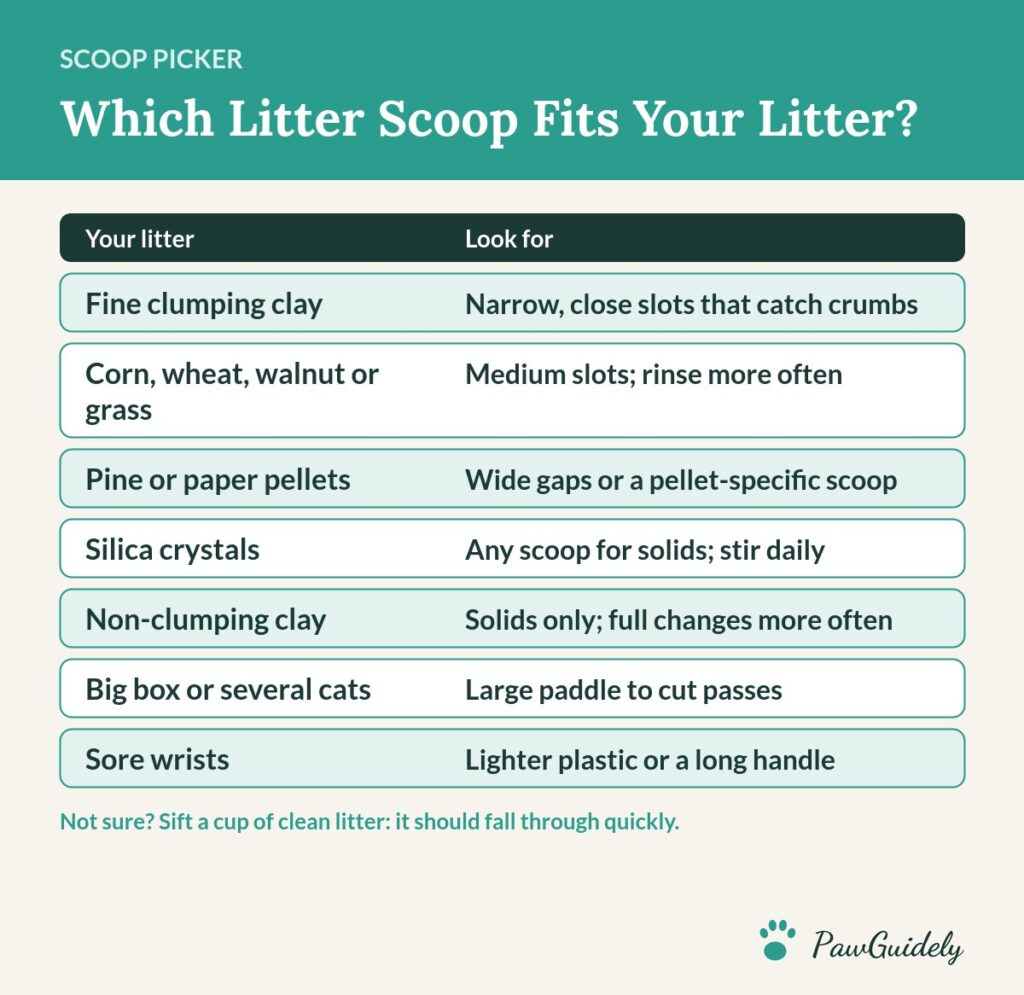
Most scoop complaints (clumps falling through, litter jamming the slots, crumbs left behind) come from a mismatch between slot size and granule size. Check what is in your box before comparing scoops.
| Litter type | Slot style | Why it matters |
|---|---|---|
| Fine clumping clay | Narrow, closely spaced | Holds onto crumbs and small urine clumps |
| Corn, wheat, walnut or grass clumping | Medium | Coarser granules fall through fast; clumps are softer, so rinse the scoop more often |
| Pine or paper pellets | Wide gaps, or a pellet scoop | Whole pellets jam narrow slots; most owners lift out solids only |
| Silica crystals | Any; used for solids | Crystals absorb urine instead of clumping, so you stir rather than sift |
| Non-clumping clay | Solid or wide scoop | Only solids can be scooped; the rest needs full changes |
Metal or Plastic? The Real Trade-Offs
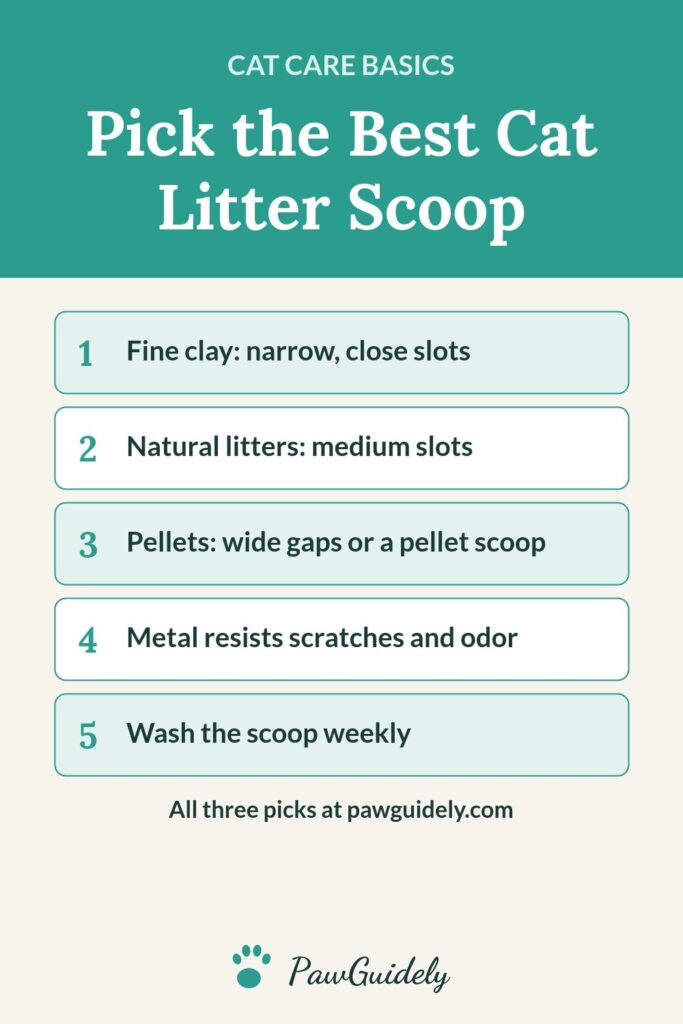
- Aluminum or steel: stiff enough to lift a clump that has cemented to the floor, and slower to scratch, so it holds less odor. The downsides are weight, a higher price and the chance of scraping a soft plastic box.
- Plastic: light, cheap and quiet. It flexes under stuck clumps, and fine scratches build up and trap smell, so plan to replace it more often.
- Coated metal: a nonstick coating helps wet clumps slide off. Wash it with a soft sponge, because abrasive pads wear the coating away.
1. iPrimio Cat Litter Scoop with Deep Shovel — Best Overall
iPrimio’s scoop is solid aluminum with a nonstick coating and a solid-core handle. The listing gives dimensions of 13.25 x 5 x 1.75 inches and a weight of 9.6 ounces, and it ships with a plastic wall hanger that sticks on with 3M adhesive. The deep, wide shovel lifts large urine clumps in one go, and the close slots leave clean clay in the box rather than in the bin.
- Rigid aluminum cuts under stuck clumps
- Nonstick coating helps wet clumps release
- Deep bowl holds big clumps without spilling
- Wall hanger included
Worth knowing: The slots are narrow, so coarse natural litters and pellets sift slowly. At nearly 10 ounces it is heavier than plastic scoops, which some owners with sore wrists notice, and the coating still needs regular washing.
2. DuraScoop Jumbo Cat Litter Scoop — Best for Big Boxes and Multiple Cats
The DuraScoop is cast in one piece from rust-resistant ADC-12 aluminum and polished smooth, with a soft non-slip grip on the handle. Because there are no joints or rivets, there is nothing to loosen or snap where the handle meets the paddle. The jumbo paddle covers more area per pass, which cuts scooping time in a large or busy box.
- One-piece cast aluminum, no weak joints
- Large paddle clears a big box in fewer passes
- Comfortable non-slip grip
- Works with clumping and non-clumping litter for solids
Worth knowing: The wide paddle can be awkward in the corners of small or covered boxes. Owners note that soft waste sticks to the outside of the paddle, so it needs a proper rinse, and some find the slat spacing lets very small clumps of fine clay slip through.
3. Litter Lifter Scoop — Best Lightweight Scoop
The Litter Lifter is made of thick plastic and shaped more like a small snow shovel than a classic scoop: a long, flat blade with no sides. Its tines are thin and peaked rather than flat, so clean litter runs off them instead of sitting on top. That shape is why owner feedback keep describing it as the fastest scoop to sift with, and the flat front edge slides under clumps stuck to the floor. It has a hanging hole and comes in several colors, and the maker also sells a separate version for pellet litter.
- Very light, easy on the wrists
- Peaked tines shed clean litter quickly
- Flat edge gets under stuck clumps
- Pellet version available
Worth knowing: Plastic can crack with years of hard use, especially if you pry with it. With no sides, a large clump can slide off if you tilt the blade, and the flat surface takes a little practice.
A Cleaning Schedule That Keeps the Scoop From Smelling
- Daily: scoop at least once a day, and twice in multi-cat homes. Tap the scoop clean and hang it rather than leaving it buried in the box.
- Weekly: wash the scoop in hot water with unscented dish soap and let it dry completely before hanging. A damp scoop collects litter that cakes on.
- At every full litter change: wash the scoop and its holder along with the box.
- Cleaners: skip strongly scented products, which can put some cats off the box, and never mix bleach with ammonia-based cleaners.
- Replace: plastic scoops once they are cracked, deeply scratched or smell even after washing.
Troubleshooting Scooping Problems
- Clumps break apart as you lift: come in from the side, slide fully under the clump and lift slowly. If clumps form on the floor of the box, the litter layer is probably too thin; follow your litter’s recommended depth.
- Clumps cemented to the floor: a rigid metal edge works better than plastic. Topping up litter depth stops it happening in the first place.
- Slots keep clogging: the slots are too narrow for your litter. Switch to a wider-slot or pellet scoop.
- Crumbs left behind: slots are too wide for fine clay. A narrower scoop fixes it.
- Back or knee strain: a long-handled scoop reduces bending, though it gives less control in corners. Sitting on a low stool also helps.
Extras: Worth It or Skip?
- Wall hanger or scoop caddy: worth it. It keeps the scoop off the floor and dripping into something you can wash.
- Scoop with a built-in bag holder: handy when the box is far from a bin, but bulkier to store.
- Extra-long handle scoops: worth it for back pain, less useful in small or covered boxes.
- Disposable scoops and scoop bags: fine for travel, too costly for daily use.
Which Scoop Should You Buy?
Fine clumping clay and one or two cats: the iPrimio. Big boxes, several cats, or you want a scoop with no joints to fail: the DuraScoop. Coarse natural litter, pellets (using the pellet version) or sore wrists: the Litter Lifter. Whichever you choose, pair it with a holder and a weekly wash.
Related Guides
- How to Clean a Litter Box: Daily, Weekly and Deep-Clean Routine
- Best Cat Litter in 2026: 5 Picks and Every Litter Type Explained
- 5 Best Cat Litter Boxes in 2026: Open, Covered, High-Sided and Top-Entry
- 4 Best Cat Litter Mats in 2026 to Stop Litter Tracking
- How Many Litter Boxes Do You Need Per Cat? (The N+1 Rule Explained)
- 6 Best Cat Litters for Multiple Cats (Odor Control That Keeps Up)
- 5 Best Litter Boxes for Large Cats (Maine Coons and Big Breeds)
Frequently Asked Questions
Is a metal or plastic litter scoop better?
Metal lasts longer and lifts stuck clumps more easily; plastic is lighter and cheaper but scratches and holds odor sooner. For clumping clay most owners prefer metal.
How often should I replace a cat litter scoop?
Replace a plastic scoop when it is cracked, deeply scratched or still smells after washing. A metal scoop can last years if you dry it before storing.
What scoop works best for pine pellets?
One with wide gaps or a pellet-specific design. Narrow slots jam with whole pellets.
Should I wash my litter scoop?
Yes. Rinse it with hot water and unscented soap about once a week and at every full litter change.
Where should I keep the litter scoop?
On a wall hanger or in a caddy next to the box, not buried in the litter, where it collects waste and bacteria.