
This post contains affiliate links. As an Amazon Associate I earn from qualifying purchases. This costs you nothing extra. See our affiliate disclosure for details.
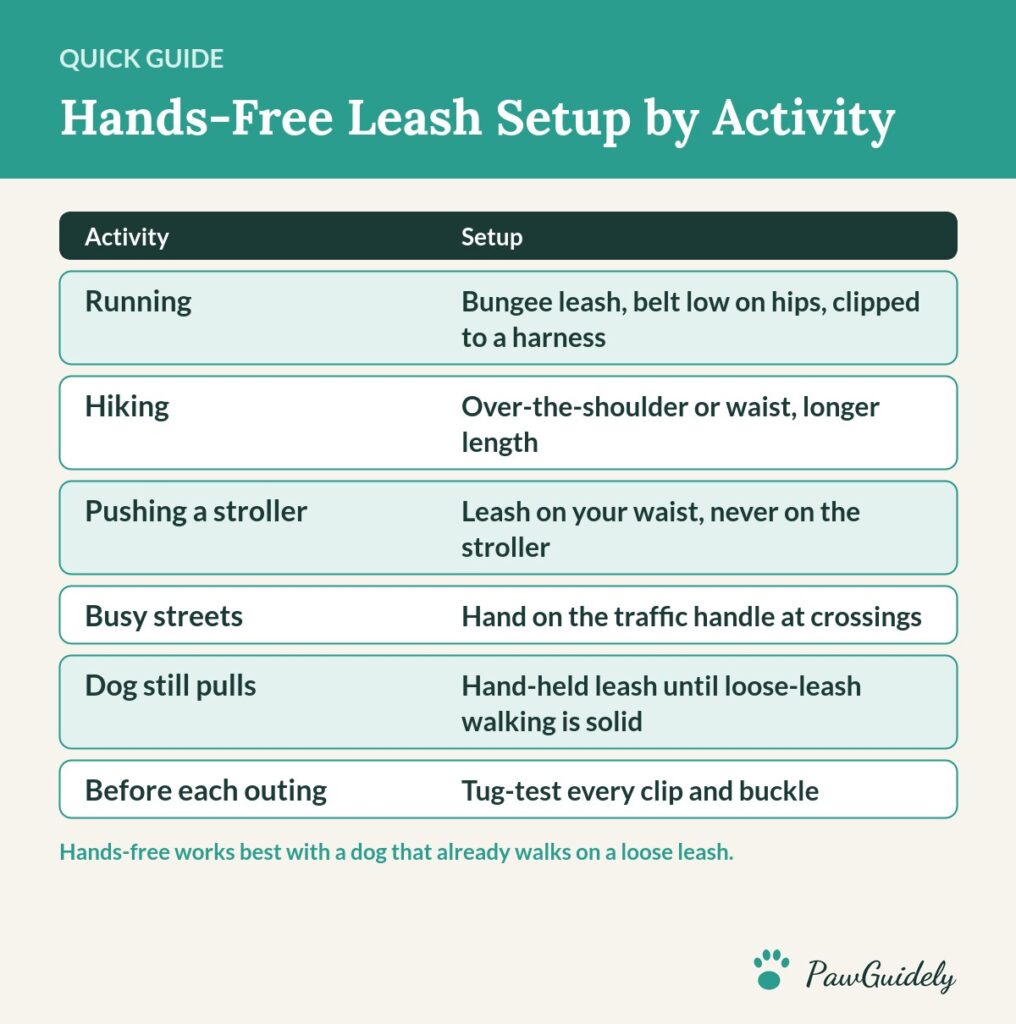
A hands-free dog leash clips to a belt or loops across your body, so both hands stay free for running, hiking or pushing a stroller. For running, the Tuff Mutt Hands-Free Bungee Leash is the simplest setup; for mixed walks where you want to switch between hand-held and hands-free, the Kurgo Quantum converts six ways; and the Ruffwear Flat Out is a sturdy non-stretch option for walking and hiking. All three work best with a dog that already walks on a loose leash.
Is Hands-Free Right for Your Dog?
Here is a simple rule: if you could not comfortably hold your dog one-handed when it spots a squirrel, do not attach it to your waist yet. A belt puts every lunge right at your center of gravity, and you cannot let go of a leash that is buckled to you.
- Good candidates: dogs that trot beside you without lunging, owners who run or hike regularly, and anyone who needs a free hand for a stroller, a coffee or a phone map.
- Not yet: dogs that lunge at bikes, wildlife or other dogs, dogs still learning loose-leash walking, and puppies that zigzag.
- Think twice: if the dog is close to your own weight or you have any balance concerns. A hand-held leash with a padded handle is the safer choice there.
Bungee, Fixed or Convertible?
| Leash type | How it feels | Best for | The trade-off |
|---|---|---|---|
| Bungee | Stretch softens sudden tugs | Running and jogging | Slower, less precise control; a dog can build momentum |
| Fixed webbing on a waist buckle | Direct and predictable | Walking and hiking | Every tug reaches your hips at full strength |
| Convertible ladder leash | Switches between hand, waist and shoulder | Mixed outings, two dogs | More clips to set up and check |
1. Tuff Mutt Hands-Free Bungee Leash — Best for Running
This is a running setup: an adjustable waist belt with a clip that slides from side to side, plus a leash with a bungee section. The listed length is 48 inches stretching to about 60, which keeps a dog close enough to run beside you. Two traffic handles let you grab your dog short at crossings, and reflective stitching helps in low light. The maker lists it for dogs of about 25–110 lb.
- Bungee section absorbs jolts when your dog changes pace
- Two traffic handles for close control
- Belt clip slides so the dog can switch sides
- Reflective stitching
Worth knowing: some owners measured the relaxed length shorter than they expected, and a few reported clip wear after months of heavy use, so inspect the clips regularly. The stretch also means slightly less precise control for a dog still learning to run beside you.
2. Kurgo Quantum 6-in-1 Leash — Best Convertible Leash
The Quantum is a ladder-style leash that adjusts from 48 to 72 inches and rearranges into six setups: a standard 6 ft leash, a 3 ft training leash, an over-the-shoulder courier style for hiking, an around-the-waist style for running, a double-dog walker and a tether. A padded floating handle, reflective trim and a carabiner (with a bottle opener) round it out. Kurgo backs it with a lifetime guarantee against manufacturing defects.
- Six configurations in one leash
- Over-the-shoulder option spreads the pull across your body
- Can walk two dogs
- Lifetime guarantee on manufacturing defects
Worth knowing: there is no bungee and no separate waist belt; the leash itself goes around your waist or across your body. Switching between setups takes a little practice, and there are more clips to check before each walk.
3. Ruffwear Flat Out Leash — Best Non-Stretch Waist Leash
The Flat Out is a 6 ft, 1 inch leash that can be held normally or buckled around your waist with a side-release buckle backed by an aluminum loop. It has a padded, adjustable handle, a separate traffic handle near the clip, a swiveling aluminum Talon clip and an accessory loop for a bag dispenser. You can also wrap it around a post or tree to tie your dog briefly during a break.
- Durable webbing with an aluminum swivel clip
- Padded main handle plus a traffic handle
- Converts between hand-held and waist-worn
- Accessory loop for waste bags
Worth knowing: there is no stretch to absorb jolts and no over-the-shoulder setup. At 6 ft, a dog has enough slack to get ahead and cross in front of you when the leash is on your waist, so teach a side position first. It also costs more than most hands-free leashes.
Setting Up a Hands-Free Leash Safely
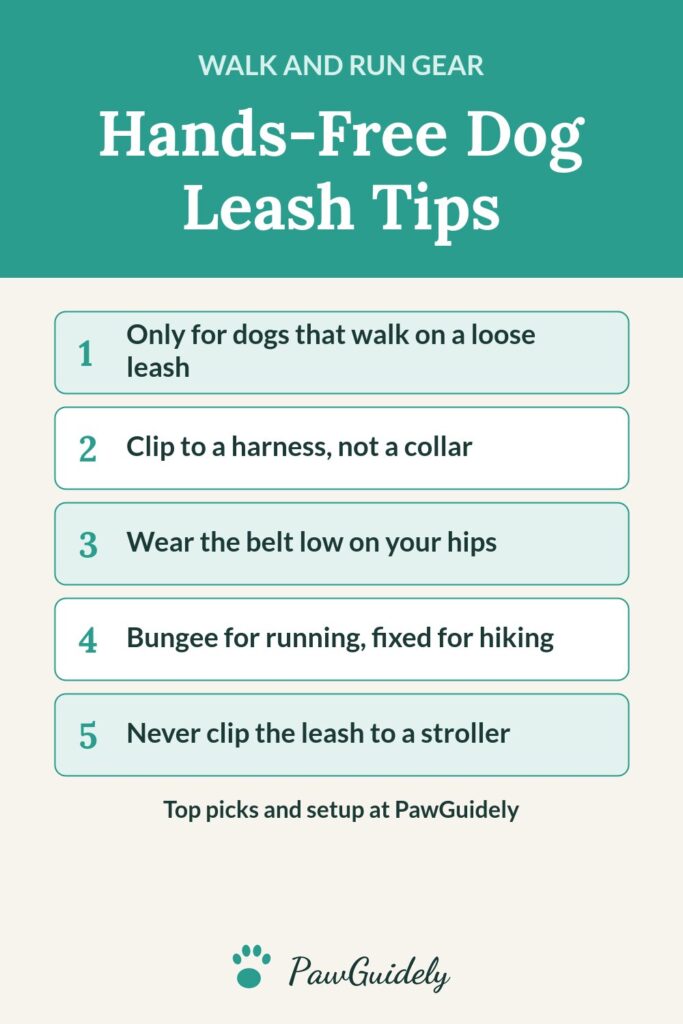
- Clip the leash to a harness rather than a collar. A sudden stop at running pace puts a lot of force through the neck.
- Wear the belt low on your hips, not around your stomach, so any tug lands near your center of gravity.
- Choose one side for your dog and stick to it. Switching sides mid-run is how legs get tangled.
- Practise at walking pace in a quiet area before you try a run or a busy trail.
- Keep a hand near the traffic handle at crossings, gates and when other dogs pass.
- Learn to open the belt buckle one-handed so you can release yourself quickly if you need to.
- Never clip the leash to a stroller frame. If your dog bolts, it can tip the stroller over.
Inspection and Care Schedule
- Before every outing: tug-test each clip and buckle, and make sure the clip gate snaps shut.
- Weekly: look along the bungee and stitching for fraying, especially near the clip and handle.
- Monthly or when muddy: hand wash with mild soap and let it air dry fully before use.
- Replace when: the bungee no longer springs back, the webbing frays near hardware, or a clip gate sticks.
Related Guides
- 5 Best Dog Leashes for Everyday Walks
- Retractable Leash vs Standard Leash
- How to Stop Your Dog Pulling on the Leash
- 4 Best No-Pull Dog Harnesses
- 5 Best Harnesses for Large Dogs
- Best Dog Water Bottles for Walks and Hikes
- Best Dog Poop Bag Holders
Frequently Asked Questions
Are hands-free dog leashes safe?
They are safe for dogs that already walk calmly beside you. With a dog that lunges, a leash attached to your waist can pull you off balance, so build loose-leash skills with a hand-held leash first.
Should I use a collar or a harness with a hands-free leash?
A harness. Running and hiking involve sudden stops and changes of pace, and a harness spreads that force across the chest instead of the neck.
What length is best for running with a dog?
A short leash of around 4 to 5 feet keeps your dog beside you without slack to trip over. Longer leashes suit hiking, where your dog needs room to sniff.
Can I walk two dogs hands-free?
Some convertible leashes, such as the Kurgo Quantum, have a two-dog setup. Only try it when both dogs are reliable on a loose leash, because two dogs pulling together can easily unbalance you.