
Most healthy adult dogs can stay in a crate for up to about 6 to 8 hours during the day, and a full night of sleep in the crate is usually fine. Puppies need much shorter stretches: a common rule of thumb is their age in months plus one, in hours. Senior dogs and dogs with health issues often need breaks more often. Below are the limits by age, why daytime and overnight crating are different, and what to do when your schedule does not fit.
Crate Time Limits by Age at a Glance
These are upper limits for a dog that already feels relaxed in its crate. They are not daily targets. A dog that is still learning to like the crate needs much shorter sessions, often just minutes at a time.
| Age | Daytime maximum | Overnight |
|---|---|---|
| 8–10 weeks | 1–2 hours, 3 at the very most | Potty break every 2–3 hours |
| 3 months | Up to about 4 hours | Potty break every 3–4 hours |
| 4 months | Up to about 5 hours | Often one break, sometimes none |
| 5 months | Up to about 6 hours | Usually sleeps through |
| 6–12 months | Build gradually toward adult limits | Sleeps through |
| Healthy adult | About 6–8 hours, less is better | A full night (around 8 hours) |
| Senior dog | Often shorter, based on comfort | May need a night potty trip |
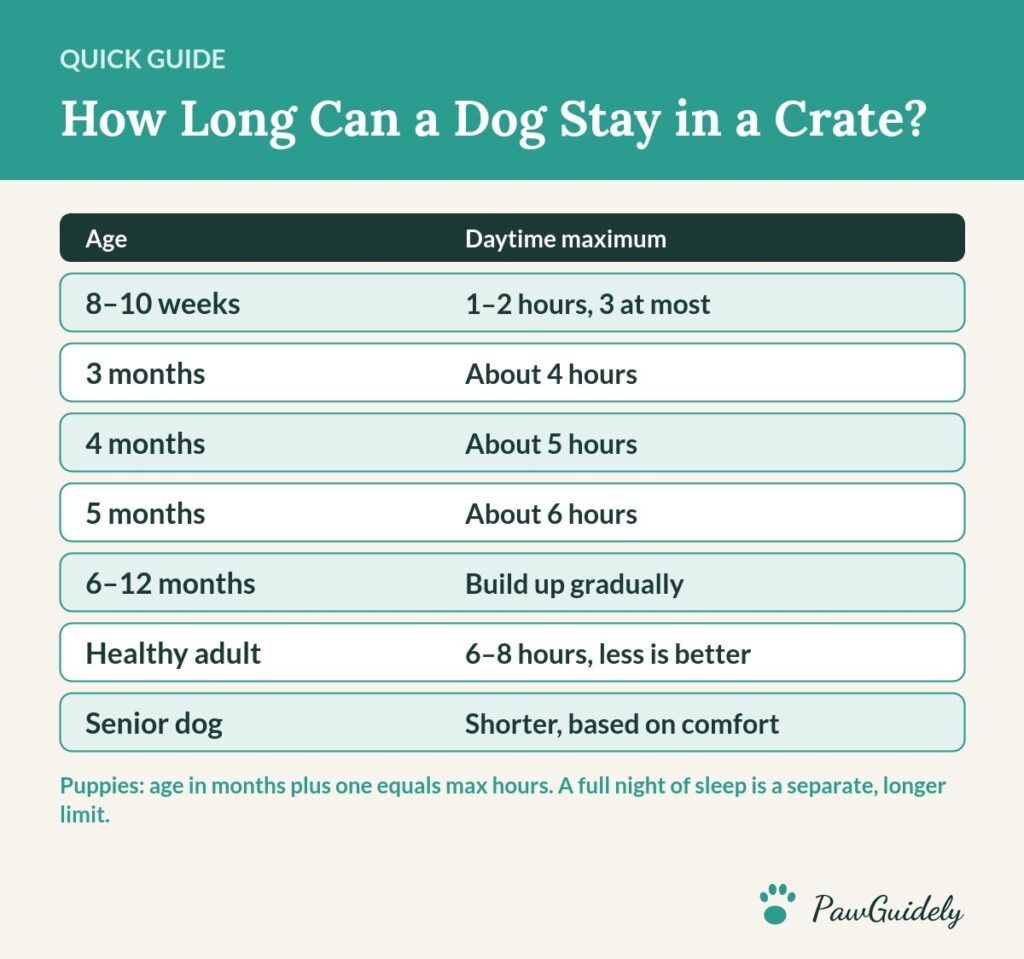
The puppy figures follow the widely used age-in-months-plus-one guideline. If you are raising a puppy and want a full sample day with meal, nap and potty times, see our crate training schedule by age.
Daytime vs Overnight: Why the Limits Differ
At night your dog is asleep, its body is resting, and it would be lying still anyway. That is why most adult dogs handle a full night in a crate without trouble, often longer than they could manage comfortably during the day.
During the day dogs are awake. They need to move, stretch, sniff, drink, go to the toilet and spend time with their people. Eight daytime hours in a crate is a long stretch even for a dog with excellent bladder control. A useful way to think about it is total crate time across 24 hours: a dog that sleeps 8 hours in the crate overnight should not then spend another full workday in it without a break.
How Long Can a Puppy Stay in a Crate?
Puppies have small bladders and limited control, so the age-plus-one rule is a ceiling, not a goal. In practice, a new 8-week-old puppy usually does best with crate naps of an hour or two during the day, with play, potty trips and training in between.
- Take your puppy outside right after every crate session, nap and meal.
- Set an alarm for night potty trips in the first weeks, and keep them quiet and boring.
- Lift the water bowl an hour or so before bedtime during house-training.
- Increase crate time slowly, a few minutes at a time, as your puppy settles.
If your puppy cries in the crate, our guide on how to stop a puppy crying in the crate covers the difference between a potty call and attention-seeking.
How Long Can an Adult Dog Stay in a Crate?
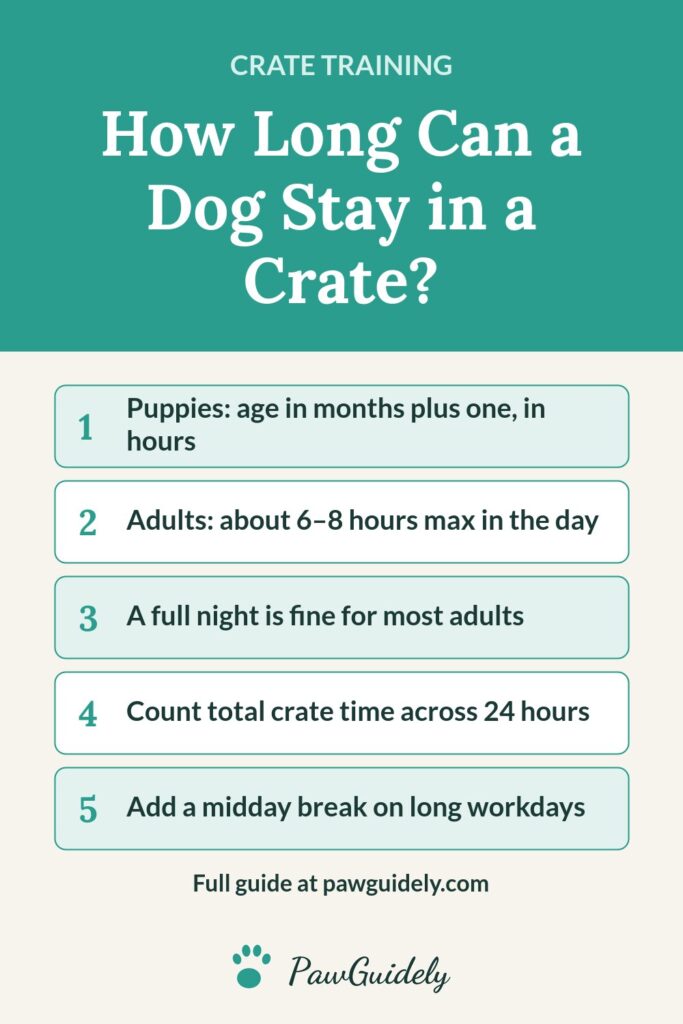
A healthy, crate-trained adult dog can usually manage up to around 6 to 8 hours in a crate during the day, and a full night is fine. That daytime figure is the upper end, not something to aim for every day. If your dog would be crated for a full workday as a regular routine, plan a midday break.
How well a dog copes also depends on its energy level, how much exercise it got beforehand, whether the crate is the right size, and how much time it spends with you the rest of the day. A young, high-energy working breed will find a long day in a crate much harder than a laid-back older dog.
If you are introducing a crate to an adult or rescue dog for the first time, start with very short sessions. Our step-by-step plan for crate training an adult dog walks through it.
How Long Can a Senior Dog Stay in a Crate?
Older dogs vary a lot. Many need to go out more often than they did a few years ago, and some get stiff when lying in one position for long periods. Base crate time on your own dog: if it is restless, asks to go out sooner, or has accidents, shorten the stretches.
A thick, supportive pad helps stiff joints, and a crate with a wide door makes getting in and out easier. Changes in bladder control or sudden restlessness can have medical causes, so mention them to your vet rather than assuming it is just age.
Signs Your Dog Is Spending Too Long in the Crate
- Accidents in the crate from a dog that is otherwise house-trained.
- Chewing the bars, bedding or tray, or a damaged crate.
- Constant barking or whining that starts well into the crate session.
- Frantic, over-the-top behavior every time you let your dog out.
- Restlessness at night after a long day of crating.
- Reluctance to go into the crate when it used to walk in on its own.
Heavy panting, drooling, injuries from trying to escape, or panic as soon as the door closes can point to anxiety rather than boredom. Stop crating for long periods and talk to your vet or a qualified trainer.
How to Reduce Crate Time on Long Workdays
- Book a midday dog walker, or ask a neighbor or family member to let your dog out.
- Use doggy daycare on some days to break up the week.
- Swap the crate for a dog playpen or a dog-proofed room once your dog is reliable.
- Give a good walk and some play before you leave, so your dog is ready to rest.
- Leave a safe food puzzle or stuffed chew to fill the first part of the day.
- Come home at lunch if you work close by, even a few days a week.
Making Crate Time Comfortable and Safe
- Pick the right size: your dog should be able to stand, turn around and lie flat. Our dog crate size chart shows which size to buy.
- Add a washable, chew-resistant pad. See our picks for dog crate pads.
- For longer stretches, consider a bowl that clips to the crate so it cannot be tipped over.
- Remove harnesses and dangling tags that could catch on wire bars.
- Only leave chews and toys that cannot be swallowed or broken into pieces.
- Keep the crate out of direct sun, drafts and away from heaters.
Related Guides
- Crate Training Schedule by Age: A Puppy Plan From 8 Weeks to Adult
- How to Crate Train an Adult Dog: A Calm, Step-by-Step Plan
- How to Stop a Puppy Crying in the Crate (Night and Day)
- 5 Best Dog Crates in 2026: Wire, Plastic, Soft-Sided, and Modular Picks Compared
- Dog Crate Sizes: Size Chart by Breed & Weight (Plus How to Measure)
- 5 Best Dog Crate Pads and Beds in 2026: Washable, Chew-Resistant and Orthopedic
- 4 Best Dog Playpens and Exercise Pens in 2026 (Indoor and Outdoor)
- Where to Put a Dog Crate in Your Home
- Crate Training a Puppy at Night: A Calm Routine
- 4 Best Crate Water Bowls and Clip-On Bowls (No-Spill Picks)
- How to Crate Train a Puppy: Step by Step
- Why Is My Dog Peeing in the Crate?
Frequently Asked Questions
Can I crate my dog for 8 hours while I work?
A healthy, crate-trained adult dog can usually manage it, but 8 hours is the upper limit, not an ideal. A midday walk or visit makes a big difference. Young puppies cannot be crated for a full workday.
How long can a dog stay in a crate overnight?
Most healthy adult dogs sleep around 8 hours in a crate overnight without problems. Young puppies need one or more potty breaks until their bladder control improves, usually by around 4 to 5 months.
Is it OK to crate a dog all day and all night?
No. A full night in the crate followed by a full day in it adds up to far too much confinement. If your dog sleeps in the crate, give it plenty of free time, exercise and company during the day.
Should I leave water in my dog’s crate?
For short stretches it is not usually needed. For longer ones, a crate-mounted bowl is a good idea. During puppy house-training, many owners lift water about an hour before bed.
Is it cruel to crate a dog?
Used properly, a crate is a safe den most dogs like. It becomes a problem when it is used as punishment or for longer than the dog can comfortably handle.
These are general guidelines. If your dog is elderly, has a medical condition or has trouble holding its bladder, ask your vet what is right for your dog.