
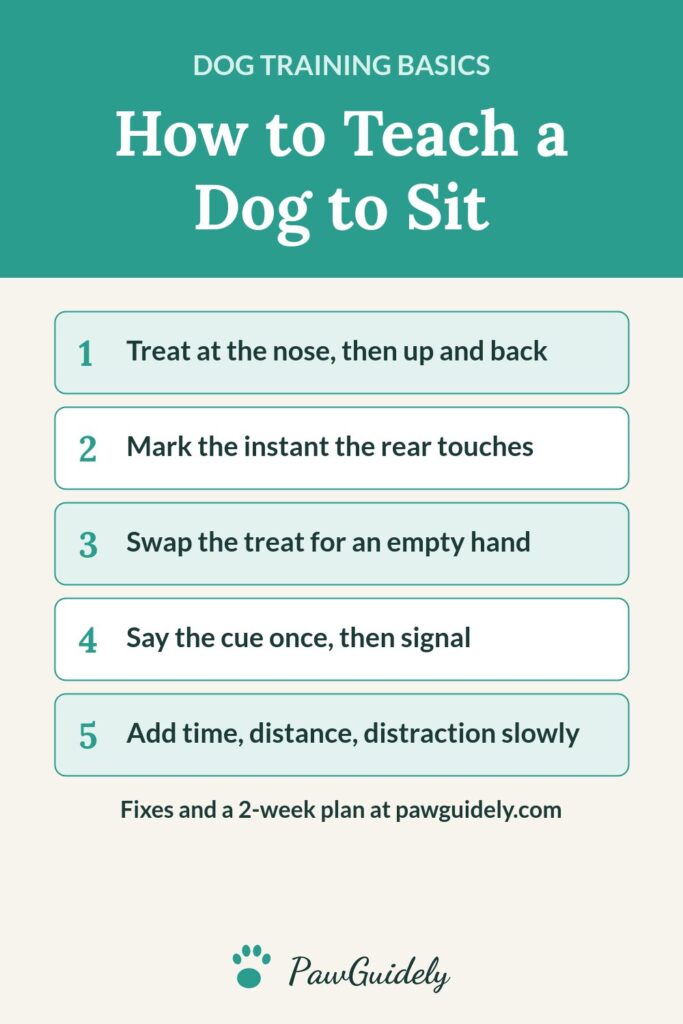
To teach a dog to sit, hold a small treat at your dog’s nose, move it slowly up and back over the head so the rear end drops, and mark and reward the instant the bottom touches the floor. Most dogs pick up the motion within a few short sessions. You add the word “sit” only once the action is reliable, then spend a few weeks making it work in the yard, at the door and on walks.
Before You Start
- Tiny, soft treats. Pea-sized pieces your dog can swallow in a second, so the lesson doesn’t stall while they chew.
- A marker. A short word such as “yes” or a clicker, used only to say “that exact moment earned a treat”.
- A release word. “Free” or “okay” tells your dog the sit is over. Without one, dogs learn to decide for themselves.
- A quiet room and short sessions. Three to five minutes, ideally before a meal when your dog is keen but not frantic.
Method 1: Lure the Sit
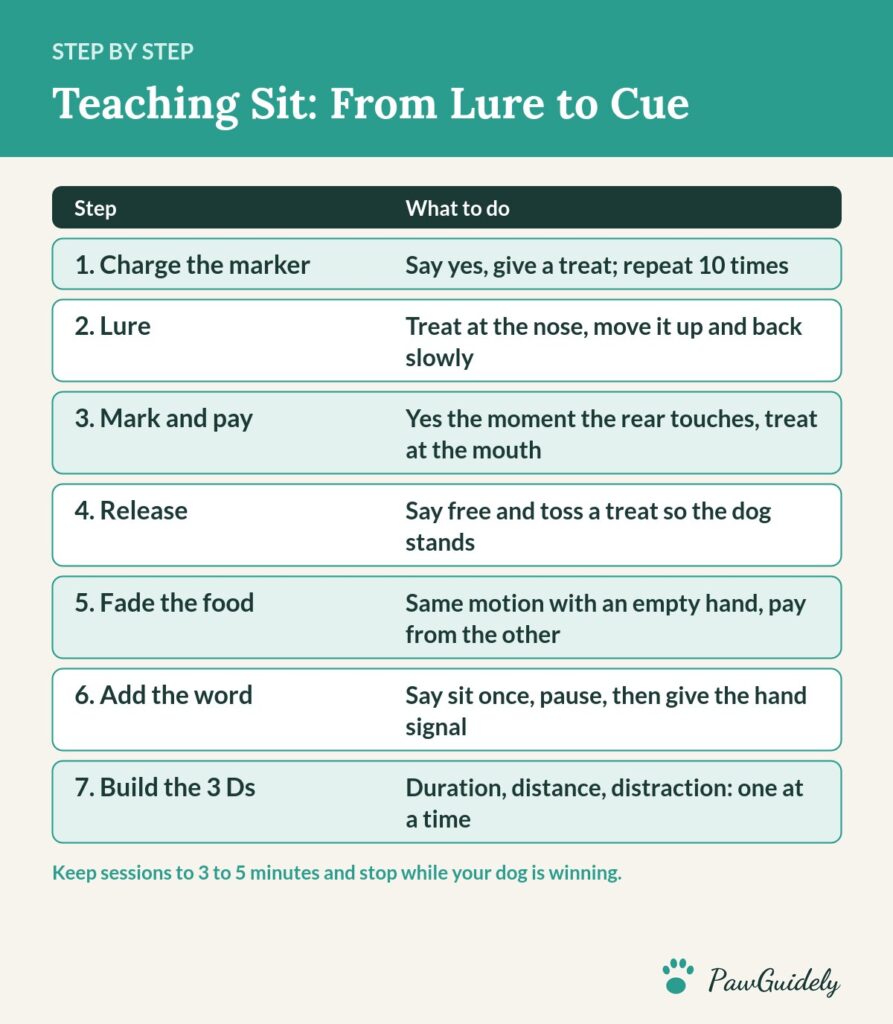
- Charge the marker. Say “yes” and hand over a treat, ten times in a row, so the word starts to predict food.
- Start with your dog standing and a treat pinched at their nose.
- Move the treat slowly up and slightly back toward the tail, staying about an inch above the nose. As the head tilts up, the rear has to go down.
- Mark the moment the bottom lands and deliver the treat right at the mouth while your dog is still sitting.
- Release. Say your release word and toss a treat a short way off so your dog stands up, ready for the next rep.
- Do 5 to 10 reps, then stop while your dog is still getting it right.
Fading the Lure: Where Most Owners Get Stuck
If you keep a treat in your luring hand for weeks, your dog learns to sit for visible food, not for you. Once your dog follows the lure on about four out of five tries, start fading it.
- Make the same motion with an empty hand, then pay from your other hand or a pouch.
- Over the next sessions, shrink the motion until it is a small upward flick of the palm.
- Add the word: say “sit” once, wait a beat, then give the hand signal. Soon your dog starts sitting on the word before the signal comes.
- Vary the pay: some reps get a treat, some get a toy or a chance to go through the door. Keep rewarding often at this stage.
Method 2: Capture the Sit
Capturing suits puppies, dogs who get overexcited by a treat in front of their face, and dogs uneasy about a hand moving over their head. Sit somewhere quiet with treats out of sight and wait. Every time your dog sits on their own, mark and reward, then toss a treat a few feet away to reset. Within a session or two most dogs start sitting on purpose to make the treats happen. When your dog is offering sits rapidly, say “sit” just before you expect it. Capturing starts slower than luring but leaves you with no lure to fade.
Turning a Kitchen Sit Into a Real-World Sit
Dogs don’t generalize well. A sit learned in the kitchen is a new skill in the yard. Trainers work on three variables, often called the 3 Ds, and change only one at a time.
| Variable | How to increase it | If your dog fails |
|---|---|---|
| Duration | Wait 1, then 2, then 3 seconds before marking; build toward 30 seconds | Go back to the last time that worked |
| Distance | Take one step back, step in again, then mark and reward | Return to standing next to your dog |
| Distraction | Practice in other rooms, then the yard, then on quiet walks | Move further from the distraction or use better treats |
Rule of thumb: when you raise one D, relax the other two. A dog practicing sit in a busy park doesn’t also need to hold it for 20 seconds.
Troubleshooting a Sit That Isn’t Working
- Your dog jumps at the treat. The lure is too high or moving too fast. Keep it within an inch of the nose and move slowly.
- Your dog backs up instead of sitting. Practice with your dog’s rear near a wall or in a hallway, so stepping back isn’t an option.
- Your dog only sits when food is visible. You haven’t faded the lure. Switch to an empty-hand signal and keep treats in a pouch or pocket.
- Your dog sits then pops straight up. The treat is arriving late or while your dog is standing. Deliver it at the mouth while the bottom is still down, and use your release word.
- You’re saying “sit, sit, sit”. Say it once. If nothing happens, help with the hand signal, then make the next rep easier.
- Your dog won’t sit on cold, wet or slippery ground. Some dogs find it uncomfortable. Carry a small mat, or accept a stand at the curb. If an older dog seems stiff or reluctant to sit at all, ask your vet.
Why You Shouldn’t Push the Rear Down
Pressing on the hips is the old-school shortcut, and it backfires. Many dogs push back against the pressure, the dog learns nothing about doing it themselves, and it can be uncomfortable for growing puppies or older dogs. Hands-off luring and capturing teach the same position without the wrestling.
A Two-Week Practice Plan
- Days 1–3: lure in a quiet room, two or three sessions a day of 3 to 5 minutes.
- Days 4–6: fade to an empty-hand signal and start adding the word.
- Days 7–10: build duration to 5 to 10 seconds and practice in other rooms.
- Days 11–14: add mild distractions: the yard, mealtimes, the front door.
Treat these as a rough guide. Young puppies and dogs new to training often need longer at each stage, and that’s normal.
Put Sit to Work Every Day
The more often sit earns something your dog wants, the stronger it gets. Ask for a sit before the food bowl goes down, before the leash clips on, before the door opens and before saying hello to visitors. Used this way, sit becomes your dog’s way of saying please, and it gives you a simple alternative to ask for when your dog would otherwise jump or rush ahead.
Related Guides
- 4 Best Dog Treat Pouches for Training and Walks
- How to Stop Your Dog Pulling on the Leash When Walking (8 Steps)
- New Puppy Checklist: 25 Essentials to Buy Before You Bring Your Puppy Home
- How to Potty Train a Puppy: A Simple Schedule That Works
- 15 Indoor Games for Dogs and Puppies to Beat Boredom on Rainy Days
- Crate Training Schedule by Age: A Puppy Plan From 8 Weeks to Adult
Frequently Asked Questions
How long does it take to teach a dog to sit?
Many dogs learn the basic motion in a few sessions. A sit that holds up outdoors and around distractions usually takes a few weeks of short daily practice.
At what age can a puppy learn to sit?
As soon as your puppy comes home. Young puppies do best with very small treats and sessions of just one to three minutes.
Should I use a clicker or a marker word?
Either works. A clicker is a little more precise; a word is always with you. What matters is using it consistently and following it with a reward.
Why does my dog sit at home but not outside?
Dogs learn in context. Practice in new places at an easier level, with better treats, before expecting a sit near distractions.
Can you teach an older dog to sit?
Yes, older dogs learn well with the same methods. Keep sessions short and talk to your vet if sitting seems uncomfortable.