
This post contains affiliate links. As an Amazon Associate I earn from qualifying purchases. This costs you nothing extra. See our affiliate disclosure for details.
Potty training a puppy is less about discipline and more about timing. Young puppies have small bladders and little control, so your job is to get them outside before they need to go, reward them when they do, and prevent accidents indoors while the habit forms. With a consistent routine, most puppies are fairly reliable by four to six months, though some breeds and individuals take longer.
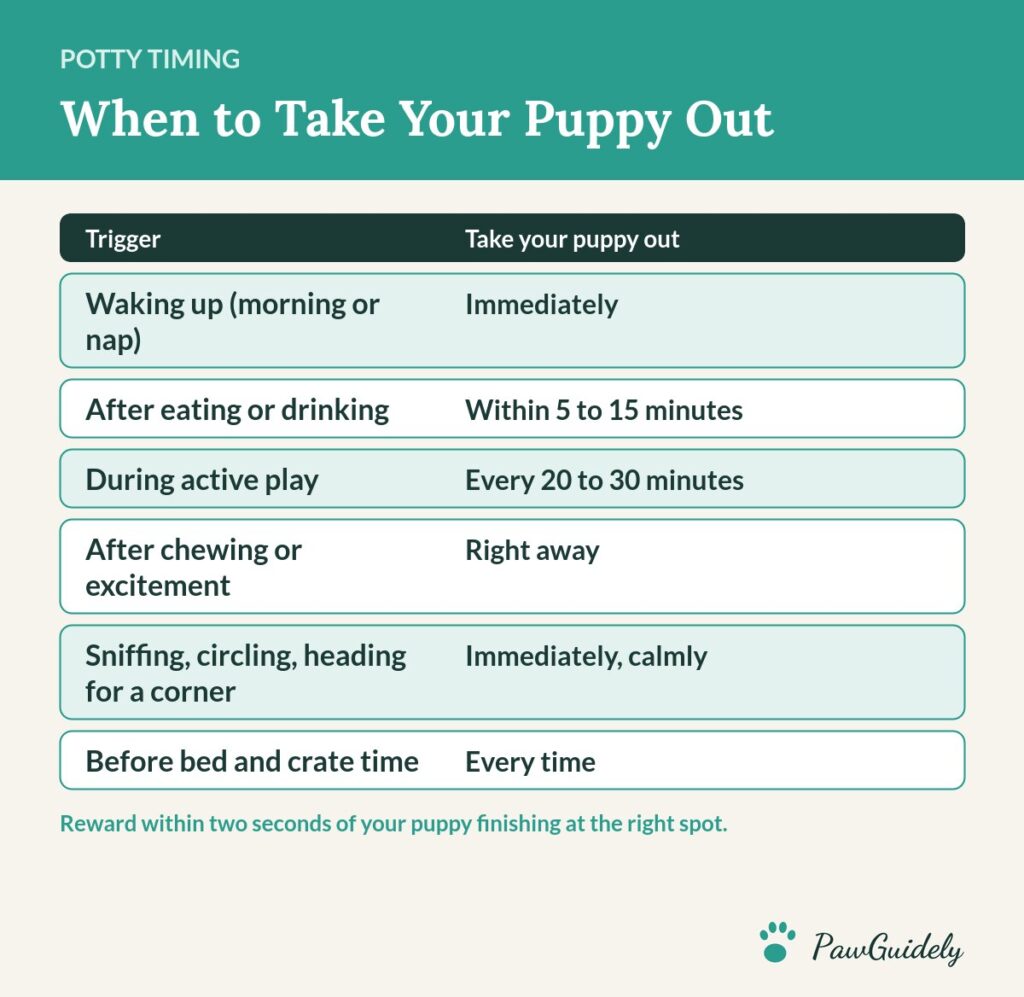
When Puppies Need to Go
| Trigger | Take your puppy out |
|---|---|
| Waking up (morning or nap) | Immediately |
| After eating or drinking | Within 5 to 15 minutes |
| During and after play | Every 20 to 30 minutes of active play |
| After chewing or excitement | Right away |
| Sniffing, circling, heading for a corner | Immediately, calmly |
| Before bed and before crate time | Every time |
A common rule of thumb is that puppies can hold it for roughly their age in months plus one hour, up to about 8 hours. A 3-month-old puppy may manage about 4 hours overnight, but far less when active during the day. Treat this as a rough guide, not a target.
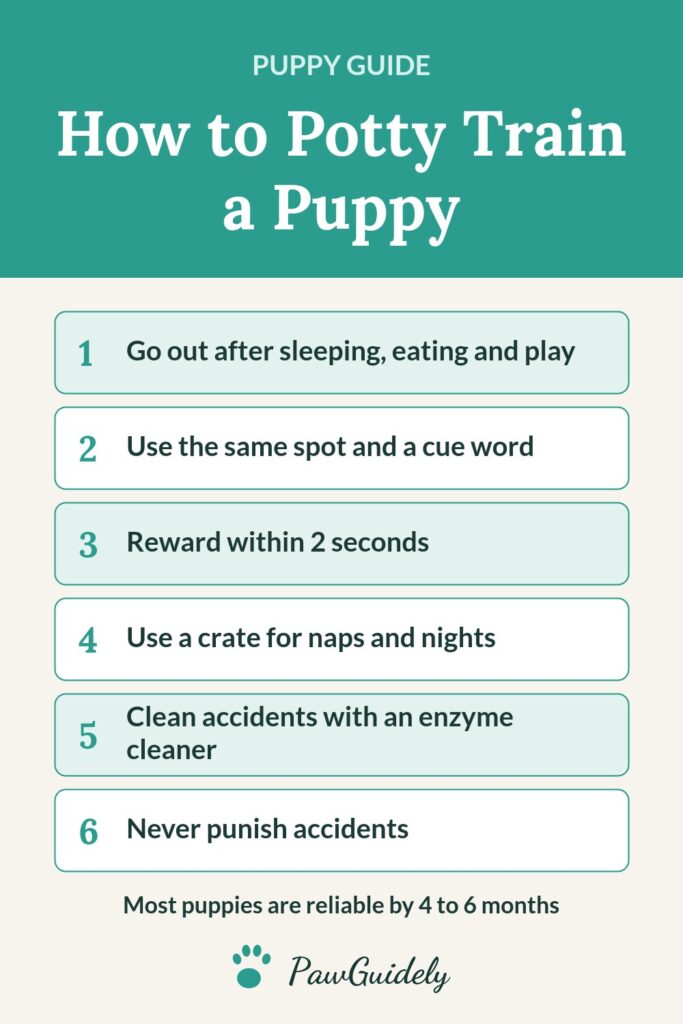
How to Potty Train a Puppy Step by Step
- Pick one potty spot. Take your puppy to the same place on a leash each time. The smell helps remind them why they are there.
- Use a cue word. Say something like “go potty” calmly as they start to go. Over time, the cue will help them go on request.
- Reward immediately. Praise and give a small treat within two seconds of them finishing, while still at the spot. A treat pouch on your belt makes this easy.
- Keep potty trips boring. No play until after they go. If nothing happens in 5 minutes, go back inside, supervise closely or crate them, and try again in 10 to 15 minutes.
- Supervise every minute indoors. Keep your puppy in the same room with you, on a leash or behind a gate. Most accidents happen when no one is watching.
- Use a crate for naps, nights and alone time. Most puppies avoid soiling where they sleep. The crate should be just big enough to stand, turn and lie down, so use a divider.
- Plan night breaks. Set an alarm rather than waiting for crying. Take them out quietly, then straight back to bed.
- Keep a simple log. Note times of meals, potty trips and accidents for a week. Patterns appear quickly and make the schedule easier.
Sample Puppy Potty Schedule
| Time | Activity |
|---|---|
| 7:00 am | Wake up, straight outside |
| 7:15 am | Breakfast, then outside 10 minutes later |
| 8:00 am | Play and training, outside after |
| 9:00 am | Nap in crate |
| 11:00 am | Wake up, outside |
| 12:00 pm | Lunch, then outside |
| 2:00 pm | Nap, then outside |
| 5:00 pm | Dinner, then outside |
| 7:00 pm | Play, outside after |
| 10:00 pm | Last trip out, then bed |
| 2:00 am | Night break for young puppies |
Adjust the times to your day. What matters is consistency: the same spot, the same cue and predictable meal times.
What About Puppy Pads?
Pee pads can help if you live in an apartment, work long hours or have a very young puppy who cannot yet go outside. The downside is that they can teach a puppy that going indoors is fine. If you use them, keep them in one spot and gradually move them closer to the door, then outside, before phasing them out.
How to Handle Accidents
- If you catch them mid-accident, calmly interrupt with a clap or “outside”, carry or lead them out, and reward if they finish there.
- If you find an accident later, just clean it up. Puppies cannot connect a scolding to something they did earlier.
- Never punish, rub their nose in it or shout. It teaches them to hide when they go, which makes training harder.
- Use an enzyme cleaner. Regular cleaners remove the stain but leave odor that draws puppies back to the same spot.
Common Mistakes
- Giving too much freedom too soon.
- Waiting for the puppy to ask to go out. Young puppies do not know how yet.
- Letting play happen before they go.
- Using ammonia-based cleaners, which smell like urine to dogs.
- Stopping rewards too early. Keep rewarding for several weeks after they seem reliable.
When to Talk to Your Vet
Check with your vet if your puppy suddenly has more accidents after doing well, pees very often in small amounts, strains, has blood in the urine, or drinks much more than usual. These can point to a medical problem such as a urinary infection rather than a training issue.
Gear That Helps
1. Nature’s Miracle Dog Stain & Odor Remover — Must-Have Cleaner
An enzymatic cleaner designed to break down urine odor rather than cover it up. It is one of the most useful things to have on hand during potty training.
- Enzyme formula targets the odor source
- Works on carpets, floors and bedding
Worth knowing: Spot-test on delicate fabrics and soak the area rather than just spraying the surface.
2. Amazon Basics Puppy Pads — Best Pads
Leak-proof, quick-dry pads for apartment living, long workdays or the playpen. Keep them in one fixed spot.
- Five-layer leak-proof design
- Quick-dry surface
Worth knowing: Plan to phase pads out as your puppy learns to go outside.
3. MidWest iCrate with Divider — Best Training Crate
The divider lets you keep the crate just big enough for your puppy now and enlarge it as they grow, which supports potty training.
- Divider panel included
- Leak-resistant tray
Worth knowing: Buy the size your dog will need as an adult.
The Bottom Line
Take your puppy out often, especially after sleep, meals and play. Reward them immediately in the right spot, supervise closely indoors, and clean accidents with an enzyme cleaner. Be patient: consistent timing now saves weeks of setbacks later.
Related Guides
- New Puppy Checklist: 25 Essentials to Buy Before You Bring Your Puppy Home
- Crate Training Schedule by Age: A Puppy Plan From 8 Weeks to Adult
- How to Stop a Puppy Crying in the Crate (Night and Day)
- 4 Best Dog Treat Pouches for Training and Walks
- How to Crate Train a Puppy: Step by Step
Frequently Asked Questions
How long does it take to potty train a puppy?
Most puppies are fairly reliable by four to six months with a consistent routine, but some take up to a year. Small breeds often take longer.
How often should I take my puppy out?
Young puppies usually need to go out every 1 to 2 hours during the day, plus after waking, eating and play. Stretch the time gradually as they get older.
Should I wake my puppy up at night to pee?
For very young puppies, a planned night break is often easier than waiting for them to cry. Keep it quiet and brief, and drop it once your puppy can last through the night.
Why does my puppy pee right after coming inside?
Usually the potty trip was too short or too exciting. Wait longer outside, keep it boring, and reward the moment they go.
Are puppy pads a bad idea?
Not always. They are useful in apartments or for very young puppies, but they can slow down outdoor training. Keep them in one spot and phase them out gradually.