
For most dogs, the best leash is a 5- to 6-foot standard leash with a padded handle and a swivel clip, sized to your dog’s weight. Our top pick is the Ruffwear Front Range: 5 ft of 3/4-inch webbing, a lockable aluminum clip and a second traffic handle near the clip. If you prefer a round rope, the BAAPET padded leash comes in 2, 4, 5 and 6 ft, with a 1/2-inch rope listed for dogs of 18–120 lb.
Below, five leashes are matched to how you walk: everyday routes, busy sidewalks, running and open spaces. Lengths, widths and weight ratings come from each maker’s or retailer’s published specs, linked under the comparison table. PawGuidely has not tested these leashes in person; see our editorial policy. If your dog pulls, the harness matters more than the leash, so pair any of these with a pick from our no-pull harness guide or a well-fitted collar from our best dog collars guide.
This post contains affiliate links. As an Amazon Associate I earn from qualifying purchases. This costs you nothing extra. See our affiliate disclosure for details.
Our Quick Picks
- Best OverallRuffwear Front Range Dog LeashCheck Price on Amazon
- Best Rope LeashBAAPET Dog Leash with Padded HandleCheck Price on Amazon
- Best for City WalksMax and Neo Double Handle Traffic LeashCheck Price on Amazon
Short on time? These are our top choices. Specs and details for all five are below.
Best Dog Leashes Compared
| Leash | Type | Length | Width | Dog weight | Hardware |
|---|---|---|---|---|---|
| Ruffwear Front Range | Flat webbing, padded handle + traffic handle | 5 ft | 3/4 in | Not stated by maker | Lockable aluminum Crux clip, accessory loop |
| BAAPET Padded Rope Leash | Round rope, padded handle | 2, 4, 5 or 6 ft | 1/2 in (1/3 in small) | 18–120 lb (1/3 in: up to 18 lb) | Swivel snap clip, reflective threads |
| Max and Neo Double Handle | Flat nylon, two padded handles | 4 or 6 ft | 1 in, 2 mm thick | Medium to large dogs | Traffic handle about 18 in from clip, D-ring |
| Tuff Mutt Hands-Free | Waist belt + bungee lead | 48 in, stretches to 60 in | 1 in | 30–120 lb (brand listing) | Belt fits 26–48 in waists, two handles |
| Flexi New Classic Tape | Retractable tape | 16 ft | Flat tape | S: 33 lb, M: 55 lb, L: 110 lb | One-button brake and lock |
1. Ruffwear Front Range Dog Leash — Best Overall
The Front Range is a 5 ft (1.5 m) leash made of 3/4-inch (20 mm) polyester Tubelok webbing with 16% recycled content. Its swiveling Crux clip is anodized aluminum and lockable, so it is harder to knock open than a standard snap. The padded foam-and-mesh handle has an accessory loop for a bag dispenser, and a second traffic handle near the clip gives you close control at crossings. It matches the Front Range harness in our no-pull harness guide.
- 5 ft × 3/4 in webbing, light for its strength
- Lockable, swiveling aluminum clip
- Padded main handle plus a traffic handle
- Accessory loop for bags or keys
Worth knowing: It comes in one length and one width, and Ruffwear does not publish a dog weight rating. For toy breeds the 3/4-inch webbing and clip are more than they need.
2. BAAPET Dog Leash with Padded Handle — Best Rope Leash
BAAPET’s leash is round, climbing-style rope with a foam-padded handle and reflective threads for low light. It comes in 2, 4, 5 and 6 ft lengths. The 1/2-inch rope is listed for dogs of 18 to 120 lb, and a thinner 1/3-inch rope covers dogs up to 18 lb. Round rope is easy to grip mid-leash when you need to shorten up, and the 2 ft length works as a close-control lead.
- Four lengths: 2, 4, 5 and 6 ft
- Two rope sizes matched to dog weight
- Padded handle reduces rope burn
- Reflective threads for dawn and dusk walks
Worth knowing: There is no traffic handle, and rope is bulkier to fold into your hand than flat webbing. Under 18 lb, choose the 1/3-inch version; the 1/2-inch rope and clip are heavy for a small dog.
3. Max and Neo Double Handle Traffic Leash — Best for City Walks
This leash is 6 ft long and 1 inch wide, made of 2 mm-thick nylon, with a second padded handle about 18 inches from the clip. Grab that handle when a bike passes or you cross a road, and your dog is held at your side. Reflective stitching runs along both sides, a D-ring takes a bag dispenser, and a 4 ft version is also sold. The brand donates a leash to a dog rescue for every one sold.
- Traffic handle about 18 in from the clip
- 1 in × 2 mm nylon for strong dogs
- Reflective stitching on both sides
- D-ring for accessories; 4 or 6 ft
Worth knowing: The traffic handle sits at a height that suits medium and large dogs; with a small dog you have to bend to use it, and the 1-inch webbing is heavier than a small dog needs.
4. Tuff Mutt Hands-Free Dog Leash — Best for Running
A hands-free leash clips to a belt so your dog’s pull goes to your hips instead of your shoulder. The Tuff Mutt’s 48-inch bungee lead stretches to 60 inches to soften sudden tugs, and the adjustable belt fits waists of 26 to 48 inches. Two handles on the lead let you take hold when you need more control, and reflective stitching runs along the belt and leash. For more options, see our hands-free leash guide.
- Waist belt leaves both hands free
- Bungee: 48 in relaxed, 60 in stretched
- Two control handles on the lead
- Belt adjusts from 26 to 48 in
Worth knowing: Hands-free leashes suit dogs that already walk politely; a dog that lunges can pull you off balance. Measure your waist before ordering, since the belt tops out at 48 inches.
5. FLEXI New Classic Tape Retractable Leash — Best Retractable
Retractable leashes reward pulling and give poor control near traffic, so they are not for everyday walks. For open fields, beaches or quiet trails, a tape model is the safer style, since flat tape is easier to see and less likely to cut than cord. The Flexi New Classic gives 16 ft of tape with a one-button brake and lock. Size it by weight: Small up to 33 lb, Medium up to 55 lb, Large up to 110 lb.
- 16 ft flat tape, safer than thin cord
- One-button brake and lock
- Three sizes rated 33, 55 and 110 lb
- Optional LED light and Multi Box attachments
Worth knowing: Not for sidewalks, busy parks, training or dogs that bolt. Lock it short near roads and other dogs. Our retractable vs standard leash guide covers the trade-offs.
How We Chose These Leashes
Picks come from each brand’s published specs (length, width, clip hardware and weight ratings) and general patterns in owner feedback; we did not test them in person. We matched each leash to one walking style instead of ranking them on a single score. Read more in our editorial policy.
Which Length and Width Does Your Dog Need?
Length: 5–6 ft suits most dogs on everyday walks. Use 4 ft on crowded sidewalks, a 2 ft traffic lead for very close control, and 15 ft or longer only for recall practice in open spaces. A quick check: stand with your dog at your side and your arm relaxed. The leash should hang in a loose J between your hand and the clip. If it drags on the ground it is too long; if it pulls straight it is too short.
| Dog weight | Flat leash width | Rope diameter | Clip |
|---|---|---|---|
| Under 10 lb | 3/8 in | 1/4–1/3 in | Small, light snap |
| 10–25 lb | 1/2 in | 1/3 in | Standard swivel snap |
| 25–60 lb | 5/8–3/4 in | 1/2 in | Swivel snap |
| 60 lb+ or strong pullers | 3/4–1 in | 1/2 in | Locking or heavy swivel clip |
Clip: the clip is the most likely point of failure. Choose a swivel clip so the leash doesn’t twist, and a locking clip for strong dogs. Check it every few weeks for rust, a weak spring or sharp edges.
Types of Dog Leashes
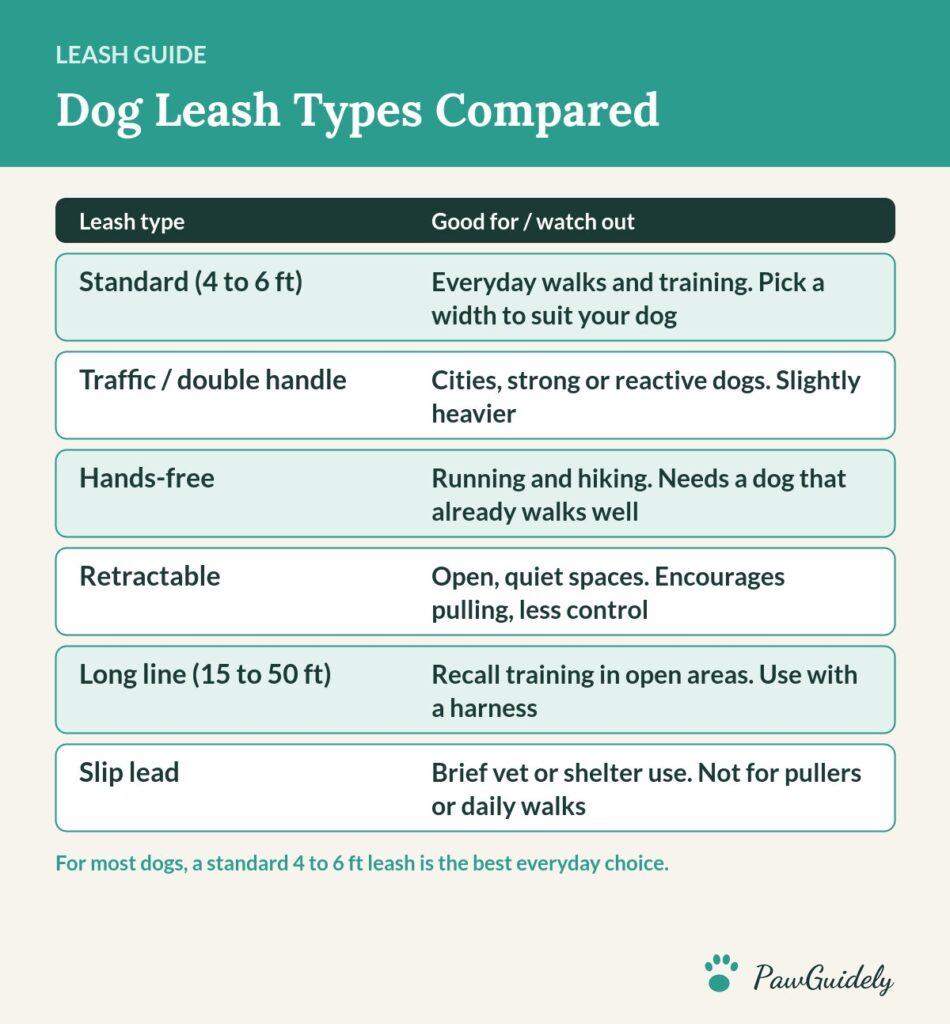
| Type | How It Works | Good For | Watch Out For |
|---|---|---|---|
| Standard (4-6 ft) | Fixed-length webbing or rope | Everyday walks and training | Choose a width that suits your dog’s size |
| Traffic / double handle | Second handle near the clip | Cities, strong or reactive dogs | Slightly heavier |
| Hands-free | Belt around your waist, often with bungee | Running, hiking, pushing a stroller | Needs a dog that already walks well |
| Retractable | Cord or tape on a spring reel | Open, quiet spaces | Encourages pulling, poor control |
| Long line (15-50 ft) | Long fixed lead | Recall training in open areas | Tangles easily; use with a harness |
| Slip lead | Loop tightens around the neck | Brief vet or shelter use | Not for pullers or daily walks |
Which Leash Should You Choose?
| If your dog… | Choose |
|---|---|
| Walks politely on everyday routes | A 5–6 ft standard leash: Ruffwear Front Range or BAAPET |
| Pulls hard or reacts to bikes and dogs | A 6 ft traffic leash (Max and Neo) on a front-clip harness |
| Weighs under 18 lb | BAAPET 1/3-inch rope in 4–6 ft |
| Runs or hikes with you and already walks well | Tuff Mutt hands-free leash |
| Is learning recall | A 15–30 ft long line on a harness |
| Explores open fields with no traffic | Flexi tape, sized by weight |
| Backs out of a flat collar | Any standard leash on a martingale collar or harness |
Buy or Skip
| Leash | Buy if | Skip if |
|---|---|---|
| Ruffwear Front Range | You want a locking clip and traffic handle in one light leash | You need a length other than 5 ft |
| BAAPET Rope | You like a round grip or need a 2, 4 or 6 ft length | You want a traffic handle |
| Max and Neo Double Handle | You walk a strong medium or large dog near traffic | Your dog is a toy breed |
| Tuff Mutt Hands-Free | You run or hike with a dog that walks politely | Your dog lunges at bikes, cats or dogs |
| Flexi New Classic | You walk open, quiet areas and your dog has solid recall | You walk sidewalks or are still training |
How to Walk Your Dog on a Leash
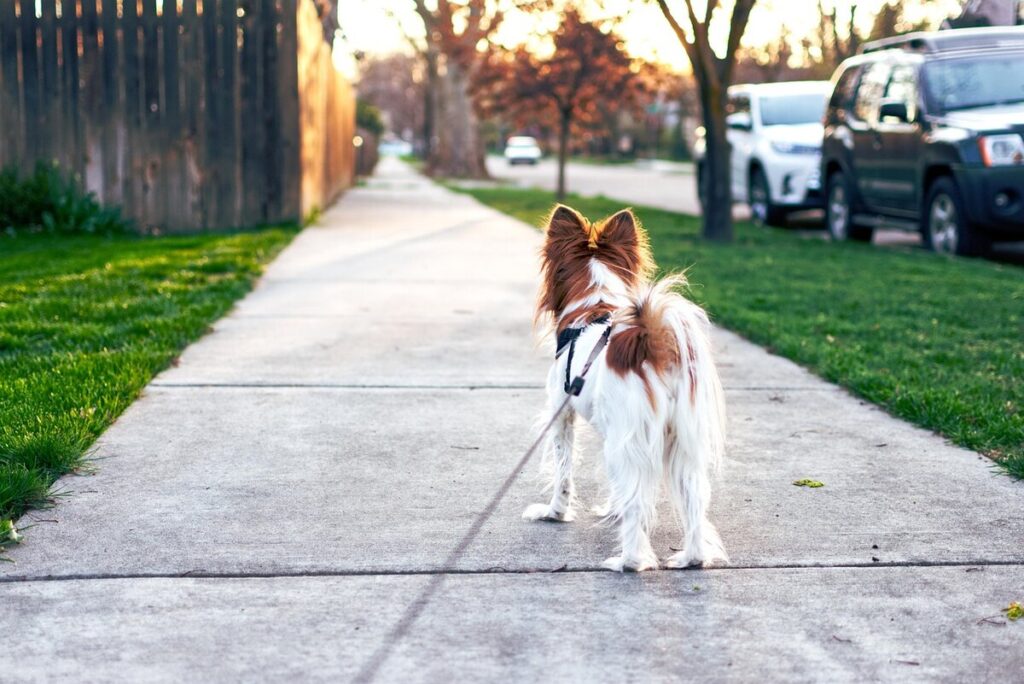
- Clip the leash to a well-fitted harness or flat collar; for pullers, a front-clip harness helps more than any leash.
- Hold the handle with your thumb through the loop and a fold of leash in the same hand, never wrapped around your wrist.
- Reward your dog for walking on a loose leash, and stop moving when it goes tight. Our guide to stopping leash pulling walks through the steps.
- Use the traffic handle or shorten your grip at crossings, near bikes and when passing other dogs.
Common Leash Problems and Fixes
- Leash twists into a coil: the clip is not swiveling. Clean grit out of the swivel or replace the leash.
- Sore hands or rope burn: switch to a padded handle, wear gloves in cold weather and never let the leash slide through your fingers.
- Clip opens on its own: a snap can roll open when twisted against a harness ring. Use a locking clip for strong or twisty dogs.
- Dog grabs and chews the leash: hold it shorter, carry a tug toy to redirect, and retire any leash with chewed fibers.
- Bungee feels slack: elastic sections wear out faster than webbing. Stretch-test it monthly and replace it once it stops springing back.
Care and Replacement
Hand-wash nylon and rope leashes in warm, soapy water and air-dry them; Ruffwear recommends a hand wash with mild detergent for the Front Range. Keep retractable reels dry. Check the stitching near the handle and clip monthly, and replace a leash with fraying, chew damage, a sticking clip or rust.
Our Verdict
For most owners, the Ruffwear Front Range is the best dog leash overall, with its locking clip, padded handle and traffic handle in a light 5 ft leash. Choose the BAAPET rope leash if you want a round grip or a specific length from 2 to 6 ft, the Max and Neo Double Handle for city walks with strong dogs, the Tuff Mutt if you run with your dog, and keep the Flexi for open, quiet places.
Related Guides
- 4 Best No-Pull Dog Harnesses in 2026 (and How to Fit One Properly)
- Dog Harness vs Collar: Is a Harness Better for Your Dog?
- Retractable Leash vs Standard Leash: Which Should You Use?
- Long Line for Dog Training: 3 Best Picks for Recall and Safe Use
- 3 Best Hands-Free Dog Leashes for Running, Hiking and Strollers
- How to Leash Train a Puppy: From First Harness to Loose-Leash Walks
Frequently Asked Questions
What is the best leash length for a dog?
A 5- or 6-foot leash suits most dogs and walks. Use 4 feet on crowded sidewalks and long lines of 15 feet or more only for recall practice in open areas.
Are retractable leashes bad for dogs?
They are a poor choice for everyday walks: they reward pulling, give you less control near traffic, and thin cords can cause burns. Use a tape-style retractable only in open, quiet spaces.
What leash is best for a dog that pulls?
A 6-foot leash with a traffic handle, clipped to a front-clip no-pull harness, gives the most control. Loose-leash training matters more than the leash itself.
How often should I replace my dog’s leash?
Replace it as soon as you see fraying, chew damage, loose stitching or a sticking or rusty clip. A leash used every day often needs replacing every year or two.