
This post contains affiliate links. As an Amazon Associate I earn from qualifying purchases. This costs you nothing extra. See our affiliate disclosure for details.
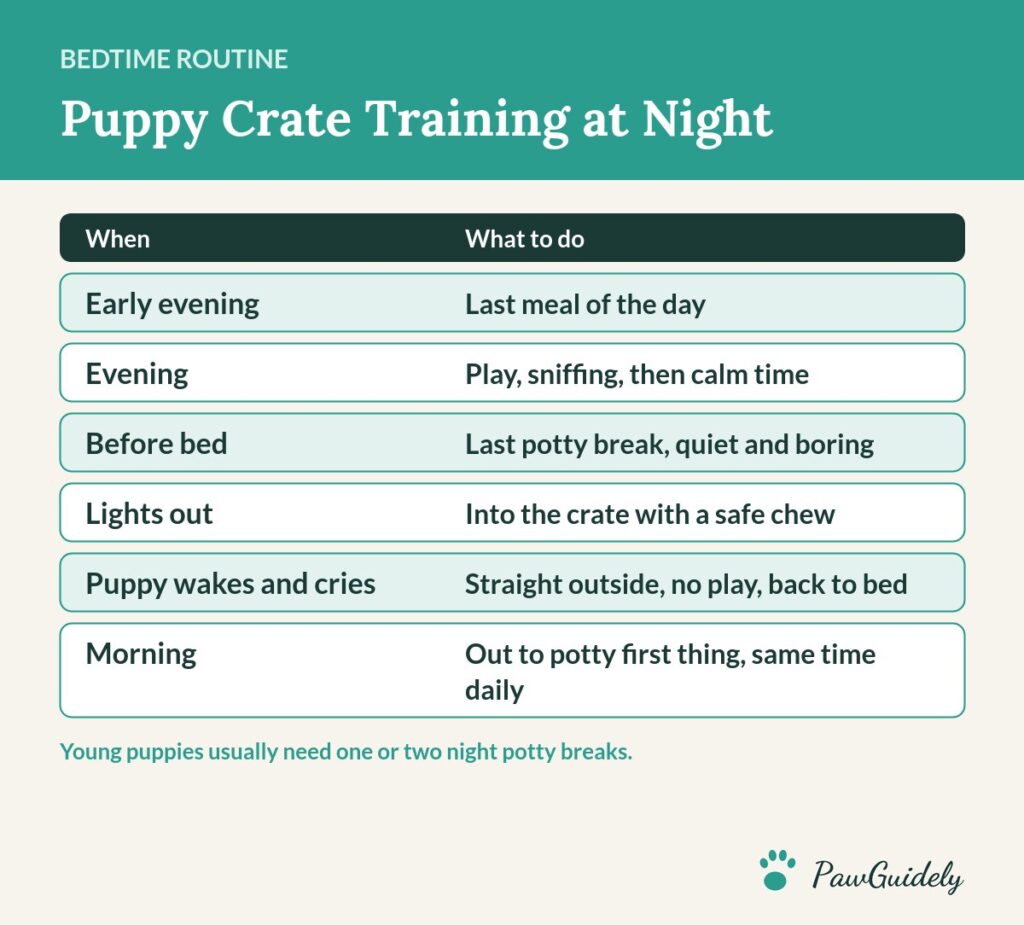
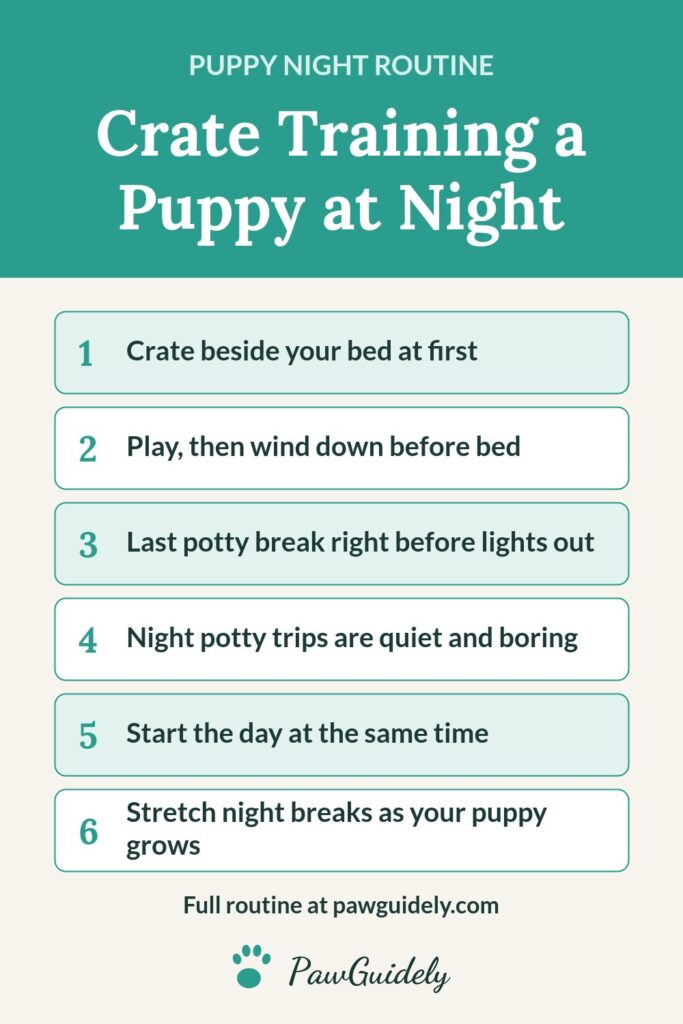
Crate training a puppy at night works best with a simple, repeatable routine: tire your puppy out in the evening, take them out to potty right before bed, settle them in a crate beside your bed, and handle night potty breaks quickly and quietly. Most young puppies cannot hold their bladder all night, so expect to get up once or twice at first. That is normal and it gets easier week by week.
This guide focuses on the night itself, from the evening wind-down to the first potty trip in the morning. For the full day plan, see our crate training schedule by age, and if crying is your main problem, read how to stop a puppy crying in the crate.
Before the First Night: Set Up the Crate
- Right size. Your puppy should be able to stand, turn around and lie down comfortably, with little extra space. A crate with a divider lets you make the space bigger as your puppy grows. Our dog crate size chart helps you choose.
- Right place. Put the crate next to your bed for the first weeks. Your puppy can hear and smell you, and you will hear when they wake.
- Simple bedding. A washable pad or towel is enough. Skip fluffy beds until you know your puppy will not chew them.
- Something safe to chew. A puppy-safe chew toy gives your puppy something to do while they settle.
- Positive practice in the daytime. Feed meals in the crate and toss treats inside so the crate is already a good place before bedtime.
The Evening Routine, Step by Step
- Give the last meal in the early evening. Many trainers suggest feeding dinner a few hours before bed so your puppy has time to digest and go to the toilet before sleep.
- Have an active play session. Ten to fifteen minutes of play, a little training and some sniffing in the yard help use up energy.
- Switch to calm time. In the hour before bed, keep things quiet. A chew, some cuddles on the floor or a short nap near you all help.
- Do the last potty break right before bed. Go to the same spot, wait quietly, and praise when they go. Keep it calm and boring.
- Into the crate. Use the same cue each night, such as “bedtime”, toss a treat in, and close the door.
- Lights out. Keep the room dark and quiet. A partly covered crate helps many puppies settle.
Night Potty Breaks by Age
Puppies sleep longer at night than they can wait during the day, but young puppies still usually need a break. These are rough guides; every puppy is different.
| Puppy age | Night potty breaks (approx.) | Tip |
|---|---|---|
| 8 to 10 weeks | Usually 1 to 2 | Set an alarm or go out when they wake and cry |
| 10 to 12 weeks | Usually 1 | Try to push the alarm a little later each week |
| 3 to 4 months | 0 to 1 | Many start sleeping through |
| 4 to 6 months | Often none | Only go out if they wake and seem uneasy |
You can either set an alarm for a set time or wait for your puppy to wake and fuss. An alarm can prevent accidents in the crate in the very early weeks. Once your puppy has a few dry nights in a row, move the alarm later by 15 to 30 minutes at a time until they sleep through.
How to Handle a Night Potty Break
The goal is to get your puppy out, let them go, and get them back to sleep with as little excitement as possible.
- Keep the lights low. Use a dim light or a phone torch rather than turning on the main lights.
- Carry or lead your puppy straight out. Go to the usual potty spot. Do not stop to play or chat.
- Wait quietly. Give them a few minutes. Praise calmly when they go.
- Go straight back to the crate. No play, no snacks beyond a single small treat if you use one.
- Leave the room dark. Settle back into bed yourself. Most puppies go back to sleep quickly once they learn night trips are boring.
What If Your Puppy Wakes Up and Cries?
First, ask whether they might need the toilet. If it has been a few hours, or they slept less than usual, take them out. If they have just been out, wait for a short pause in the crying before you respond so you do not teach them that noise opens the door. Putting your fingers near the crate or speaking softly is often enough to settle a young puppy who just wants to know you are there.
If crying goes on for a long time every night, look at the daytime routine. A puppy who naps all evening, has not had enough play, or has not spent calm time in the crate during the day is more likely to protest at night.
The Morning Routine
Mornings matter as much as bedtime. Get up at roughly the same time each day and take your puppy straight outside before anything else. Lift them out calmly rather than making a big fuss, so they do not start waking early to get the exciting greeting sooner. If your puppy starts waking earlier and earlier, a crate cover that blocks morning light can help; see our crate cover picks.
Week-by-Week: What Progress Looks Like

- First week: Crate beside the bed, one or two night breaks, some crying at first. Focus on routine, not perfection.
- Weeks two and three: Less crying, fewer wake-ups. Start moving the night alarm later if your puppy stays dry.
- Weeks four to six: Many puppies sleep longer stretches. If you want the crate elsewhere, start moving it a few feet every few nights.
- After that: Most puppies are sleeping through by around four to six months, though some take longer.
Crate, Playpen or Your Bed? Puppy Sleeping Options Compared
Here is how the common choices stack up for a young puppy that is still house-training.
| Option | Good for | Downsides |
|---|---|---|
| Crate in your bedroom | House-training, easy night potty trips, settling a new puppy | Takes bedroom space; you hear every whimper |
| Crate in another room | Owners who sleep lightly, puppies that already sleep through | Harder to hear potty calls; more crying early on |
| Playpen with bed | Puppies that dislike enclosed crates, longer stretches | Room for a toilet corner, so house-training is slower |
| Puppy-proofed small room | Older puppies that are reliably clean | Risk of chewing; puppy may roam and have accidents |
| Your bed | Some owners of older, house-trained dogs | Falls, accidents, and a habit that is hard to undo |
When Can a Puppy Stop Sleeping in a Crate?
There is no set age. Many owners keep using a crate at night until their puppy is through the chewing stage and fully house-trained, which for many dogs is somewhere between 6 months and 2 years. Some dogs choose to keep sleeping in an open crate for life.
Signs your puppy may be ready to try sleeping outside the crate:
- No accidents in the house for several weeks.
- No longer chews furniture, cables or shoes when unsupervised.
- Settles quickly at bedtime and sleeps through the night.
Start by leaving the crate door open at night in a puppy-proofed room. If things go well for a couple of weeks, you can give more freedom. If accidents or chewing start, go back to the crate for a while.
Common Night-Time Mistakes
- Putting the crate in another room on night one. Isolation makes the first nights much harder.
- Playing during night potty trips. Your puppy learns that waking up is fun.
- Skipping the last potty break. It is the single biggest help for a dry night.
- A crate that is too big. Extra space can lead to a potty corner. Use a divider.
- Scolding accidents. Clean up with an enzyme cleaner and take your puppy out sooner next time.
If your puppy has frequent accidents, seems to need to pee very often, or strains to go, ask your vet. Medical issues like urinary infections can look like house training problems.
Gear That Helps
1. MidWest iCrate with Divider — Best Crate for Growing Puppies
A popular folding wire crate that comes with a divider panel, so you can keep the space puppy-sized at night and make it bigger as your puppy grows.
- Divider panel included
- Folds flat
- Removable tray for easy cleaning
Worth knowing: Buy the size your puppy will need as an adult and use the divider in the meantime.
2. KONG Puppy — Best Settling Chew
Stuff a KONG Puppy with part of your puppy’s food and freeze it for a calm chew at bedtime. The softer rubber is made for puppy teeth.
- Made for puppy teeth
- Can be stuffed and frozen
- Easy to clean
Worth knowing: Choose a size that is too big to swallow.
3. MidWest Quiet Time Defender Crate Cover — Best for Early Risers
A fitted cover with roll-up panels. Covering the top and back helps many puppies settle and can block early morning light.
- Roll-up door and side panels
- Fits MidWest wire crates
- Machine washable
Worth knowing: Leave the side facing your bed open, and remove it if your puppy chews it.
Related Guides
- Crate Training Schedule by Age: A Puppy Plan From 8 Weeks to Adult
- How to Stop a Puppy Crying in the Crate (Night and Day)
- 4 Best Dog Crates for Puppies (That Grow With Them)
- 5 Best Dog Crate Pads and Beds: Washable, Chew-Resistant and Orthopedic
- 4 Best Dog Crate Covers for a Calmer, Den-Like Crate
- Dog Crate Sizes: Size Chart by Breed & Weight
- Should You Cover Your Dog’s Crate at Night?
- 12 Crate Training Mistakes to Avoid (and What to Do Instead)
- My Dog Hates the Crate: What to Do
- 3 Best Long Lines for Dog Training and Recall (and How to Use One Safely)
Frequently Asked Questions
Should I crate my puppy at night?
Yes, for most puppies a crate beside your bed is a safe, calm place to sleep and helps with house training. Keep it the right size and plan for night potty breaks.
How many times should I take my puppy out at night?
Young puppies around 8 to 10 weeks usually need one or two night breaks. By three to four months many need one or none. Every puppy is different.
Should I wake my puppy up to pee at night?
In the first weeks, a set alarm can prevent accidents. Once your puppy has several dry nights, move the alarm later bit by bit until they sleep through.
Should I put water in my puppy’s crate at night?
Most owners leave water out of the crate overnight for young puppies and offer it before the last potty break. Ask your vet if your puppy has any health needs.
When can I move the crate out of my bedroom?
Once your puppy sleeps through calmly, usually after a few weeks. Move it gradually, a few feet every few nights, and go back a step if crying returns.
Should I close the crate door at night?
Yes, for a young puppy that is still house-training and chewing. Close it once your puppy is calm and used to the crate. Older, reliable dogs can sleep with the door open.
Can a puppy sleep in a playpen instead of a crate?
Yes. A playpen with a bed works for some puppies, especially those that dislike enclosed spaces. Because there is more room, house-training may take a little longer.
This guide is general advice. Ask your vet about frequent accidents, straining or any health concerns.