
This post contains affiliate links. As an Amazon Associate, PawGuidely earns from qualifying purchases at no extra cost to you. See our affiliate disclosure for details.
The retractable leash vs standard leash question divides dog owners. Retractable leashes give dogs up to 16 feet or more of freedom at the press of a button, while a standard 4- to 6-foot leash keeps your dog close and under control. Most trainers and many vets favor a standard leash for everyday walks, and reserve retractables, if they use them at all, for open, quiet places. Below we compare the two on control, training and safety, and explain when each makes sense.
Retractable Leash vs Standard Leash at a Glance
| Standard Leash (4-6 ft) | Retractable Leash (10-26 ft) | |
|---|---|---|
| Control | High and consistent | Low when extended |
| Training loose-leash walking | Excellent | Works against it; tension is constant |
| Freedom to sniff | Moderate | High |
| Safety near roads and dogs | Good | Poor unless locked short |
| Injury risk | Low | Cord burns, cuts and handle drops |
| Best use | Everyday walks, cities, training | Open, quiet areas with a well-trained dog |
Pros and Cons of a Standard Leash
A standard fixed-length leash is simple, strong and predictable. Your dog always knows how far it can go, and you can shorten it instantly by gathering it in your hand. It is the best tool for teaching loose-leash walking, because the leash only goes tight when your dog pulls, which gives you a clear moment to stop or redirect.
- Pros: reliable control, great for training, safe near traffic and other dogs, durable and inexpensive.
- Cons: less room to roam and sniff, which some dogs and owners miss on quiet walks.
Pros and Cons of a Retractable Leash
A retractable leash is a thin cord or flat tape wound onto a spring-loaded reel inside a plastic handle. The dog can walk out to the full length, and the reel takes up slack as it comes back. A button locks the length. The appeal is obvious: more freedom for the dog without letting it off leash.
- Pros: lets dogs explore in open spaces, no slack dragging on the ground, convenient for well-trained dogs in quiet areas.
- Cons: constant tension teaches pulling, poor control at distance, thin cords can burn or cut skin, and a dropped handle can clatter after a dog and scare it into running.
Retractable Leash Safety Concerns
Retractable leashes cause more problems than people expect. Because a dog can be 16 feet away, it can reach a road, another dog or a person before you can react. Braking a dog running at full speed can jolt its neck. Thin cords have caused burns and cuts to people who grab them or get wrapped up. Handles are easy to drop, especially with cold or wet hands. Using a retractable with a flat collar increases the strain on the neck, so if you use one, attach it to a harness.
Leashes Worth Considering
1. BAAPET Padded Standard Leash — Best Standard Leash
For everyday walks, a padded 5- or 6-foot leash is hard to beat. BAAPET’s leash comes in several lengths and widths, has a comfortable padded handle and reflective stitching, and is inexpensive enough to keep a spare. See more options in our best dog leashes guide.
- Padded handle
- Reflective stitching
- Several lengths and widths
- Affordable
2. FLEXI New Classic Tape Retractable Leash — Best Retractable
If you still want a retractable for open spaces, choose a tape model rather than thin cord. Flexi’s New Classic uses a flat tape that is more visible and less likely to cut, with a one-button brake and lock. Size it by your dog’s weight, and keep it locked short near people, dogs and roads.
- Flat tape instead of thin cord
- Reliable brake and lock
- Sized by dog weight
- Well-known brand
Worth knowing: Not suitable for training, busy areas or dogs that bolt.
3. Long Training Leash (10-100 ft) — Best Alternative
A long line gives a dog room to explore without the constant tension of a retractable. It is a fixed-length leash in lengths from 10 to 100 feet that you let out and gather by hand. Trainers use long lines to practice recall safely. This one is reflective and available in several lengths.
- Freedom without spring tension
- Ideal for recall training
- Many lengths available
- Reflective
Worth knowing: Use with a harness, never a collar, and wear gloves; long lines can tangle and cause rope burn if they run through your hands.
Which Leash Should You Use?
| Situation | Best Choice |
|---|---|
| Everyday neighborhood walks | Standard 5-6 ft leash |
| City sidewalks, crowds, traffic | Standard 4-6 ft leash, ideally with a traffic handle |
| Puppy or dog learning not to pull | Standard leash plus a front-clip harness |
| Recall training in open areas | Long line with a harness |
| Quiet beach or field, trained dog | Tape retractable or long line |
| Strong or reactive dog | Standard leash; avoid retractables |
If your dog pulls, the leash is only part of the fix. A front-clip harness and consistent loose-leash training make the biggest difference. See our guides to the best no-pull harnesses and harness vs collar.
Tips If You Use a Retractable Leash
- Attach it to a harness, not a collar.
- Choose tape over thin cord, and a model rated for your dog’s weight.
- Lock it short near roads, doorways, other dogs and people.
- Never grab the cord or tape with your hand.
- Hold the handle firmly and do not use it with dogs that lunge or bolt.
- Inspect the tape and brake regularly and replace the leash if it frays or sticks.
Our Verdict
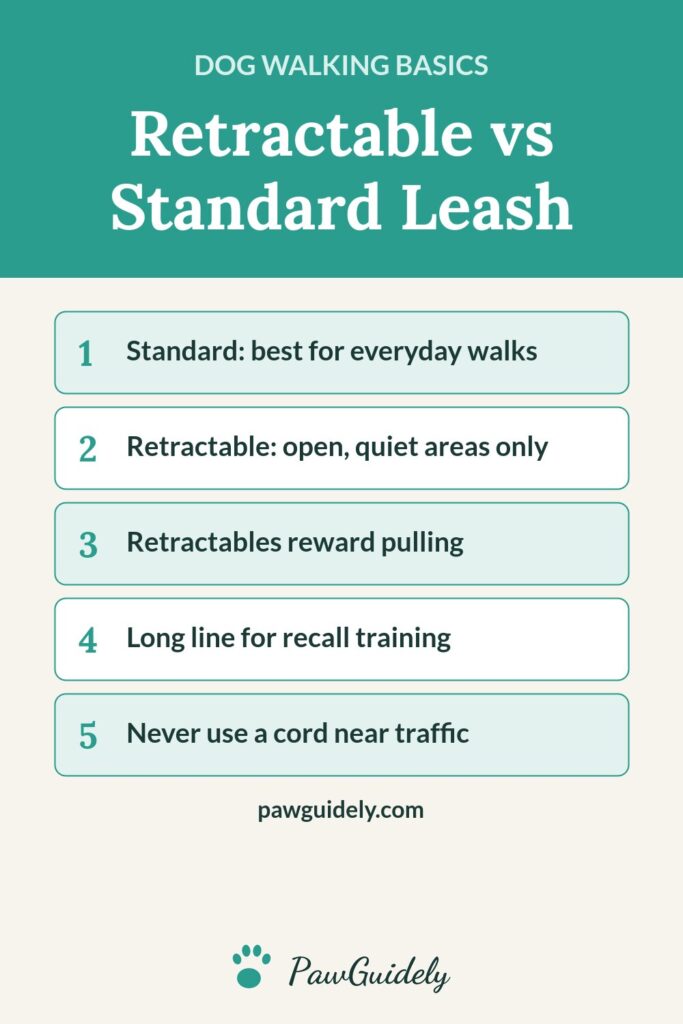
In the retractable leash vs standard leash debate, the standard leash wins for everyday walks, training and safety. A retractable can be useful for a well-trained dog in open, quiet places, but a long line gives the same freedom with better control. For most owners, a padded 5- or 6-foot leash for daily walks and a long line for weekend adventures is the best combination.
Related Guides
- 5 Best Dog Leashes for Everyday Walks, Running and Training
- Dog Harness vs Collar: Which Is Better for Your Dog?
- 4 Best No-Pull Dog Harnesses in 2026 (and How to Fit One Properly)
- 4 Best Dog Treat Pouches for Training and Walks
Frequently Asked Questions
Are retractable leashes bad for dogs?
They are not ideal for everyday walks. They reward pulling, reduce control and can cause injuries. Used carefully in open, quiet areas with a harness, they can be acceptable for well-trained dogs.
Why do trainers dislike retractable leashes?
The spring keeps constant tension on the leash, which teaches dogs that pulling earns more distance. That works against loose-leash training.
What is safer than a retractable leash?
A long line gives your dog room to explore without spring tension, and you control the length by hand. Use it with a harness.
What length standard leash is best?
A 5- or 6-foot leash suits most dogs and situations. A 4-foot leash is useful for busy sidewalks.
Can I use a retractable leash with a collar?
It is better to use a harness. Sudden stops at the end of a long retractable can jolt the neck when attached to a collar.