
This post contains affiliate links. As an Amazon Associate I earn from qualifying purchases. This costs you nothing extra. See our affiliate disclosure for details.
For most cats, the right carrier is about one and a half times your cat’s body length, measured from the nose to the base of the tail, and tall enough for your cat to stand without crouching. An average 8–12 lb cat usually fits a carrier about 18–19 inches long, while large cats and Maine Coons need 20–24 inches or more. This guide explains what size cat carrier you need, how to measure, and when to size up or down.
Cat Carrier Size Chart
Carriers are usually listed by length and a maximum pet weight. Use both. Weight tells you whether the frame and handles can take the load; length and height tell you whether your cat will actually be comfortable.
| Cat Size | Typical Weight | Carrier Length to Look For | Notes |
|---|---|---|---|
| Kitten | Under 6 lbs | 16–18″ | Will outgrow it; consider buying the adult size |
| Small adult | 6–9 lbs | 17–19″ | Most standard carriers fit |
| Average adult | 8–12 lbs | 18–19″ | Look for a rating of 15 lbs or more |
| Large adult | 13–18 lbs | 20–24″ | Hard carriers or structured soft carriers |
| Extra large / Maine Coon | 18 lbs+ | 24″ or larger | Small dog kennels often fit better |
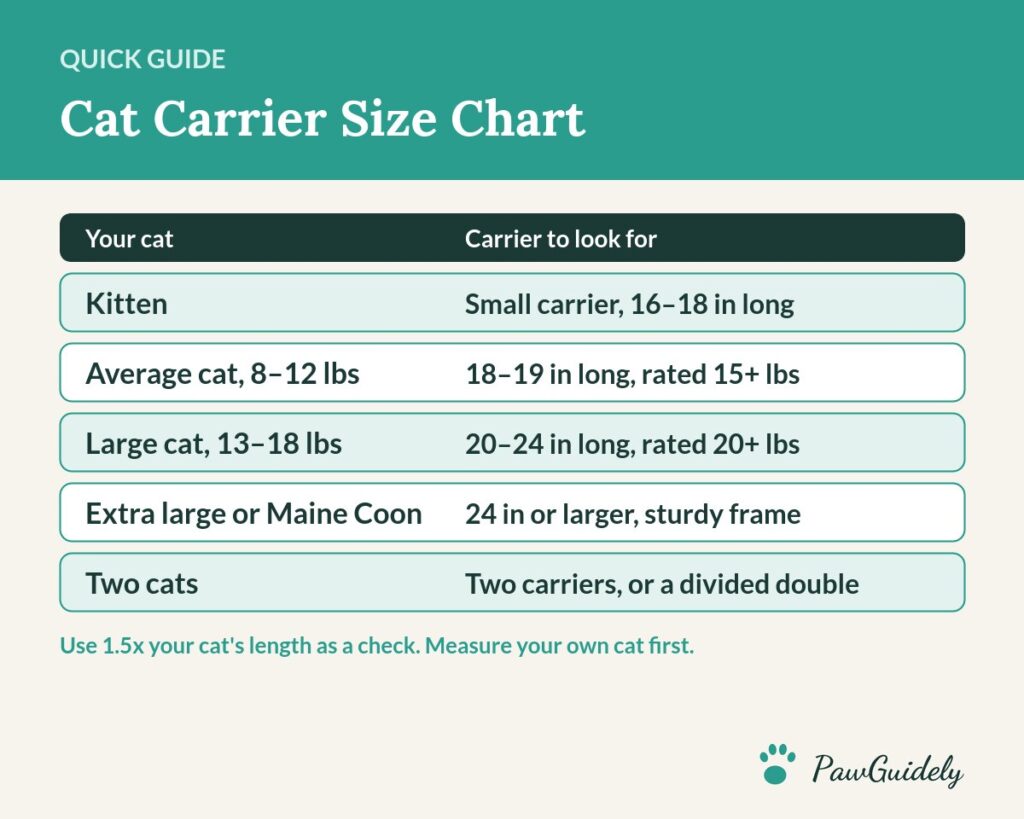
These are typical figures. A long, lean cat may need a bigger carrier than its weight suggests, while a compact, heavy cat may fit a shorter one as long as the weight rating is high enough.
How to Measure Your Cat for a Carrier
You need two numbers: length and height. Measure when your cat is relaxed, and ask a helper to hold treats if your cat won’t stand still.
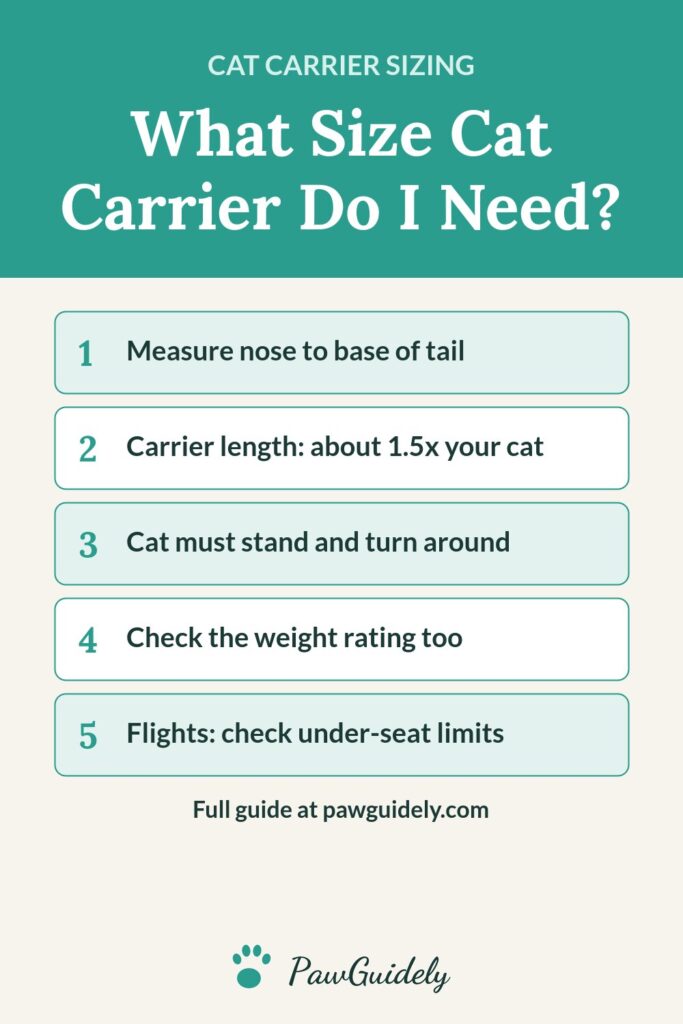
- Length: measure from the tip of the nose to the base of the tail, not the tail tip.
- Height: measure from the floor to the top of the head while your cat is sitting or standing naturally.
- Work out the carrier size: multiply the length by about 1.5 for the carrier length, and add a couple of inches to the height.
- Check the weight rating: make sure the carrier is rated above your cat’s weight, not right at the limit.
Then do the comfort check. Your cat should be able to stand up, turn around and lie down in a natural curled position. If your cat has to crouch or press against the sides, the carrier is too small.
Can a Cat Carrier Be Too Big?
Yes. Many cats feel more secure in a snug space, and in a car a carrier that is much too large lets your cat slide around during braking and turns. A carrier that is far bigger than needed is also heavier and harder to carry. Aim for comfortable, not spacious. If you already own a large carrier, a folded towel or a small bed inside can take up some of the extra room.
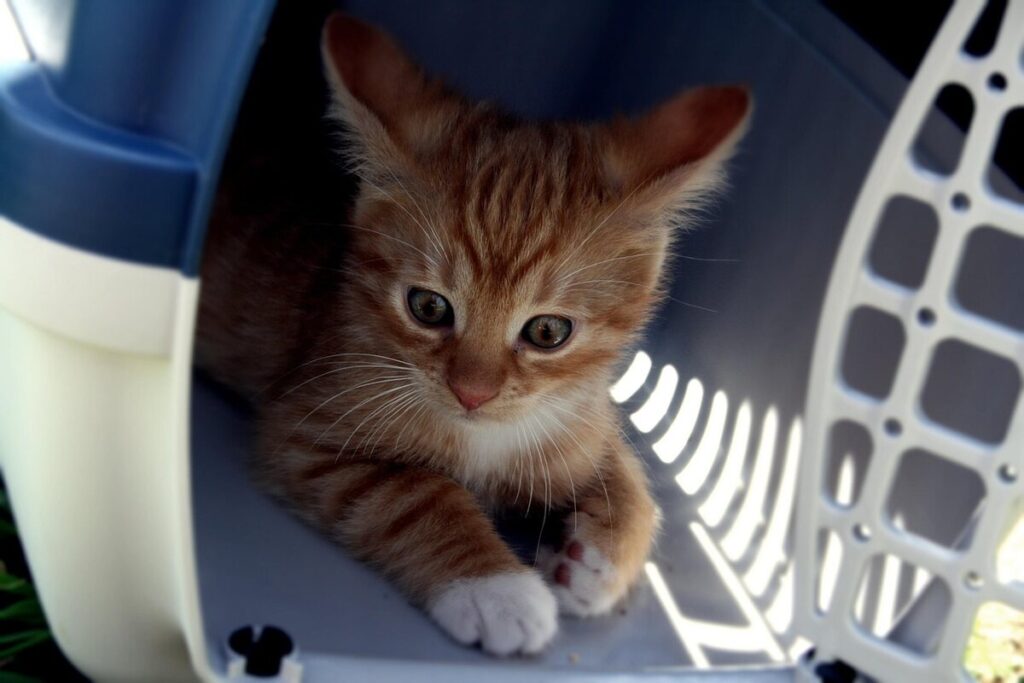
The exception is long trips. For a drive of several hours, a slightly larger carrier with room for a small litter tray or pad can make sense, as long as it is secured in the car.
Hard vs Soft Carriers: Does Size Work the Same?
The same sizing rule applies to both, but they behave differently once your cat is inside.
- Hard carriers keep their shape, so the listed interior space is what your cat gets. They are easier to clean after an accident and stack well in a car, but they are bulky to carry.
- Soft carriers can sag in the middle when lifted, which makes the space feel smaller to a heavy cat. A firm base panel helps. They are lighter and better for flights.
- Top-loading carriers of either type are easier for nervous cats, because you can lower them in rather than pushing them through a front door.
If your cat is near the top of a size range, a hard carrier in that size usually feels roomier than a soft one with the same label.
Sizing a Carrier for Flights
In-cabin carriers must fit under the seat in front of you, and every airline sets its own maximum dimensions. Under-seat limits are often around 17–18 inches long and about 10–11 inches high, but they vary by airline and even by aircraft, so check your airline’s current rules before you buy.
- Soft-sided carriers can squeeze slightly under the seat, which is why most airline carriers are soft.
- Your cat still has to stand and turn around inside, so a very large cat may not qualify for the cabin.
- Airlines usually count the carrier plus cat toward a weight limit, so check that too.
Carriers We Recommend by Size
These carriers appear in our full best cat carriers guide. Check the size options on each listing against your cat’s measurements.
1. Sherpa Original Deluxe — Best for Average Cats and Flights
A soft carrier with mesh panels, a padded shoulder strap and flexible sides that help it fit under airline seats. It comes in more than one size, so you can choose a smaller one for flights or a larger one for car and vet trips.
- Lightweight and easy to carry
- Flexible frame for under-seat storage
- Top and side entry
Worth knowing: Soft carriers are less protective in a crash than hard shells, so secure it well in the car.
2. Sleepypod Air — Best Premium Travel Carrier
A structured carrier designed for air travel, with ends that compress so it can fit under smaller airline seats and then expand again once you are seated. It suits small to average cats.
- Compresses for under-seat loading
- Firm structure with good ventilation
- Doubles as a car carrier
Worth knowing: It costs much more than a basic soft carrier and is not meant for very large cats.
3. Petmate Two Door Top Load Kennel — Best for Vet Visits
A hard plastic carrier with both a front door and a top door, so you can lower an anxious cat in from above and let the vet examine them without tipping them out. It comes in 19-inch and 24-inch sizes.
- Top door makes loading easier
- Easy to wipe clean
- Larger size suits bigger cats
Worth knowing: Hard carriers are bulky and won’t fit under most airline seats.
Large Cats and Two Cats
For cats over about 15 lbs, look for a sturdy hard carrier or a structured soft carrier with a firm base, and carry it with both hands or a shoulder strap. Some owners of very large cats use a small dog kennel, which is fine as long as the cat can be secured and the kennel isn’t far bigger than needed.
For two cats, two separate carriers are usually safer and calmer than one shared one. If you prefer one bag, see our guide to cat carriers for two cats.
Related Guides
- 5 Best Cat Carriers for Vet Trips, Car Rides and Flights
- Best Cat Carriers for Two Cats
- Sleepypod vs Sherpa: Which Pet Carrier Is Better?
- How to Get Your Cat Used to a Carrier
- New Cat Checklist
Frequently Asked Questions
What size carrier does a 10 lb cat need?
Most 10 lb cats fit a carrier about 18–19 inches long that is rated for at least 15 lbs. Measure your cat’s length to confirm.
How big should a cat carrier be compared to the cat?
About one and a half times your cat’s length from nose to tail base, with enough height to stand without crouching.
Is a dog carrier OK for a cat?
Yes. Carriers and small kennels sold for dogs work fine for cats as long as the size and weight rating fit and the doors close securely.
What size carrier does a Maine Coon need?
Many adult Maine Coons need a carrier 24 inches long or more, rated for 20 lbs or higher. A sturdy hard kennel is often the most practical choice.
Carrier sizes and airline rules change. Check the current product listing and your airline’s pet policy before you buy.