
This post contains affiliate links. As an Amazon Associate I earn from qualifying purchases. This costs you nothing extra. See our affiliate disclosure for details.
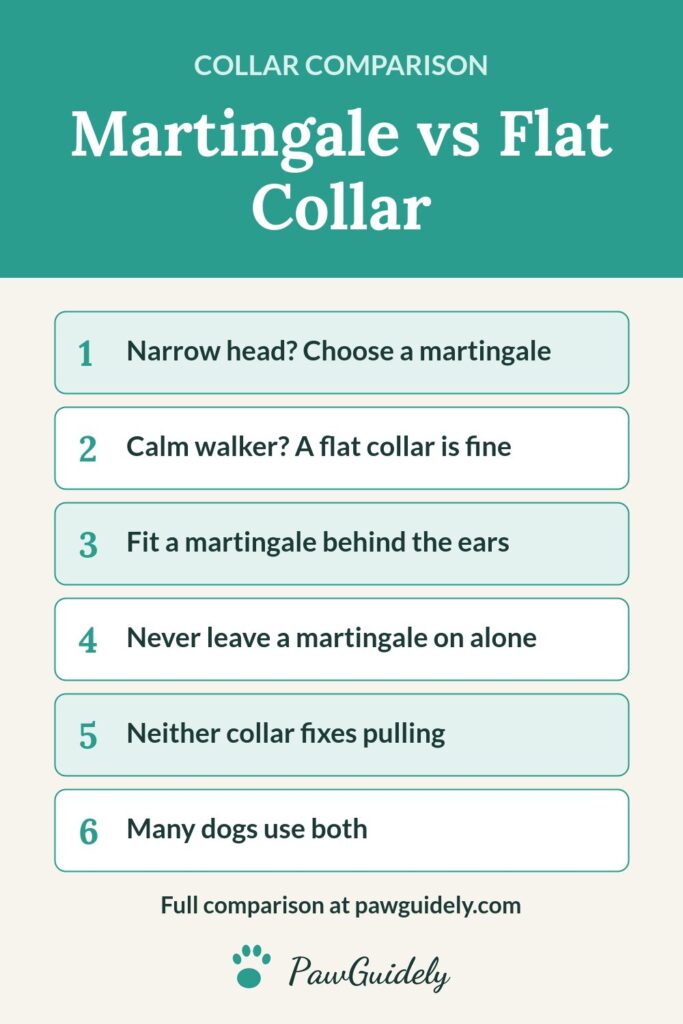
A flat collar is the right everyday collar for a dog that walks calmly and can’t pull its head through it. A martingale is better for dogs whose head is about as narrow as their neck, such as greyhounds, whippets and other sighthounds, and for nervous dogs that back out of collars, because it tightens a limited amount under tension to stop slipping. Neither collar is a fix for pulling; for that, a harness and training work better.
Which One Does Your Dog Need?
Use these rules in order. The first one that matches your dog is usually the answer.
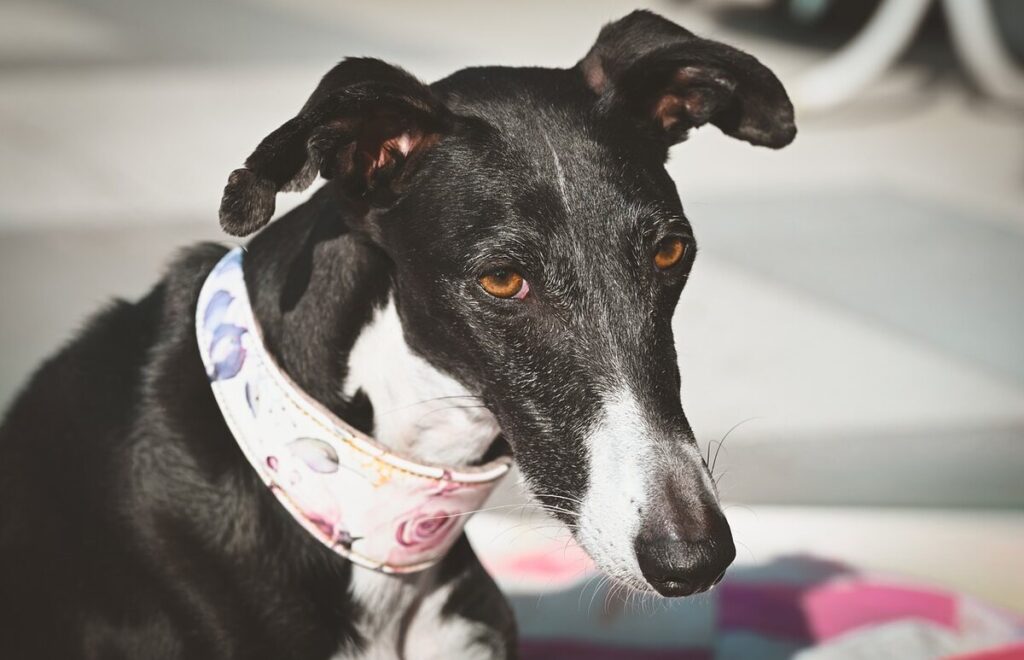
- Has your dog ever slipped a collar? Use a martingale for walks, or a harness.
- Is the head the same width as the neck, or narrower? A flat collar loose enough to be comfortable will slide straight off. Choose a martingale.
- Does your dog pull hard? Put the leash on a harness instead of either collar. See our harness vs collar guide.
- Does the collar stay on all day, including alone or in a crate? Use a flat collar with a quick-release or breakaway buckle. Martingales should come off when you’re not supervising.
- None of the above? A well-fitted flat collar is all you need.
Side-by-Side Comparison
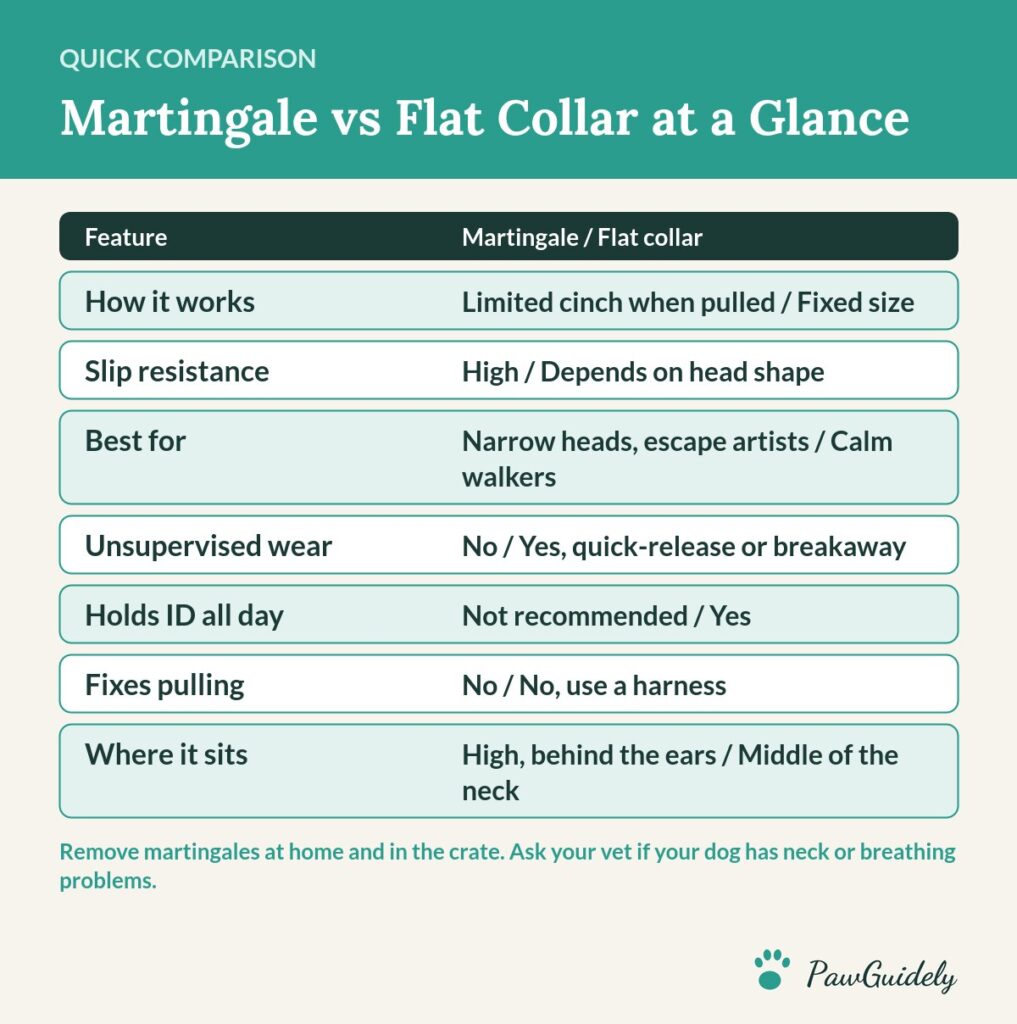
| Martingale collar | Flat collar | |
|---|---|---|
| How it works | Two loops; leash tension closes the small loop, which tightens the large one a set amount | Fixed size set by a buckle or clip |
| Slip resistance | High when fitted correctly | Depends on head shape and fit |
| Pressure when the dog pulls | Increases until the control loop closes | Stays the same, focused on the front of the neck |
| Safe to wear unsupervised | No | Yes, ideally a quick-release or breakaway style |
| ID tags all day | Better on a separate everyday collar | Yes |
| Typical users | Sighthounds, fearful rescues, dogs that back out | Most dogs that walk calmly |
| Where it sits | High on the neck, behind the ears, when tightened | Around the middle of the neck |
How a Martingale Actually Works
A martingale has a large loop that goes around the neck and a smaller control loop that the leash clips to. When your dog pulls back or backs away, the control loop closes and draws the large loop tighter, but only until the two ends of the control loop meet. That built-in stop is the difference between a martingale and a slip lead or choke chain, which keep tightening.
You’ll see two main styles:
- All-fabric control loop: quiet and light. A good choice for dogs that startle at the sound of chain.
- Chain control loop: a short section of chain that makes a small jingle when it closes. Some owners like it as a cue; others find it noisy.
- Slip-on or buckled: classic martingales slide over the head. Buckled versions open like a flat collar, which helps dogs that dislike things pulled over their ears.
How to Fit Each Collar
Fitting a flat collar
- Measure around the middle of the neck with a soft tape and choose the size whose range puts your dog’s measurement near the middle, so there’s room to adjust either way.
- Tighten until two fingers slide flat underneath, not stacked.
- With the collar on, gently draw it forward toward the ears. If it passes over the head with little effort, it’s too loose for that dog, or that dog needs a martingale.
- Recheck weekly on growing puppies and after a big change in coat, such as a grooming clip.
Fitting a martingale
- Slide the large loop over the head and position it high on the neck, just behind the ears, where the head is narrowest.
- Pull the leash ring up to close the control loop. The collar should now be snug against the neck without squeezing.
- If the control loop closes completely and the collar is still loose, shorten the large loop. If it’s tight before the loop has closed much, lengthen it.
- Let the leash go slack. The collar should drop to sit loosely around the middle of the neck.
- Test it: with the loop closed, try to ease the collar forward over the ears. It should stop at the jaw.
Safety Rules That Matter Most
- Take the martingale off at home, in the crate, in the car and anywhere you’re not watching. The loose loop and rings can catch on crate wire, furniture or another dog’s jaw during play.
- Never use a martingale for leash jerks or corrections. It’s designed to stop slipping, not to cause discomfort.
- Don’t use any collar as a tie-out point.
- Check stitching, webbing and hardware regularly, and replace a collar that’s fraying.
- If your dog coughs on walks, has a short-nosed breed, or has any neck or breathing issue, talk to your vet about whether a harness is the better choice.
Common Mistakes and How to Fix Them
| Mistake | What happens | Fix |
|---|---|---|
| Fitting a martingale as tight as a flat collar | Constant pressure even when the leash is slack | Loosen until it hangs loosely mid-neck when relaxed |
| Control loop closes before the collar is snug | The dog can still back out | Shorten the large loop |
| Leaving the martingale on in the crate | Snag risk | Switch to a breakaway or quick-release collar at home |
| Loose flat collar on a sighthound | Slips over the head when the dog backs up | Martingale for walks, or a well-fitted harness |
| Using either collar to stop pulling | Pressure on the throat, coughing, no change in pulling | Front-clip harness plus loose-leash training |
For a training plan that actually changes pulling, see how to stop your dog pulling on the leash.
Can a Dog Wear Both?
Yes, and many owners of escape-prone dogs do. A common setup is a lightweight quick-release flat collar with ID tags worn at home, and a martingale added for walks. Owners of very fearful dogs sometimes clip the leash to both a martingale and a harness so there’s a backup if one fails. If your dog wears a martingale on walks, keep ID on the everyday collar so it’s always there.
Two Collars That Share the Same Sizing
Ruffwear makes a martingale and a flat collar in the same three neck ranges, which makes it easy to run the both-collars setup above.
1. Ruffwear Chain Reaction Collar — Best Martingale for Escape-Prone Dogs
A limited-cinch martingale with a short stainless chain section on the control loop and reflective webbing. Sizes cover necks of 11 to 14, 14 to 20 and 20 to 26 inches.
- Limited cinch stops slipping without continuing to tighten
- Reflective webbing for low-light walks
- Separate ID attachment point and a tag silencer
- Three sizes with clear neck ranges
Worth knowing: the chain makes noise when it closes, which bothers some sound-sensitive dogs, and like every martingale it should come off when your dog is unsupervised.
2. Ruffwear Front Range Collar — Best Everyday Flat Collar
A flat collar with a side-release buckle, in the same 11 to 14, 14 to 20 and 20 to 26 inch neck ranges. It’s 3/4 inch wide in small and 1 inch wide in medium and large.
- Easy side-release buckle
- Separate ID attachment with a quick ring for tags
- Silicone tag silencer included
- Matches the Chain Reaction’s sizing
Worth knowing: a side-release buckle won’t break away under load, so it isn’t a breakaway collar, and on a narrow-headed dog it can still slip off like any flat collar.
Related Guides
- Dog Harness vs Collar: Is a Harness Better for Your Dog?
- 4 Best No-Pull Dog Harnesses (and How to Fit One Properly)
- How to Stop Your Dog Pulling on the Leash When Walking
- 5 Best Dog Leashes for Everyday Walks, Running and Training
- 4 Best Harnesses for Small Dogs
- 5 Best GPS Dog Trackers
- 4 Best Martingale Collars for Escape Artists and Sighthounds
Frequently Asked Questions
Is a martingale collar better than a regular collar?
Only for dogs that can slip a regular collar, such as narrow-headed breeds and nervous dogs that back away. For a calm dog with a wider head, a flat collar does the job and is safer to leave on.
Is a martingale collar cruel?
No, when it’s fitted correctly and not used for corrections. The cinch is limited, so it should tighten to snug and stop.
Can a dog wear a martingale collar all the time?
It’s not recommended. The loose loop can catch on crates and furniture, so remove it when you aren’t supervising.
Does a martingale collar stop pulling?
Not on its own. It stops slipping. For pulling, a front-clip harness and loose-leash training are more effective.
How tight should a martingale collar be?
Snug against the neck when the control loop is pulled closed, and loose around the middle of the neck when the leash is slack.