
This post contains affiliate links. As an Amazon Associate I earn from qualifying purchases. This costs you nothing extra. See our affiliate disclosure for details.
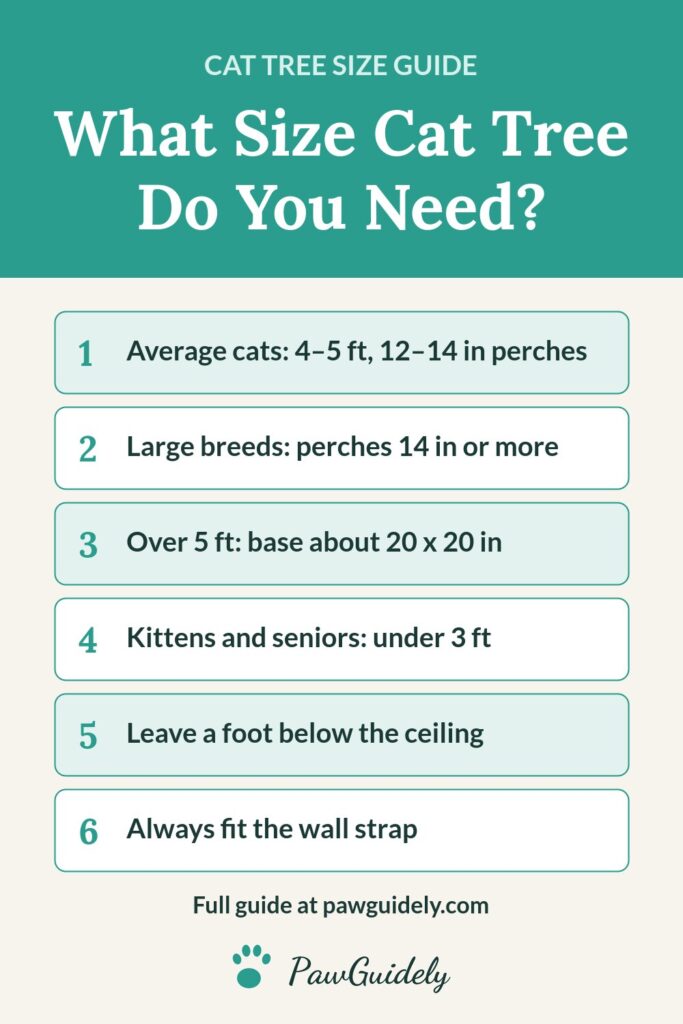
The right cat tree size depends on your cat’s body, not just the tree’s height. Most average adult cats do well with a tree 4 to 5 feet tall with perches around 12 to 14 inches across, while large breeds such as Maine Coons and Ragdolls need perches of 14 inches or more and a heavier, wider base, usually at least 20 inches on each side for trees over 5 feet. Kittens and senior cats are better served by trees under 3 feet with short steps.
Cat Tree Size Chart by Cat Size
| Cat | Typical weight | Tree height | Perch size | Base and stability |
|---|---|---|---|---|
| Kitten | Still growing | 2 to 3 ft | Any; short steps matter more | Small base is fine; plan to upgrade |
| Small or slim adult (Siamese, Devon Rex) | 6 to 9 lb | 3 to 5 ft | About 12 in | Standard base |
| Average adult (domestic shorthair) | 8 to 11 lb | 4 to 5 ft | 12 to 14 in | Wall strap for anything over 4 ft |
| Large breed (Maine Coon, Ragdoll, Norwegian Forest Cat) | 12 to 20 lb or more | 4 to 6 ft | 14 in or more, or deep baskets | Base about 20 x 20 in or larger, plus wall strap |
| Senior or less mobile cat | Any | 2 to 3 ft, or ramps | Wide and padded | Low, steady, few jumps |
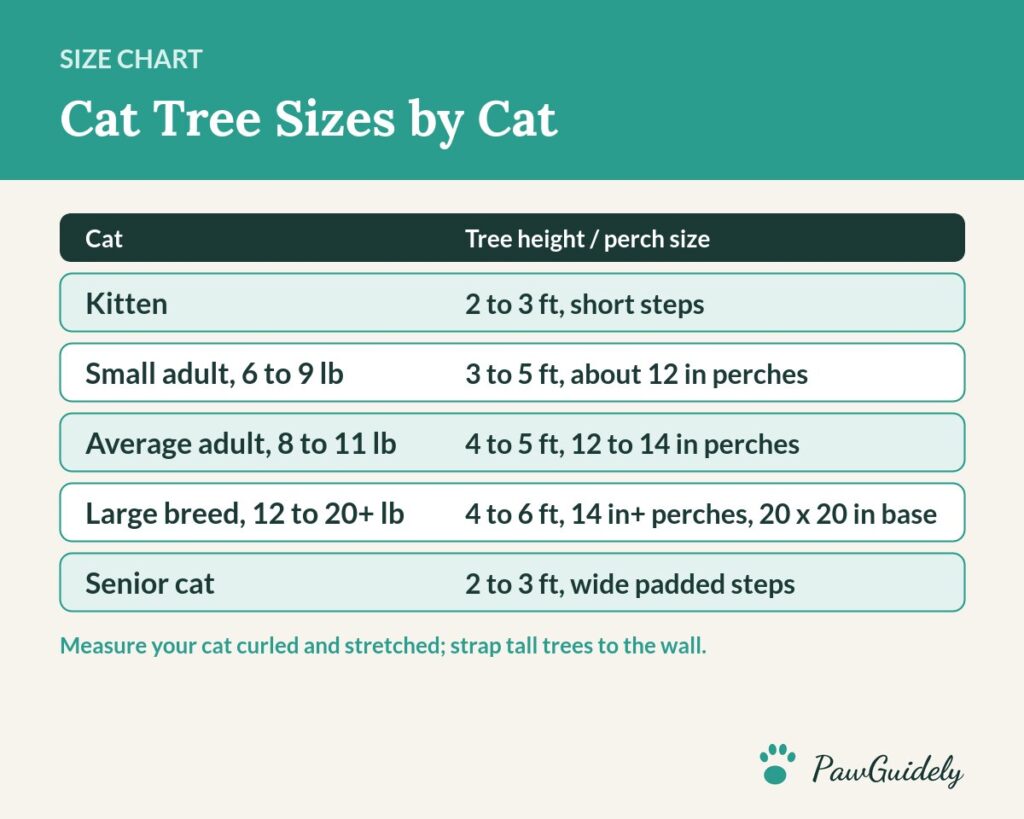
Weights are typical ranges, and plenty of cats sit outside them. A lanky 11 lb cat may need more perch length than a compact 13 lb one, which is why measuring your own cat beats going by breed.
How to Measure Your Cat for a Cat Tree
- Curled length and width: measure your cat while it sleeps curled up. The perch or basket should fit that oval with a little room to spare.
- Stretched length: measure from nose to the base of the tail while your cat lies stretched out. Cats that sleep sprawled need perches close to this length, or they will hang off the edge.
- Full stretch height: watch your cat scratch a door frame and note how high its front paws reach. The scratching post section should be at least that tall.
- Chest width: measure across the widest part of the chest and shoulders. Condo openings should be a couple of inches wider, or big cats will simply ignore the cubby.
- Your ceiling: leave at least a foot between the top perch and the ceiling so a cat can sit up and jump down comfortably.
Height: How Tall Is Tall Enough?
Height is about confidence and territory as much as exercise. A cat that likes to watch the room from above will use a 5 to 6 foot tree; a laid-back cat may never go above the middle level. In multi-cat homes, taller trees with several top-level perches help, because cats can share the space without one sitting directly on top of the other.
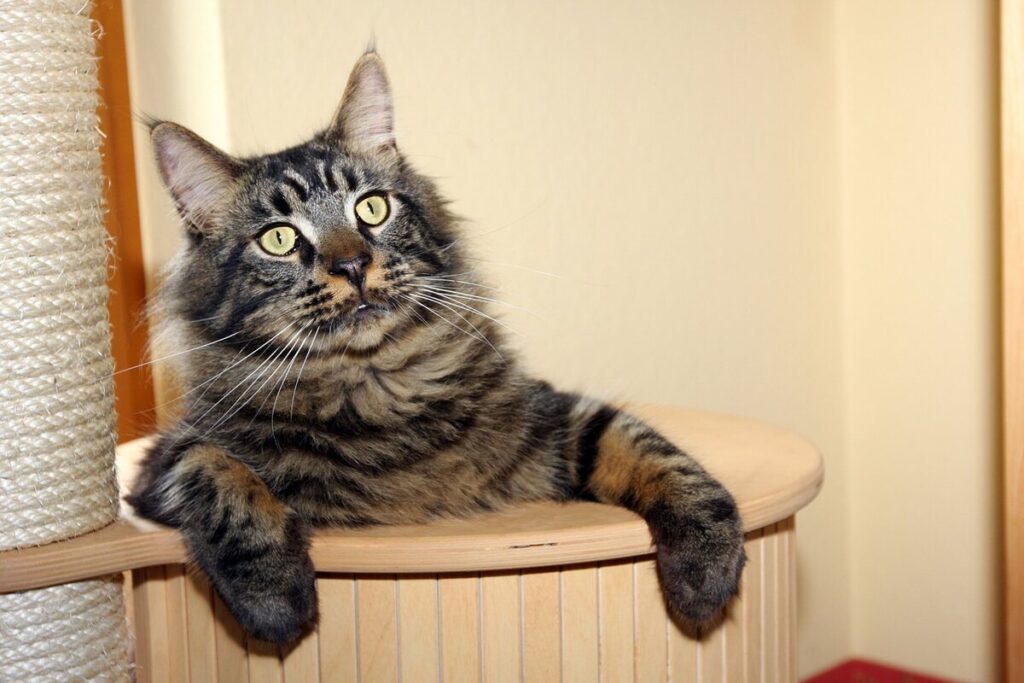
Go lower, not higher, for kittens under about six months, older cats and any cat with stiff joints. Steps about a foot apart are easier than big leaps, and a ramp or wide ledge beats a narrow ladder. If your cat has a health or mobility issue, ask your vet what kind of climbing is sensible.
Base Size and Weight: The Part Big Cats Test
A large cat landing on a top perch puts a lot of sideways force on the tree. The taller the tree, the bigger and heavier the base needs to be. A practical rule: for any tree over 5 feet, look for a base of at least 20 by 20 inches and always fit the anti-tip wall strap. For comparison, the Armarkat 57-inch tree lists a 24 by 20 inch base and the Feandrea multi-level tree lists about 23.6 by 21.7 inches.
- Thicker sisal-wrapped posts, around 3.5 inches or more, feel steadier under a heavy cat than thin ones.
- Metal bolts hold better over time than plastic connectors.
- Corner placement adds support from two walls.
- Large cats often prefer open baskets and flat perches to enclosed cubbies.
Troubleshooting a Tree That Does Not Fit
- The tree wobbles when your cat jumps on: the base is small for the height. Tighten every bolt, fit the wall strap and move it into a corner. If it still sways, it is the wrong tree for that cat.
- Your cat lies with legs or tail hanging off: the perch is too small. Add a wider shelf nearby or choose a tree with bigger platforms.
- The condo is never used: the opening may be too tight or the space cramped. Many big cats just want flat perches.
- Your cat will not go past the first level: the gaps between platforms are too big, or the tree feels unstable. Older cats in particular need shorter steps.
- The sofa still gets scratched: the post is too short or too wobbly for a full stretch. See our guide to stopping furniture scratching.
Upkeep That Keeps a Tree Safe
- Monthly: check and tighten bolts, and test the tree by pushing the top platform sideways.
- Weekly: vacuum perches and baskets to remove hair and litter dust.
- As needed: rewrap or replace sisal posts once they are shredded down to the core.
- When your cat grows: a kitten tree that was fine at 5 lb may be too small and unstable for a 14 lb adult.
Cat Trees at Three Sizes
These three cover small, large and extra-tall setups with dimensions that are published clearly. PawGuidely compares cat trees from specs, manufacturer information and owner feedback.
1. Feandrea Small Cat Tower (18.5 Inch) — Best for Kittens and Tight Corners
A compact tower under 20 inches tall with a padded top perch, a cave and sisal posts, on a footprint of roughly 20 by 15 inches. It suits kittens, seniors and small apartments rather than climbers.
- Low height suits kittens and older cats
- Small footprint fits beside a sofa or window
- Cave gives a hiding spot
- Sisal posts for scratching
Worth knowing: Too low for cats that like to be up high, and the top perch is sized for one small or average cat at a time.
2. Armarkat B5701 57-Inch Cat Tree — Best for Large Cats
A 57-inch tree with a 24 by 20 inch base, 14 by 12 inch perches and a condo about 15 by 14 by 12 inches. Platforms are pressed wood over 3.5-inch sisal-wrapped tubes with metal hardware and a faux fleece covering.
- Wide base for its height
- Perches big enough for many large cats
- Thick posts and metal hardware
- Roomy condo compared with budget trees
Worth knowing: The fleece covering is glued on, so it cannot be removed for washing, and 14 by 12 inch perches can still be snug for the very biggest cats.
3. Feandrea 67-Inch Multi-Level Cat Tree — Best for Tall Climbers and Multi-Cat Homes
A tall, multi-level tree with several perches, caves and a basket. Current listings put it at about 70 inches tall with a footprint of roughly 23.6 by 21.7 inches, and Feandrea markets it for large cats.
- Several top-level perches for more than one cat
- Broad footprint for a tall tree
- Mix of caves, basket and open platforms
- Lots of sisal post surface
Worth knowing: At this height the wall strap is essential, and it will not fit under low or sloped ceilings, so measure your room first.
Related Guides
- Best Cat Trees for Large Cats: Sturdy, Tall and Compact Picks
- Best Cat Trees for Small Spaces and Apartments
- Best Cat Scratching Posts and Scratchers
- Best Cat Window Perches
- How to Stop a Cat Scratching Furniture
- New Cat Checklist
Frequently Asked Questions
How tall should a cat tree be for a Maine Coon?
Usually 4 to 6 feet, but perch size and base matter more than height. Look for perches of 14 inches or more and a base around 20 by 20 inches or larger, and strap it to the wall.
What size perch does a large cat need?
Measure your cat curled up and stretched out. Most large-breed cats need perches of at least 14 inches across, and sprawlers need something closer to their full stretched length.
Is a 3-foot cat tree tall enough?
For kittens, senior cats and laid-back cats, yes. Active adult cats and multi-cat homes usually get more use from a 4 to 6 foot tree.
How big should the base of a cat tree be?
For trees over 5 feet, aim for at least 20 by 20 inches, more for heavy cats, and always use the anti-tip strap.
Should I buy a kitten a full-size cat tree?
A short tree with small steps is safer at first. If you buy a tall tree now, block or remove the upper levels until your kitten is older and more coordinated.