
This post contains affiliate links. As an Amazon Associate I earn from qualifying purchases. This costs you nothing extra. See our affiliate disclosure for details.
The best harness for French Bulldogs is a Y-front design that keeps every strap off the throat, adjusts at the neck as well as the chest, and is light enough not to trap heat. For most adult Frenchies the Ruffwear Front Range is the strongest all-round pick. The Voyager Step-in Air suits smaller Frenchies and puppies that hate things going over their head, and the PetSafe Easy Walk is the budget choice for a Frenchie that pulls.
Below you will find why Frenchies are harder to fit than most small dogs, the size ranges that matter for this breed, and a measuring routine that works on a short neck and a deep chest.
Why a Frenchie Is Harder to Fit Than Other Small Dogs
The AKC breed standard caps French Bulldog weight at 28 pounds, so on paper they look like an easy small-dog fit. Their shape says otherwise: a broad, deep ribcage, a heavy front end, a short thick neck and a large head. That build creates four specific problems.
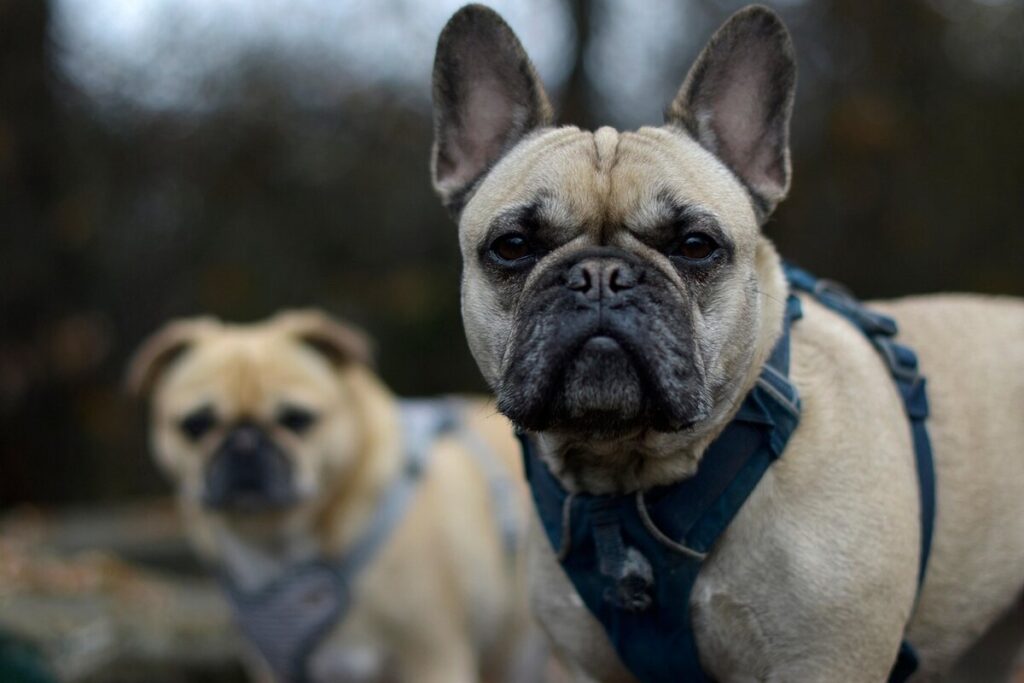
- Neck pressure matters more. Frenchies are brachycephalic (flat-faced), so their airway is already narrow. A collar, or a harness strap that rides up toward the windpipe when the dog leans forward, can make breathing harder. If your Frenchie snores loudly, tires quickly or breathes noisily on easy walks, mention it to your vet.
- Weight charts mislead. So much of a Frenchie’s weight sits in the ribcage that a 22-pound Frenchie can need a bigger chest size than a 22-pound terrier. Size by girth.
- Big head, short neck. Over-the-head harnesses with a fixed neck opening either won’t go on, or are loose enough at the neck for the dog to reverse out.
- Heat. Flat-faced dogs cool themselves poorly, so thick padding and dark fabric on a warm day are a real trade-off, not just a style choice.
Frenchie Harness Picks Compared
| Harness | Style | Sizes that suit Frenchies | Leash points | Best for |
|---|---|---|---|---|
| Ruffwear Front Range | Padded Y-front, side buckles | XS 17–22 in, S 22–27 in girth | Back and chest | Most adult Frenchies |
| Voyager Step-in Air | Mesh step-in vest | Up to 23 in chest (XL is 20.5–23 in) | Two D-rings on the back | Puppies, petite adults, hot weather |
| PetSafe Easy Walk | Strap harness, front clip | Small 15–21 in, Small/Medium 19–26 in girth | Chest only | Pullers, tight budgets |
1. Ruffwear Front Range Harness — Best Overall for Frenchies
The Front Range is a padded Y-front harness that slips over the head and closes with side-release buckles on both sides of the ribcage. It has four adjustment points, which is what makes it work on a Frenchie: you can snug the neck loop separately from the chest strap instead of living with a fixed opening. An aluminum V-ring on the back handles everyday walks, and a reinforced webbing loop on the chest lets you redirect pulling. Ruffwear sizes it on girth alone (XS 17–22 in, S 22–27 in) and recommends the larger size when a dog falls between two.
- Adjustable neck loop as well as chest strap
- Front and back leash attachments
- Foam padding spreads load across a broad chest
- Reflective trim and a small ID pocket
Worth knowing: Foam padding is warmer than mesh, so keep summer walks short and shaded. A Frenchie sitting at the XS/S boundary can take a few adjustments before the neck loop is snug and the belly strap clears the armpits.
2. Voyager Step-in Air Dog Harness — Best for Small Frenchies and Hot Weather
This mesh vest goes on with the front legs, not over the head, and fastens on the back with a buckle backed by hook-and-loop. The listing puts it at about 0.3 lb, and the air-mesh body is about as cool as a walking harness gets, which suits a breed that struggles in heat. The limit for Frenchies is size range: the largest size, XL, covers a 20.5–23 inch chest. Puppies and petite adults usually fit; a broad-chested adult often won’t.
- Nothing passes over that big head
- Very light, breathable mesh
- Reflective bands on both sides
- Two D-rings on the back
Worth knowing: Measure before ordering: if your Frenchie is over 23 inches around the ribs, this harness tops out too early. Owners also report some size runs coming up small or large, and hook-and-loop loses grip with age, so check it each month.
3. PetSafe Easy Walk Harness — Best for Frenchies That Pull
The Easy Walk puts the leash ring on the chest. When the dog pulls, a martingale loop tightens slightly and swings the dog sideways, which takes the reward out of pulling. The strap crosses the breastbone rather than the throat, and the light webbing traps far less heat than a padded vest. PetSafe lists Small for a 15–21 inch girth and Small/Medium for 19–26 inches, with four adjustment points and quick-snap buckles on the shoulder and belly straps.
- Front clip discourages pulling without neck pressure
- Minimal straps stay cool
- Overlapping sizes help between-size dogs
- Low cost
Worth knowing: There is no back ring, and on short-legged dogs a slack leash can drop between the front legs. The lower strap can rub behind the elbows on a deep-chested dog, so check for redness after the first few walks. Treat it as a training tool rather than an all-day harness.
How to Measure a French Bulldog for a Harness
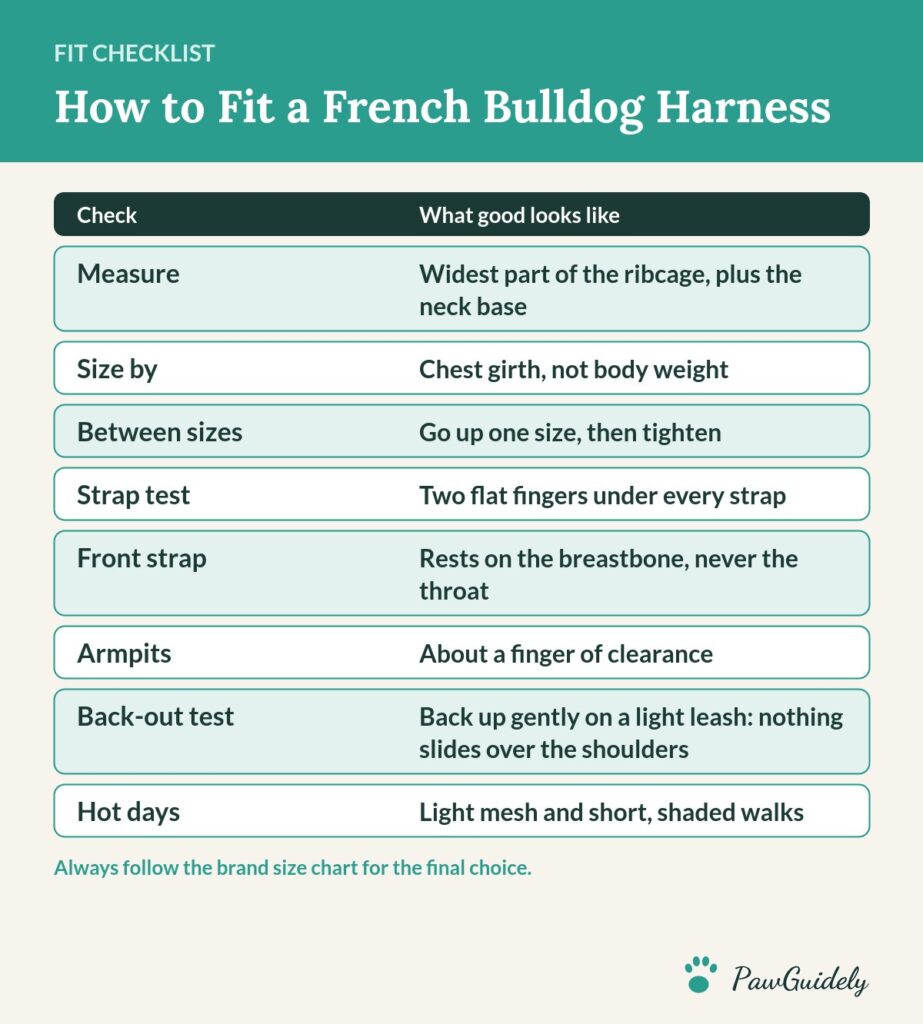
- Use a soft sewing tape. Wrap it around the widest part of the ribcage, usually just behind the front legs. On a Frenchie this is deeper than it looks, so keep the tape level and snug without squeezing.
- Measure the neck at its base, where it meets the shoulders. Harness neck loops sit lower than a collar, so a collar measurement will be too small.
- Compare both numbers with the brand’s chart and ignore the weight column if it disagrees with girth.
- If girth lands between two sizes, Ruffwear and PetSafe both advise taking the larger one and tightening it down.
- Fit check: two flat fingers under every strap, the front panel resting on the breastbone, and the belly strap about a finger’s width behind the armpits.
- Back-out test: step backwards slowly with light tension on the leash. If the harness starts sliding forward over the shoulders, tighten the neck loop first.
Designs That Often Clash With Frenchie Anatomy
None of these is a bad harness in general. They just tend to fight the Frenchie body shape.
- Fixed-neck over-the-head vests. An opening wide enough to clear the skull is usually loose on the short neck, which is how dogs back out on a busy street.
- Straight-front harnesses. A horizontal strap across the shoulders can slide up toward the throat when the dog leans into the leash. A Y-front sits on the breastbone and stays there.
- Thick winter vests for everyday use. Comfortable on a cold morning, too warm for a Frenchie on a mild afternoon.
- Clipping the leash to a collar. Keep a light collar on for ID tags, but walk a flat-faced dog from the harness.
Warm-Weather Walks
No harness fixes heat intolerance. Walk early or late in the day, keep the pace easy, carry water, and stop in shade if breathing becomes loud or labored. Light-colored mesh absorbs less sun than dark padding. If your Frenchie struggles to breathe even on gentle, cool walks, book a vet check rather than switching gear.
Upkeep and When to Replace
- Monthly: buckles click firmly, hook-and-loop still grips, stitching at the leash ring is intact.
- After every few walks at first: look for hair loss or redness in the armpits and across the chest.
- Growing puppies: re-measure every two to three weeks; a harness that fit at 12 weeks can pinch a month later.
- Adults: re-measure after any weight change, since a few pounds on a Frenchie usually shows up in the chest.
- Washing: hand-wash in cool water with mild soap and air-dry; heat can warp buckles and foam.
Quick Decision Rule
Measure the chest first. Over 23 inches: choose the Front Range for daily walks, or the Easy Walk if pulling is the main problem. Under 23 inches and living somewhere hot, or your dog panics at anything going over the head: start with the Voyager. If your Frenchie pulls hard, many owners use a front-clip harness for training walks and a padded back-clip harness for relaxed ones.
Related Guides
- 4 Best Harnesses for Small Dogs (Comfortable and Escape-Resistant)
- PetSafe Easy Walk vs Ruffwear Front Range: Which Harness Is Better?
- Dog Harness vs Collar: Is a Harness Better for Your Dog?
- 4 Best No-Pull Dog Harnesses in 2026 (and How to Fit One Properly)
- How to Stop Your Dog Pulling on the Leash When Walking (8 Steps)
- How to Keep Your Dog Cool in Summer: 12 Practical Tips
- 5 Best Dog Leashes for Everyday Walks, Running and Training
Frequently Asked Questions
What size harness does a French Bulldog need?
There is no single Frenchie size because chest depth varies a lot. Measure ribcage girth and use the brand’s chart; puppies and petite adults can be XS, while broad adults often need a small or small/medium.
Is a harness or collar better for a French Bulldog?
For leash walking, a harness that keeps straps away from the throat. A light collar is still useful for ID tags.
Can French Bulldogs wear a no-pull harness?
Yes. Choose a front-clip design whose strap sits on the breastbone, and check behind the elbows for rubbing during the first week.
How tight should a Frenchie harness be?
Two flat fingers should slide under each strap. Any looser and a short-necked dog can usually reverse out.
Should my Frenchie wear a harness all day?
No. Take it off indoors to let the skin breathe and avoid rubbing, and put it on just before walks.