
This post contains affiliate links. As an Amazon Associate I earn from qualifying purchases. This costs you nothing extra. See our affiliate disclosure for details.
For most owners the best dog training clicker is a button clicker on a finger band, such as the PetSafe Clik-R, because it stays on your hand while you juggle a leash and treats. If your dog is noise-shy, pick a softer clicker like the Karen Pryor i-Click; if you train outdoors or at a distance, a louder box-style clicker carries better. Below are five picks matched to those situations, plus how to charge a clicker and fix the mistakes that make it stop working.
Match the Clicker to the Situation
A clicker only does one job: it tells your dog “that exact moment earned a reward.” The best one is whichever you can press instantly, every time, at a volume your dog finds neutral. Start from where and how you train.
| Your situation | Look for | Pick from this list |
|---|---|---|
| Dog flinches at sudden sounds | Soft, muted click | Karen Pryor i-Click |
| Training on walks with a leash in hand | Finger band, small body | PetSafe Clik-R |
| Park, yard or field work at a distance | Loud, sharp click | StarMark Clicker System |
| Several people training the same dog | Multipack with straps | Downtown Pet Supply 4-pack |
| Brand new to marker training | Clicker plus written guide | Karen Pryor Training Kit |
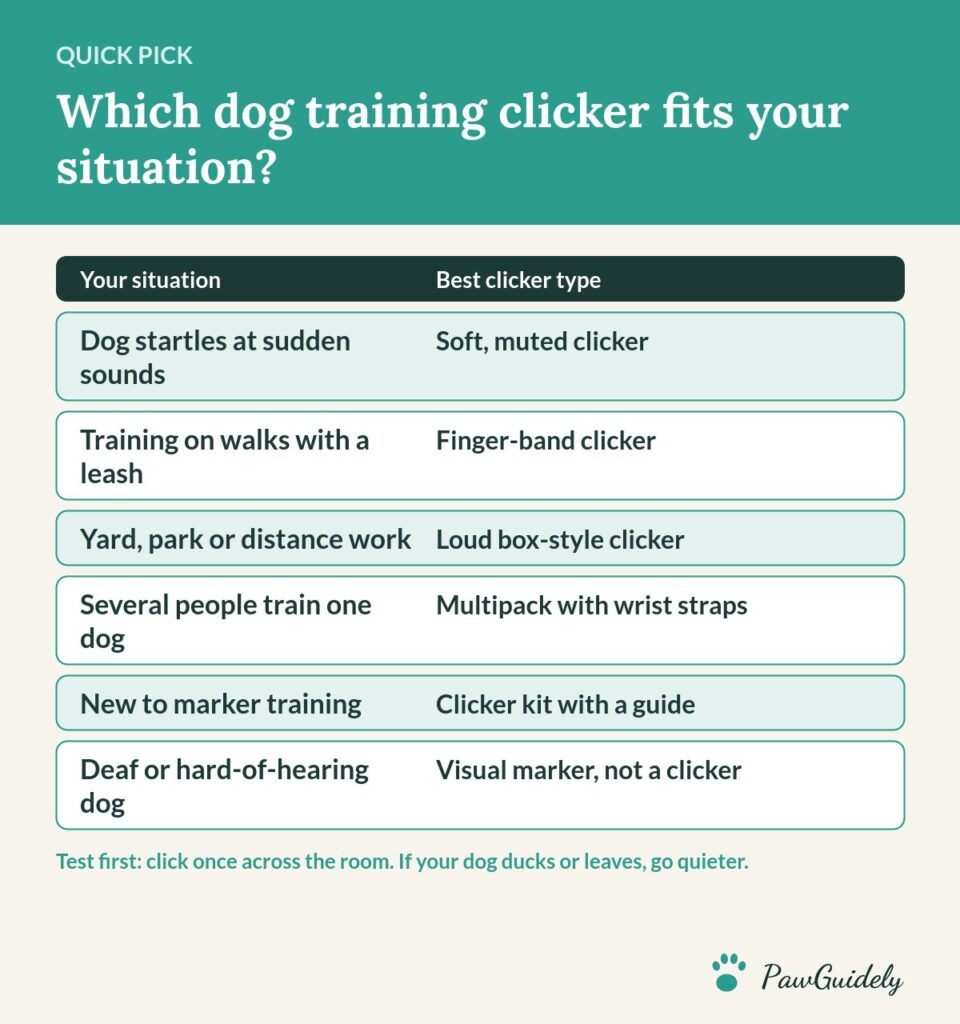
A simple test: click once from across the room before you start. If your dog ducks, freezes or leaves, that clicker is too loud for them right now. Try a quieter model, muffle it in a pocket or behind your back for the first sessions, or use a short marker word instead.
Four Things That Separate a Good Clicker From a Drawer Gadget
- Button feel. Timing is the whole point of a clicker. A stiff button or one you have to hunt for makes you click half a second late, which marks the wrong behavior.
- How it stays with you. A finger band, wrist coil or lanyard means the clicker is in your hand when the good moment happens, not in a bag.
- Volume for your setting. Indoors, a quiet click is plenty. Outdoors, wind, traffic and distance swallow soft clicks.
- Consistency. Box clickers rely on a thin metal tongue. If one gets dropped, wet or bent, the sound can change or go dead, so keep a spare.
Our Picks, Compared From Specs and Owner Feedback
We compared these clickers from manufacturer information and recurring patterns in owner feedback, focusing on button feel, volume and how each one attaches to your hand.
1. PetSafe Clik-R Training Clicker — Best for Everyday Training
The Clik-R sits on an elastic finger band, so the button rests under your thumb while your palm stays free for treats or a leash. It also has a loop if you prefer to hang it on a lanyard. For daily walks and kitchen sessions, this hands-free design is the main reason to choose it over a plain box clicker.
- Finger band keeps it in position without gripping
- Leaves your palm free for treats and a leash
- Light and small enough to forget you are wearing it
- One of the cheaper branded clickers
Worth knowing: It is small and easy to misplace, and some owners report the button starting to stick after heavy use. Buy two if you train daily.
2. Karen Pryor Clicker Training Kit — Best for First-Time Clicker Trainers
This starter kit pairs a clicker with a short getting-started book and trick cards, and listings also mention treat samples. If you have never used a marker before, the written plan helps you avoid the classic mistakes: clicking to get attention, clicking without paying, and moving on too fast.
- Step-by-step material written for beginners
- Trick cards give you ready-made session ideas
- Clicker uses a light-press button
- Good gift for a new puppy owner
Worth knowing: It costs noticeably more than a plain clicker, and if you already know the basics the book adds little. A few owners report the button not registering every press.
3. StarMark Clicker Dog Training System — Best for Outdoor Training
StarMark’s clicker has a loud, sharp sound and comes with a step-by-step training guide. It weighs about 0.4 ounces and measures roughly 2.3 by 1.5 inches, so it fits a pocket easily. The volume is the reason to pick it: it cuts through wind and background noise when your dog is ten or twenty feet away.
- Loud click that carries outdoors
- Compact and very light
- Includes a written training guide
- Large press area
Worth knowing: That volume can startle sensitive dogs indoors, it has no wrist strap, and owners often describe the button as stiff at first.
4. Downtown Pet Supply Training Clickers (4-Pack) — Best for Families
Four clickers in different colors, each with a wrist strap and a large button. In a house where several people train the same dog, everyone gets their own, and color coding makes it easy to leave one by the door, one in the car and one in the treat pouch.
- Four clickers for the price of one or two premium models
- Wrist straps on each clicker
- Big button that is easy to find without looking
- Colors help you spot a dropped clicker
Worth knowing: Some owners find the click not loud enough for distance work outdoors, and the build is lightweight plastic.
5. Karen Pryor i-Click — Best for Noise-Sensitive Dogs
The i-Click has a raised button and a softer click than a traditional box clicker, which makes it the usual recommendation for dogs who startle at sharp sounds. The listing notes it can be pressed with a thumb, a palm or even a foot, and it tends to land button side up when dropped.
- Quieter click suits noise-shy dogs and small rooms
- Raised button can be pressed from several angles
- Can be clicked with your foot when both hands are busy
- Lands in a clickable position if dropped
Worth knowing: the softer sound is easy to lose outdoors or across a busy park, and it is usually sold in multipacks, so you may pay for more clickers than you need.
Your First Clicker Session, Step by Step
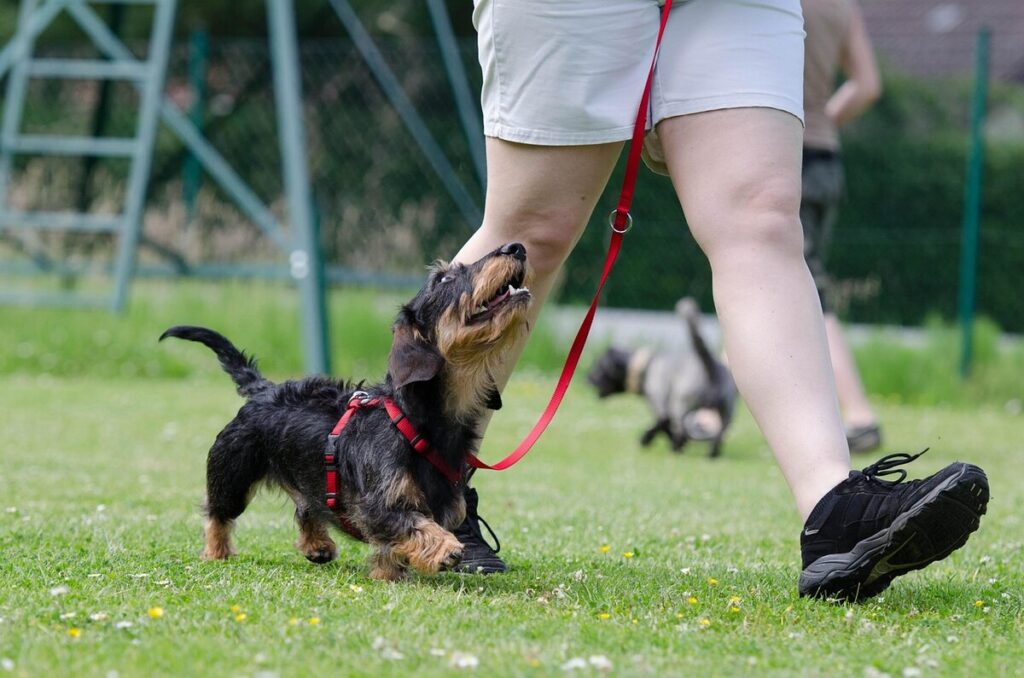
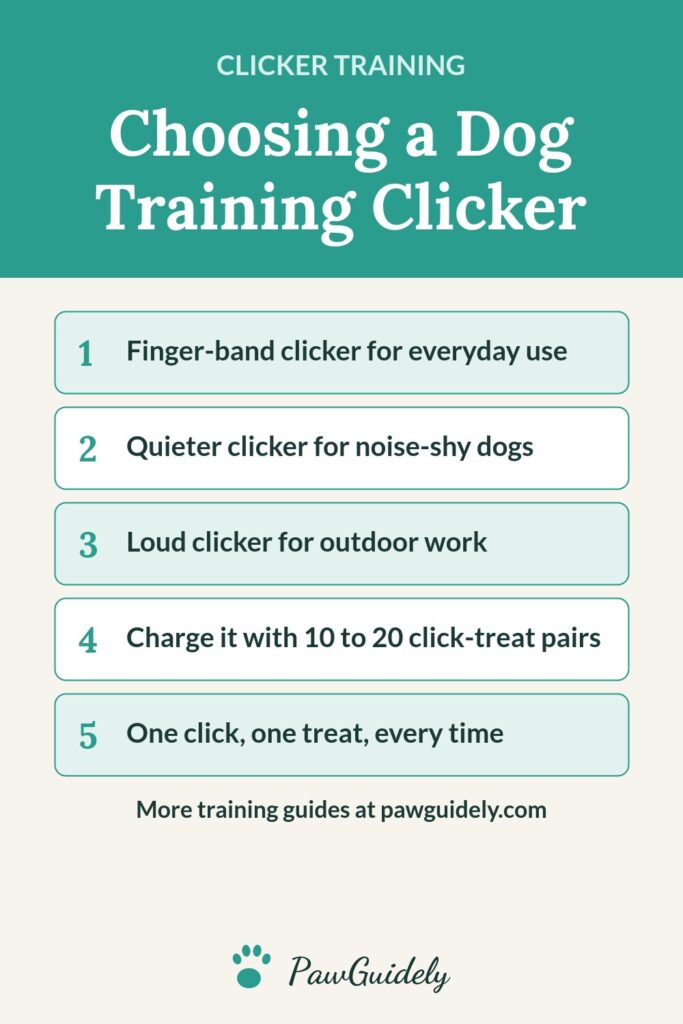
- Charge the clicker. Click, then hand over a treat. Repeat 10 to 20 times in a quiet room. Your dog doesn’t need to do anything yet; you are teaching that the sound predicts food.
- Check the connection. Wait until your dog looks away, then click. If their head snaps toward you, the clicker is charged.
- Pick one easy behavior. Eye contact or touching your palm with their nose are good starters because they happen naturally and quickly.
- Click the instant it happens. Click during the behavior, not after your dog has moved on. Then deliver the treat within a second or two.
- Keep it short. Three to five minutes, then stop while your dog is still keen. Two or three short sessions a day beat one long one.
When the Clicker Stops Working: Troubleshooting
- Your dog ignores the click. You may have clicked without treating too often. Recharge it with ten quick click-treat pairs and pay every click from now on.
- You click to call your dog. The clicker marks a behavior; it isn’t a recall. Use your dog’s name or a recall cue for that.
- Your dog stares at your treat hand. Keep treats in a pouch or behind your back and only reach for one after the click.
- The wrong behavior keeps getting rewarded. Your click is late. Practice timing without your dog: bounce a ball and click each time it hits the floor.
- Your dog seems worried by the sound. Stop, switch to a quieter clicker or a marker word, and charge it again at a lower volume.
Clicker or Marker Word: Which Should You Use?
The trade-off is precision against convenience. A clicker sounds identical every time and is faster than speaking, which helps when you are shaping small movements or teaching tricks. A word such as “yes” is always with you and leaves both hands free, but it changes with your tone and mood. Many owners use the clicker for teaching new skills and switch to a word once the behavior is solid.
Skip the clicker if…
- You won’t carry it. A marker word you use consistently beats a clicker that lives in a drawer.
- Your dog is deaf or hard of hearing. Use a visual marker such as a thumbs-up or an open-hand flash instead.
- Your dog stays nervous of the sound after a few gentle sessions. A calm marker word does the same job.
Related Guides
- 4 Best Dog Treat Pouches for Training and Walks
- How to Stop Your Dog Pulling on the Leash When Walking
- 15 Indoor Games for Dogs and Puppies
- 5 Best Dog Puzzle Toys, From Beginner to Genius Level
- New Puppy Checklist: 25 Essentials
- How to Potty Train a Puppy
Frequently Asked Questions
Do you have to give a treat every time you click?
Yes. Each click is a promise of a reward, and skipping the treat weakens what the click means. Once a behavior is reliable, stop clicking for it and use praise or life rewards instead of clicking without paying.
How old does a puppy need to be for clicker training?
Puppies can start as soon as they come home, often around 8 weeks. Keep sessions to a minute or two and use tiny, soft treats.
Will I need a clicker forever?
No. The clicker is for teaching. Once your dog responds reliably to the cue, you can fade the clicker and reward with treats, play or praise.
Can a clicker stop barking?
Not on its own. You can click and reward moments of quiet or an alternative behavior, but clicking while your dog is barking rewards the barking.