
This post contains affiliate links. As an Amazon Associate, PawGuidely earns from qualifying purchases at no extra cost to you. See our affiliate disclosure for details.
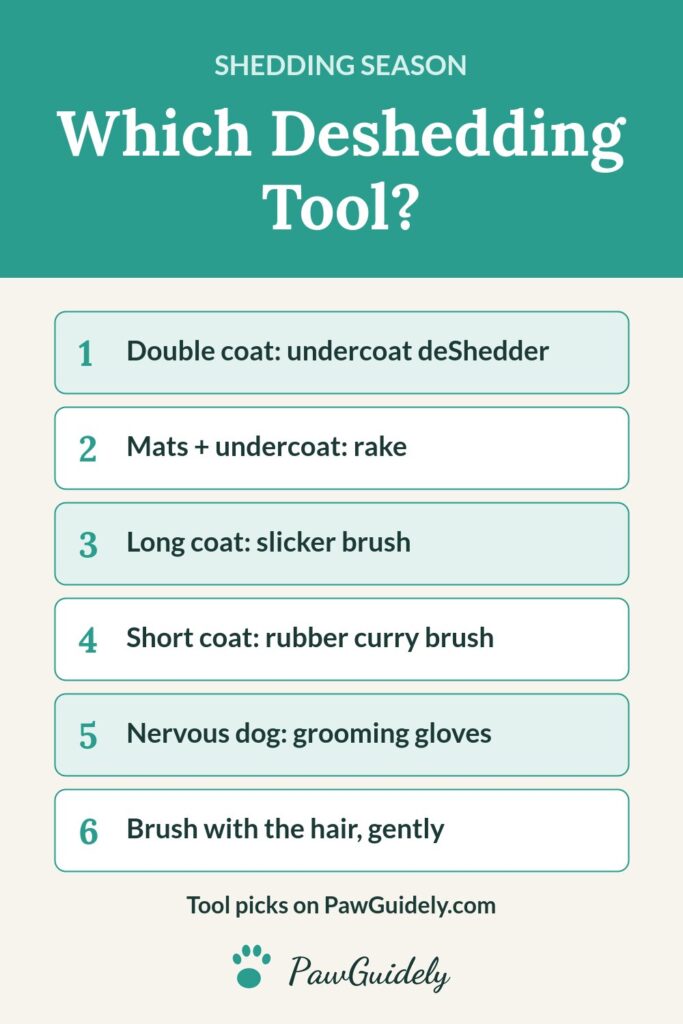
No single brush works for every dog. Blade-style deshedders are brilliant on thick double coats but can irritate short, fine coats; rubber curry brushes are perfect for short-haired dogs but barely touch a Husky’s undercoat. Below we match six popular tools on Amazon to the coats they handle best, based on manufacturer details and hands-on reviews.
Quick Comparison
| Tool | Type | Best Coat Type |
|---|---|---|
| FURminator Undercoat deShedding Tool | Blade deshedder | Thick double coats (Huskies, Shepherds, Retrievers) |
| Hertzko Deshedding Tool | Curved blade | Most coat types, small to large dogs |
| Pat Your Pet Undercoat Rake | Double-sided rake | Dense undercoats with tangles or mats |
| Hertzko Self-Cleaning Slicker Brush | Slicker brush | Long, medium and curly coats |
| KONG ZoomGroom | Rubber curry brush | Short, smooth coats |
| Pat Your Pet Grooming Gloves | Glove | Nervous dogs, quick daily touch-ups |
1. FURminator Undercoat deShedding Tool — Best for Double Coats
The FURminator is the tool most owners of heavy shedders swear by. Its stainless steel edge reaches through the topcoat to pull out loose undercoat, and a button ejects the collected hair. It comes in sizes and in long-hair and short-hair versions, so pick the one that matches your dog (the link goes to the large, long-hair version for dogs over 50 lbs).
- Removes large amounts of loose undercoat
- Hair ejector button for easy cleanup
- Sizes and versions for different dogs
- Ergonomic handle
Worth knowing: it’s powerful, so use light strokes and don’t overdo it. Once a week is plenty outside of heavy shedding season, and it’s not suited to low-shedding or very fine coats.
2. Hertzko Deshedding Tool — Best All-Rounder
Hertzko’s deshedder uses a curved stainless steel edge that follows the shape of your dog’s body, which reviewers find gentler on the skin than a straight blade. It works on short to long coats and on dogs of all sizes, which makes it a good first tool if you’re not sure what your dog needs.
- Curved edge is gentler on skin
- Works on short to long coats
- Suitable for small to large dogs
- Also works on cats
Worth knowing: as with any blade tool, go gently and stop if the skin looks red.
3. Pat Your Pet Double-Sided Undercoat Rake — Best for Mats and Tangles
This affordable rake has two sides: one with fewer, wider teeth to work through tangles and mats, and one with more teeth to pull out loose undercoat. It’s a great choice for thick, long coats that knot easily, like Collies, Newfoundlands and Bernese.
- Two sides: dematting and deshedding
- Good for thick, tangle-prone coats
- Affordable
- Works on dogs and cats
Worth knowing: the dematting side has sharp edges, so work slowly around mats and never pull on the skin.
4. Hertzko Self-Cleaning Slicker Brush — Best for Long and Curly Coats
A slicker brush is the everyday tool for long, medium and curly coats. Its fine wire bristles remove loose hair and light tangles, and the self-cleaning button retracts the bristles so the collected hair wipes straight off. Regular use between deeper deshedding sessions keeps coats from matting.
- Fine bristles remove loose hair and small tangles
- Self-cleaning retracting bristles
- Good for daily brushing
- Comfortable grip
Worth knowing: it won’t reach deep into a thick double coat like a deshedder or rake, so double-coated dogs benefit from both.
5. KONG ZoomGroom — Best for Short Coats
For short, smooth coats like Labs, Beagles, Boxers and Pit Bulls, a rubber curry brush does the job better than any blade. The ZoomGroom’s soft rubber fingers loosen dead hair and massage the skin, and it works in the bath to lather shampoo. Most dogs love it.
- Ideal for short, smooth coats
- Gentle rubber massages the skin
- Works wet or dry, great at bath time
- Inexpensive and durable
Worth knowing: it doesn’t hold on to hair, so brush outdoors or wipe up afterward, and it’s not effective on long coats.
6. Pat Your Pet Grooming Gloves — Best for Nervous Dogs
Some dogs won’t tolerate a brush but happily accept being petted. Grooming gloves have soft rubber tips on the palm and fingers, so you remove loose hair while stroking your dog. They’re also handy for quick touch-ups before visitors arrive.
- Feels like petting, great for anxious dogs
- Left and right gloves for faster grooming
- Works on short and long coats
- Washable
Worth knowing: they remove less hair than a dedicated deshedding tool, so they’re a complement rather than a replacement for heavy shedders.
How to Deshed Your Dog Without Irritating the Skin
- Work on a dry, tangle-free coat. Remove mats first with a rake or comb.
- Brush in the direction the hair grows. Never brush against it.
- Use light pressure. Deshedding tools are designed to do the work. Pressing hard can scratch the skin.
- Keep sessions short. 10 to 20 minutes, a few times a week during heavy shedding, is better than one long session.
- Check the skin. Stop if you see redness or your dog becomes uncomfortable.
Low-shedding breeds such as Poodles and Bichons generally don’t need deshedding tools; a slicker brush and comb are a better fit. Pair regular brushing with nail care, too; our dog nail grinder guide covers the tools.
Related Guides
- 4 Best Dog Nail Grinders in 2026 (Plus How to Grind Without Hitting the Quick)
- 4 Best Slow Feeder Dog Bowls in 2026 for Dogs That Eat Too Fast
- 5 Best Dog Crate Pads and Beds in 2026: Washable, Chew-Resistant and Orthopedic
Frequently Asked Questions
How often should I use a deshedding tool?
For most double-coated dogs, once or twice a week, and more during seasonal coat blows in spring and fall. Blade tools used too often can thin the coat and irritate the skin.
Is the FURminator bad for dogs?
Used gently and not too often, it’s widely used and safe for suitable coats. Problems usually come from heavy pressure or overuse, or using it on fine, single coats it isn’t designed for.
Can deshedding tools be used on cats?
Many can, including the Hertzko, the Pat Your Pet rake and grooming gloves. Cats have thinner skin, so use very light pressure.
Does bathing help with shedding?
Yes. A bath loosens dead hair, and brushing afterward, once the coat is dry, removes much more of it. A rubber curry brush like the ZoomGroom helps during the bath itself.