This post contains affiliate links. As an Amazon Associate I earn from qualifying purchases. This costs you nothing extra. See our affiliate disclosure for details.
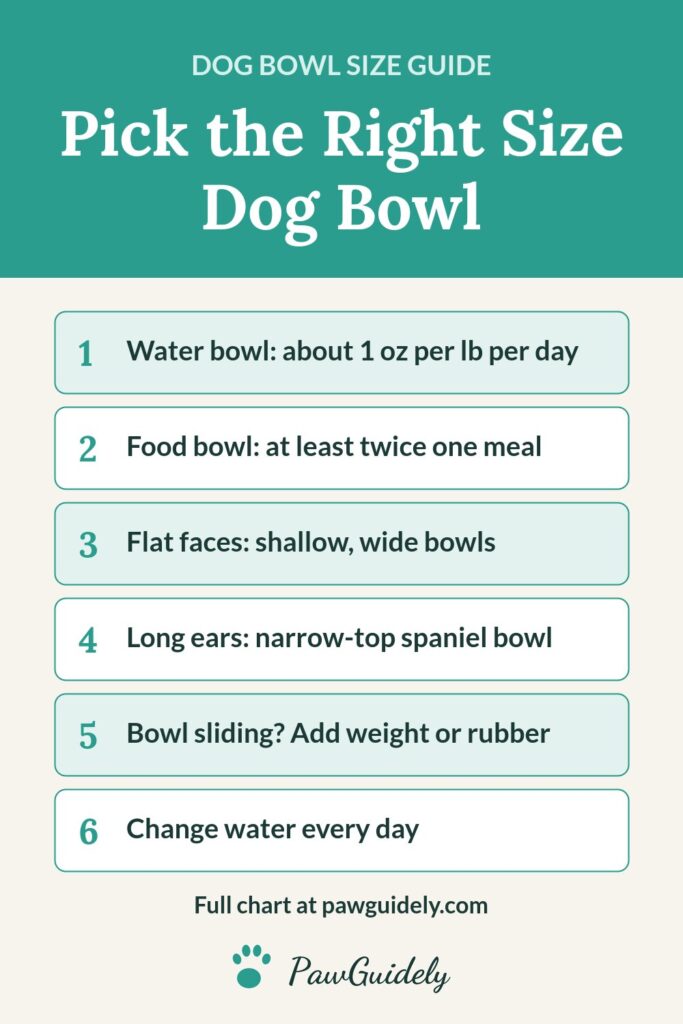
For most dogs, the food bowl should hold about twice one meal so kibble stays inside the rim, and the water bowl should hold roughly a day’s water, which is about one ounce per pound of body weight as a starting point. That works out to a 1 to 2 cup food bowl for toy breeds, 3 to 4 cups for medium dogs and 6 cups or more for large and giant breeds. The chart below turns this into dog bowl sizes by weight, then covers the shape and depth that suit flat faces, long ears and messy drinkers.
Dog Bowl Size Chart by Weight
| Dog weight | Rough daily water | Water bowl to buy | Food bowl to buy | Example breeds |
|---|---|---|---|---|
| Under 10 lb | Up to about 10 oz | 2 cups (16 oz) | 1 to 1.5 cups | Chihuahua, Yorkie, Maltese |
| 10–25 lb | 10–25 oz | 3–4 cups (24–32 oz) | About 2 cups | Shih Tzu, Pug, Miniature Schnauzer |
| 25–50 lb | 25–50 oz | 6–7 cups (48–56 oz) | 3–4 cups | Beagle, Cocker Spaniel, Border Collie |
| 50–80 lb | 50–80 oz | 8–10 cups (64–80 oz) or two bowls | 5–6 cups | Labrador, Boxer, German Shepherd |
| 80 lb and up | 80 oz and up | 12 cups (96 oz) or more, refilled twice a day | 7–8 cups | Rottweiler, Great Dane, Newfoundland |
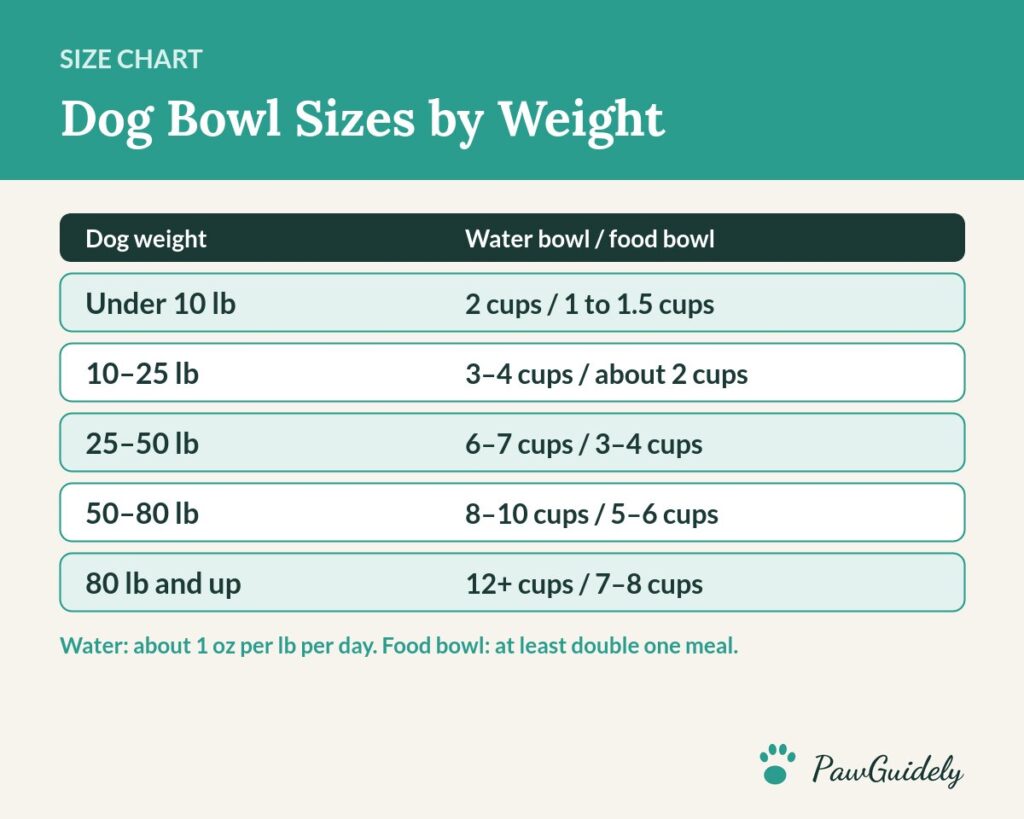
The water column uses the common one-ounce-per-pound guideline. Hot weather, long walks and an all-dry diet push a dog’s needs up; dogs on wet food usually drink less from the bowl. Treat the numbers as a floor for bowl size, not a drinking target. If your dog suddenly drinks a lot more or a lot less than usual, that is worth a call to your vet.
Why the Food Bowl Should Be Bigger Than the Meal
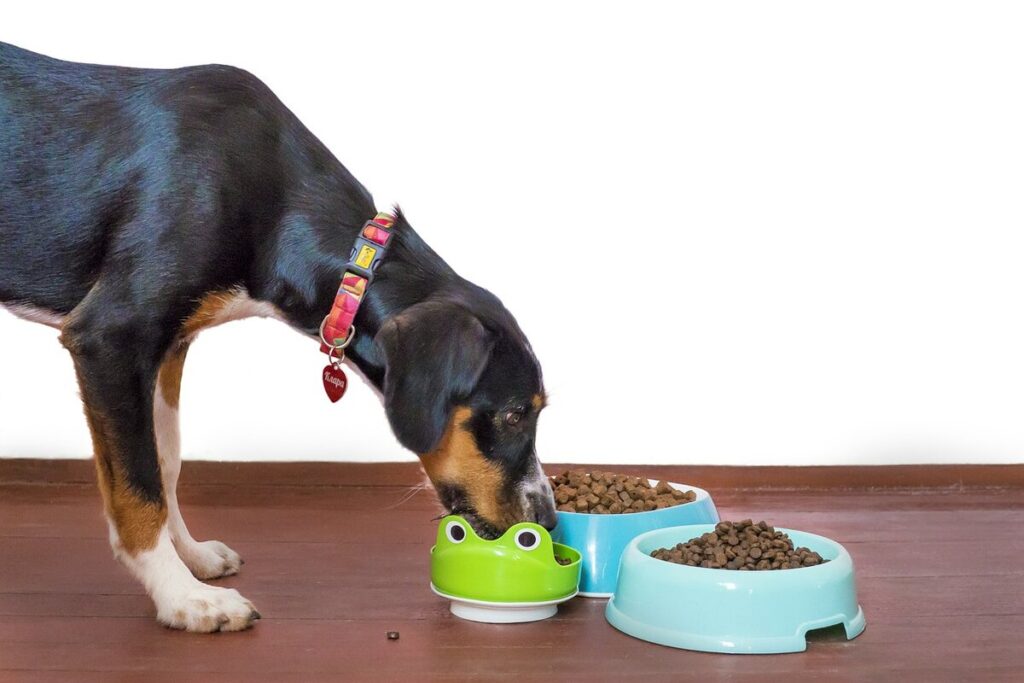
Product listings give capacity filled to the brim, but nobody feeds that way. A bowl packed level with the rim sends kibble over the edge the moment a dog pushes its nose in. A simple rule: measure one meal in a measuring cup, then buy a bowl rated for at least double that amount.
Here is how it plays out. A 60 lb dog eating 3 cups a day split into two meals gets 1.5 cups per meal, so a 3 to 4 cup bowl is about right. A 12 lb dog eating 3/4 cup a day in two meals needs only a 1 cup bowl; a big 4 cup bowl would leave a small dog chasing a few pieces of kibble around a wide, deep dish. Daily food amounts vary a lot between brands, so use the feeding chart on your own bag rather than a generic number.
Width and Depth: Match the Bowl to the Face
Capacity is only half the decision. The same 3 cup capacity can come as a wide, shallow dish or a narrow, deep one, and the right choice depends on your dog’s muzzle and ears.
| Dog type | Bowl shape that suits it | Why |
|---|---|---|
| Flat-faced breeds (Pug, French Bulldog, Shih Tzu) | Shallow and wide, about 2 inches deep or less, or a tilted bowl | They can reach food without pressing their whole face into the bowl |
| Long ears (Cocker Spaniel, Basset Hound, Cavalier) | Long-ear or “spaniel” bowl: narrow top, wider base | Ears hang outside the bowl instead of dipping into food and water |
| Long, narrow muzzles (Greyhound, Collie, Doberman) | Deeper bowl is fine | A deep bowl holds more without needing a wide footprint |
| Toy breeds and young puppies | Small diameter, about 5 to 6 inches across and low sides | Less climbing into the bowl and less food pushed out |
| Giant breeds and enthusiastic drinkers | Heavy or wide-based bowl, or a feeder with a spill tray | Less sliding and fewer puddles around the bowl |
Bowl Height and When Floor Level Is Fine
Most healthy dogs eat comfortably from a bowl on the floor. Raised feeders mainly help some tall, older or stiff dogs. Research on raised bowls and bloat in large, deep-chested breeds has been mixed, so if you own one of those breeds, ask your vet before switching. Our elevated dog bowl guide explains how to measure for height if you do go that route.
Material Choice Changes With Size
- Stainless steel: the default for every size. It does not scratch easily, goes in the dishwasher and comes in the widest range of capacities.
- Ceramic: useful for small dogs that push light bowls around, because the weight keeps it in place. Replace any ceramic bowl that chips or cracks.
- Plastic: light and cheap, but scratches give bacteria somewhere to sit, and chewers can damage it. Fine as a short-term travel bowl.
- Non-skid bases: a rubber ring or pad matters more as bowls get bigger, since a full 8 cup water bowl is easy to slosh.
Troubleshooting: Signs the Bowl Is the Wrong Size
- Kibble on the floor every meal: the bowl is filled too close to the rim. Size up one step or fill it only two-thirds.
- The bowl travels across the kitchen: it is too light for your dog. Try a rubber base, a heavier ceramic bowl or a bowl holder.
- The water bowl is dry by mid-afternoon: it is too small for your dog or your household. Add a second bowl in another room.
- Wet, dirty ear tips after meals: switch to a long-ear bowl with a narrow opening.
- A flat-faced dog leaves food in the edges: choose a shallower or tilted bowl.
- Meals vanish in seconds: size is not the issue; a slow feeder bowl is the better fix.
- Puddles around the water bowl: a wider base, a mat or a feeder with a spill tray will help more than a bigger bowl.
Puppies: Size for Now, Not for Adulthood
It is tempting to buy the adult-size bowl on day one, but a 6 cup bowl in front of an 8 week old puppy invites paddling, tipping and playing. Start with a small food bowl matched to current meal sizes and replace it as meals grow. A water bowl can be a little larger than the chart suggests for puppies, as long as it is shallow and stable. Our new puppy checklist covers the rest of the starter kit.
Cleaning Schedule by Bowl Type
- Wet or raw food bowls: wash after every meal.
- Dry food bowls: wash at least once a day.
- Water bowls: empty and refill daily, and scrub off any slimy film with hot soapy water several times a week. Larger bowls need this just as much, because partly emptied water goes stale.
- Non-skid rings: remove them before the dishwasher if the maker says so, and dry them before refitting.
- Replace: plastic bowls once scratched, ceramic bowls once chipped.
Bowls Sold in Clear Size Steps
These two make sizing easier because the listings give capacity or size versions clearly. PawGuidely compares products from specs, manufacturer information and owner feedback; we have not used these with our own dogs.
1. Loving Pets Bella Bowl — Best for Picking an Exact Capacity
A stainless steel bowl inside a molded resin shell with a removable rubber ring underneath. Retailer listings give capacity by size: roughly 15 oz for the small (about 10 to 20 lb dogs), 27 oz for the medium (20 to 35 lb), 54 oz for the large (35 to 65 lb) and 72 oz for the extra large (65 to 100 lb), with an extra small size for toy breeds.
- Capacity and dog weight are listed for each size
- Stainless interior is easy to clean
- Rubber ring reduces sliding and noise
- Low, wide shape works for many flat-faced dogs
Worth knowing: Capacities are brim-full figures, so usable meal size is smaller than the label. The rubber ring has to come off before the bowl goes in the dishwasher.
2. Neater Feeder Deluxe — Best for Messy Drinkers
A raised feeder with stainless bowls set over a spill-catching tray, sold in small, medium and large versions. It suits big dogs that splash water across the floor more than dogs that simply need a bigger bowl.
- Spill tray catches water and dropped food
- Comes in sizes for small, medium and large dogs
- Bowls lift out for washing
- Keeps the feeding area drier on wood floors
Worth knowing: It takes more floor space than plain bowls, and it raises the bowls, which is not right for every dog. Check with your vet first if your dog is a large, deep-chested breed.
Related Guides
- Best Elevated Dog Bowls (and Whether Your Dog Needs One)
- Best Slow Feeder Dog Bowls for Dogs That Eat Too Fast
- Best Dog Water Bottles for Walks and Travel
- Dog Bed Size Chart by Weight and Breed
- Dog Crate Size Chart by Breed and Weight
- New Puppy Checklist
Frequently Asked Questions
What size bowl does a 50 lb dog need?
A 3 to 4 cup food bowl and a water bowl of about 6 cups (48 oz) or more. On hot days or after long walks, refill the water once during the day.
Can a dog bowl be too big?
Yes, mainly for small dogs and puppies. An oversized bowl is harder to eat from, easier to step in, and a large water bowl that is only partly emptied still needs changing every day.
How many ounces should a dog water bowl hold?
Start with about one ounce per pound of body weight and round up. A 20 lb dog does well with a bowl that holds at least 24 oz.
Should the water bowl be bigger than the food bowl?
Usually, yes. Dogs drink more by volume than they eat, so the water bowl is often one or two size steps up from the food bowl.
What bowl is best for a dog with long ears?
A long-ear or spaniel bowl with a narrow top and wide base, which keeps the ears outside the bowl while the dog eats and drinks.