
This post contains affiliate links. As an Amazon Associate I earn from qualifying purchases. This costs you nothing extra. See our affiliate disclosure for details.
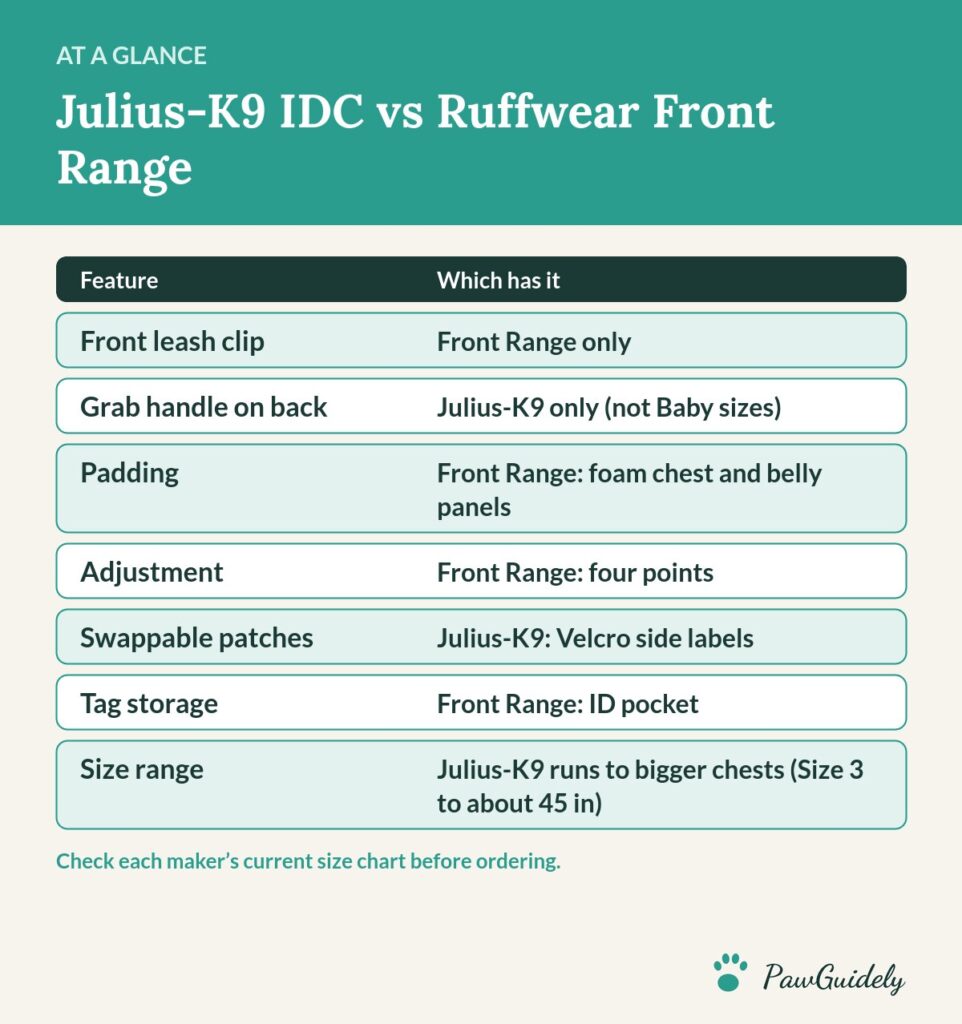
If your dog pulls, the Ruffwear Front Range is the better buy because it has a front chest clip that turns a pulling dog back toward you. If you want a sturdy back handle for steadying or lifting your dog, swappable name patches and a harness built for bigger, chestier dogs, the Julius-K9 IDC Powerharness is the better fit. Neither one fixes pulling on its own.
This Julius-K9 vs Ruffwear comparison uses the makers’ specs, published size charts and recurring patterns in owner feedback. It covers the standard IDC Powerharness and the Front Range, the two models most people are choosing between.
The Short Version
| Julius-K9 IDC Powerharness | Ruffwear Front Range | |
|---|---|---|
| Leash points | Back O-ring only | Back V-ring plus front chest clip |
| Handle | Yes, on top (not on Baby 1 and Baby 2 sizes) | No |
| Feel | Stiffer, saddle-style body panel | Soft, foam-padded vest |
| Adjustment | Chest and belly straps | Four adjustment points |
| Visibility | Reflective chest strap, seams and side lettering | Reflective trim and a light loop |
| Extras | Velcro side patches you can swap | ID pocket that keeps tags quiet |
| Better for | Handling, working-style use, deep-chested dogs | Pullers, everyday walks, all-day comfort |
Pulling: The Biggest Difference
The standard IDC Powerharness clips only at the back. A back clip is comfortable and fine for a dog that already walks nicely, but it lets a determined dog lean into the harness with its whole chest. Some owners notice their dog pulls harder in a back-clip harness than on a flat collar, simply because it doesn’t hurt.
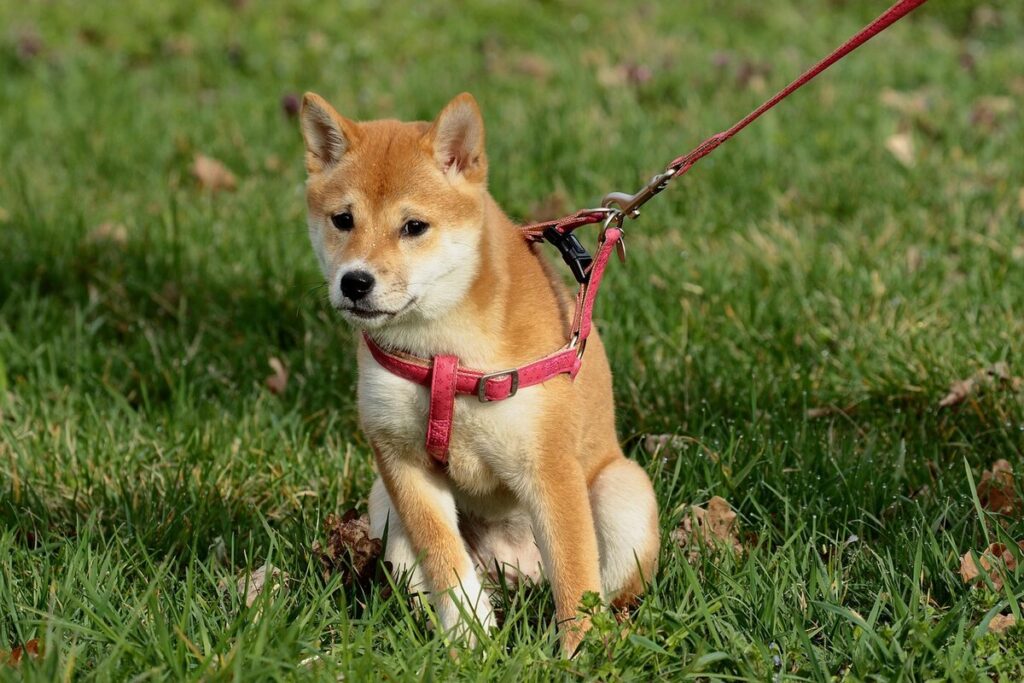
The Front Range has a reinforced webbing clip at the chest as well as the usual back ring. Clipping at the front means pressure on the leash swings the dog’s shoulders sideways toward you, which takes the power out of pulling. You can switch to the back ring once your dog’s leash manners improve. If loose-leash walking is the goal, pair either harness with a training plan like the one in our guide on How to Stop Your Dog Pulling on the Leash When Walking (8 Steps).
The Handle: Why Julius-K9 Owners Love It
The top handle is the main reason people pick the Julius-K9. It lets you hold your dog close at a busy crossing, steady an older dog on steps, or help a dog over a stile or into a car. The Front Range has no handle at all, so if you need one from Ruffwear you would be looking at a different model.
The handle is for short holds and guidance. It is not designed to carry a dog’s full weight for any distance, and it is not a substitute for a proper lifting aid for a dog with mobility problems. Ask your vet about support slings if that is the real need.
Sizing Compared
Both brands size by chest girth, measured around the widest part of the ribcage just behind the front legs. The ranges below come from the makers’ published charts; always check the current chart for the exact model and color you order, because retailers sometimes list older sizing.
| Julius-K9 IDC size | Chest girth | Typical weight |
|---|---|---|
| Baby 2 | 13–17.7 in (33–45 cm) | 4–11 lb |
| Mini-Mini | 15.7–20.9 in (40–53 cm) | 9–15 lb |
| Mini | 19.3–26.4 in (49–67 cm) | 15–33 lb |
| Size 0 | 22.8–29.9 in (58–76 cm) | 31–55 lb |
| Size 1 | 24.8–33.5 in (63–85 cm) | 51–66 lb |
| Size 2 | 28–37.8 in (71–96 cm) | 62–88 lb |
| Size 3 | 32.3–45.3 in (82–115 cm) | 88–154 lb |
| Ruffwear Front Range size | Chest girth |
|---|---|
| XXS | 13–17 in (33–43 cm) |
| XS | 17–22 in (43–56 cm) |
| S | 22–27 in (56–69 cm) |
| M | 27–32 in (69–81 cm) |
| L/XL | 32–42 in (81–107 cm) |
Two practical rules follow from these charts. First, Julius-K9 sizes overlap a lot, so when your dog’s girth fits two sizes, choose the one where it lands closer to the middle; a harness cinched to its last inch tends to shift and rub. Second, Ruffwear’s ranges barely overlap, so a dog right on a boundary is the tricky case. Look at how much strap would be left at your dog’s measurement in each size and pick the one with room to adjust both ways. For broad, heavy dogs, see 5 Best Harnesses for Large Dogs: Strong, Comfortable and Secure.
Comfort and Fit Problems to Expect
Owner feedback for both harnesses point to a handful of recurring fit issues. Most come down to size or strap adjustment rather than the harness itself.
- Rubbing behind the front legs: reported with the Julius-K9 on narrow or deep-chested dogs, because the belly strap sits close to the armpit. Check the strap is not twisted and that your dog sits mid-range in the size.
- Chest strap riding up toward the throat: usually a sign the Julius-K9 is too big. A correctly sized one sits on the breastbone.
- Front Range sliding sideways: happens when the neck straps are loose but the belly straps are tight. Even out all four adjustment points.
- Dog backs out of the harness: neither model is designed as an escape-proof harness. For a dog that reverses out of everything, a third strap around the waist matters more than the brand.
- Hot dogs in summer: the IDC’s body panel covers more of the back than the Front Range’s straps, so heavily coated dogs may run warmer in it on hot days.
Durability and Care
Both are built for daily use. Julius-K9 uses a stainless steel back ring and a sturdy plastic click buckle; Ruffwear uses an aluminum V-ring and reinforced webbing at the front clip. Neither should go in the dryer. Hand-wash or use a gentle cold cycle inside a laundry bag, rinse out salt or mud after beach and trail walks, and let them air-dry fully before storing so the padding does not stay damp.
Check the stitching at the leash points and the buckle teeth every month or two. Replace any harness with frayed webbing at the clip or a buckle that releases with a light tug.
Which One Should You Buy?
- Your dog pulls hard: Front Range, clipped at the chest.
- You need a handle to steady your dog: Julius-K9 IDC.
- Your dog is over about 90 lb or has a very large chest: Julius-K9, which runs to bigger sizes.
- You want the softest everyday harness: Front Range.
- You want a reflective label or your dog’s name on the side: Julius-K9, with swappable Velcro patches.
- Your dog is between sizes on both charts: pick the brand where your dog sits mid-range.
The Two Harnesses
1. Ruffwear Front Range Harness — Best for Dogs That Pull
A padded everyday harness with both a front and back leash point. It suits most medium dogs that walk daily and still pull at times.
- Front chest clip helps redirect pulling
- Foam-padded chest and belly panels
- Four adjustment points for a closer fit
- ID pocket keeps tags quiet; reflective trim and light loop
Worth knowing: There is no top handle, and dogs near a size boundary can be awkward to fit because the ranges barely overlap.
2. Julius-K9 IDC Powerharness — Best for Handling and Big Chests
A sturdy, saddle-style harness with a top handle and swappable side patches. It suits dogs that already walk well and owners who need a solid grip point.
- Top handle for steadying or short lifts (not on Baby 1 and 2)
- Wide size range, up to Size 3 for very large dogs
- Reflective chest strap, seams and side lettering
- Swappable Velcro patches for names or messages
Worth knowing: there is no front clip, so it does little for a dog that pulls, and narrow or deep-chested dogs may get rubbing behind the front legs.
Related Guides
- PetSafe Easy Walk vs Ruffwear Front Range: Which Harness Is Better?
- 4 Best No-Pull Dog Harnesses in 2026 (and How to Fit One Properly)
- Dog Harness vs Collar: Is a Harness Better for Your Dog?
- 5 Best Harnesses for Large Dogs: Strong, Comfortable and Secure
- 4 Best Harnesses for Small Dogs (Comfortable and Escape-Resistant)
- How to Stop Your Dog Pulling on the Leash When Walking (8 Steps)
- 5 Best Dog Leashes for Everyday Walks, Running and Training
Frequently Asked Questions
Is the Julius-K9 a no-pull harness?
The standard IDC Powerharness is not. It clips only at the back, which is comfortable but gives you little leverage over a dog that pulls. A front-clip harness plus training works better for pullers.
Does the Ruffwear Front Range have a handle?
No. The Front Range has a back V-ring and a front clip but no grab handle. Choose a different Ruffwear model or the Julius-K9 if a handle matters to you.
Which is better for a large dog?
For very large or barrel-chested dogs the Julius-K9 has more room, with sizes running to about 45 inches of chest girth. The Front Range tops out around 42 inches.
Can my dog wear either harness all day?
It is better not to. Take any harness off when your dog is resting at home or in a crate, and check for rubbing under the front legs after long walks.