
This post contains affiliate links. As an Amazon Associate I earn from qualifying purchases. This costs you nothing extra. See our affiliate disclosure for details.
A harness that is too loose lets your dog back out of it. One that is too tight rubs, restricts movement and makes walks miserable. Most sizing problems come from guessing by weight or breed alone. Knowing how to measure a dog for a harness takes two minutes and a soft tape measure, and it makes choosing the right size much easier.
What You Need
- A soft, flexible tape measure (a piece of string and a ruler works too)
- Treats to keep your dog standing still
- A helper, if your dog is wriggly
- The size chart for the harness you are considering
How to Measure a Dog for a Harness Step by Step
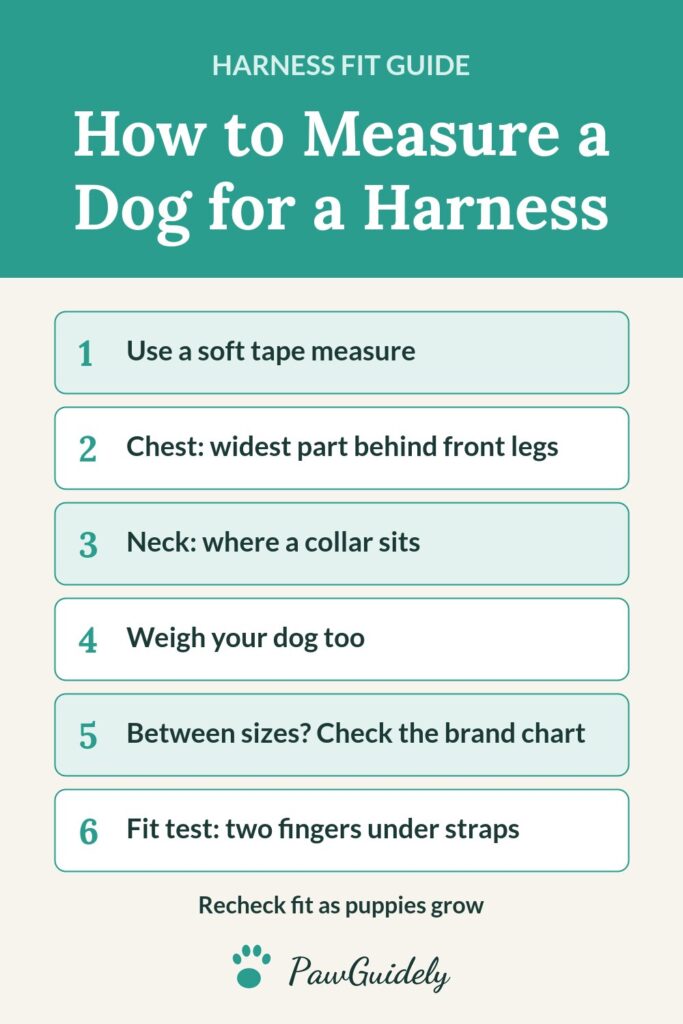
- Stand your dog on a level surface. They should be standing naturally, not sitting or lying down.
- Measure the chest girth. Wrap the tape around the widest part of the rib cage, just behind the front legs. This is the most important measurement for almost every harness.
- Measure the neck. Wrap the tape around the base of the neck, where a collar would sit, not the thin part near the head.
- Keep the tape snug but not tight. You should be able to slip one finger under the tape.
- Weigh your dog. Many size charts list weight ranges, which are useful as a cross-check.
- Compare to the brand’s chart. Sizes vary between brands, so never assume a medium in one brand equals a medium in another.
- If between sizes, check which straps adjust most. Many owners size up for deep-chested dogs and down for slim dogs, but the brand’s advice comes first.
Typical Harness Sizes by Breed
| Size | Typical chest girth | Example breeds |
|---|---|---|
| XS | 13 to 18 in. | Chihuahua, Yorkie, Toy Poodle |
| S | 17 to 22 in. | Shih Tzu, Pug, Dachshund |
| M | 22 to 27 in. | Beagle, Cocker Spaniel, Border Collie |
| L | 27 to 32 in. | Labrador, Golden Retriever, Boxer |
| XL | 32 to 42 in. | German Shepherd, Rottweiler, Bernese |
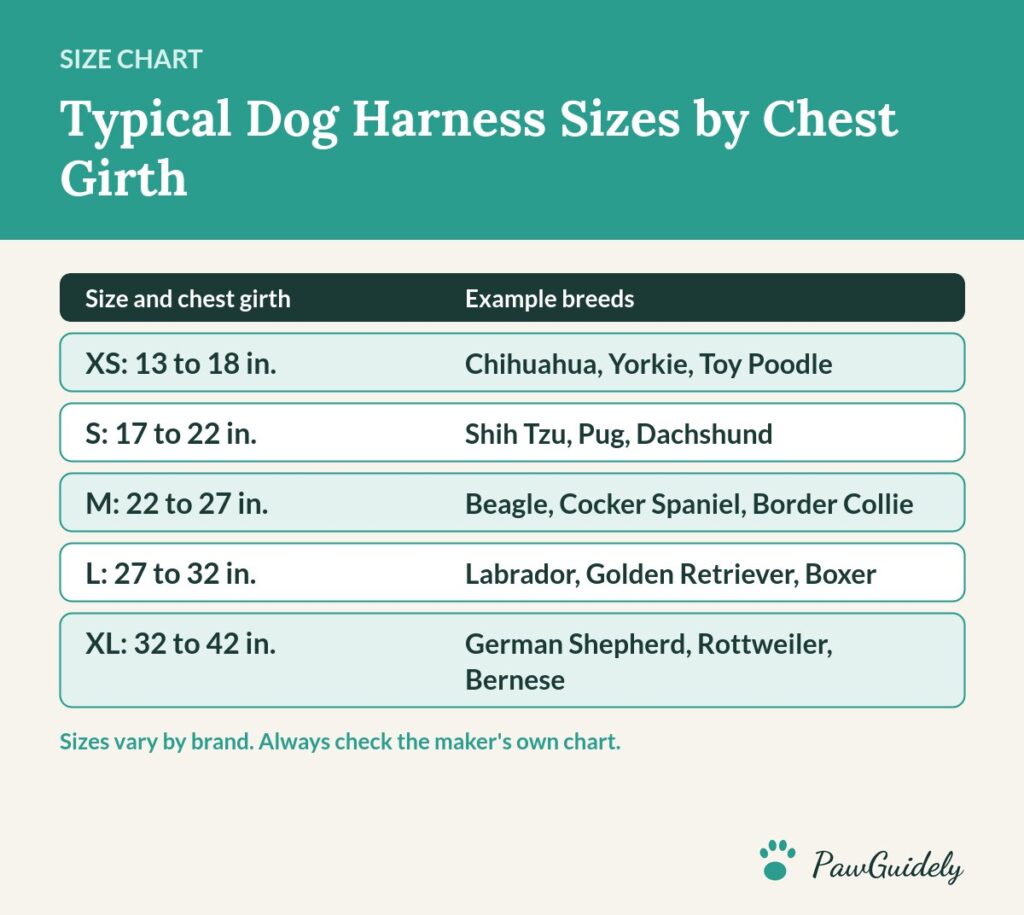
This table is a general guide only. Individual dogs vary a lot, and every brand’s chart is different, so always measure.
How a Harness Should Fit
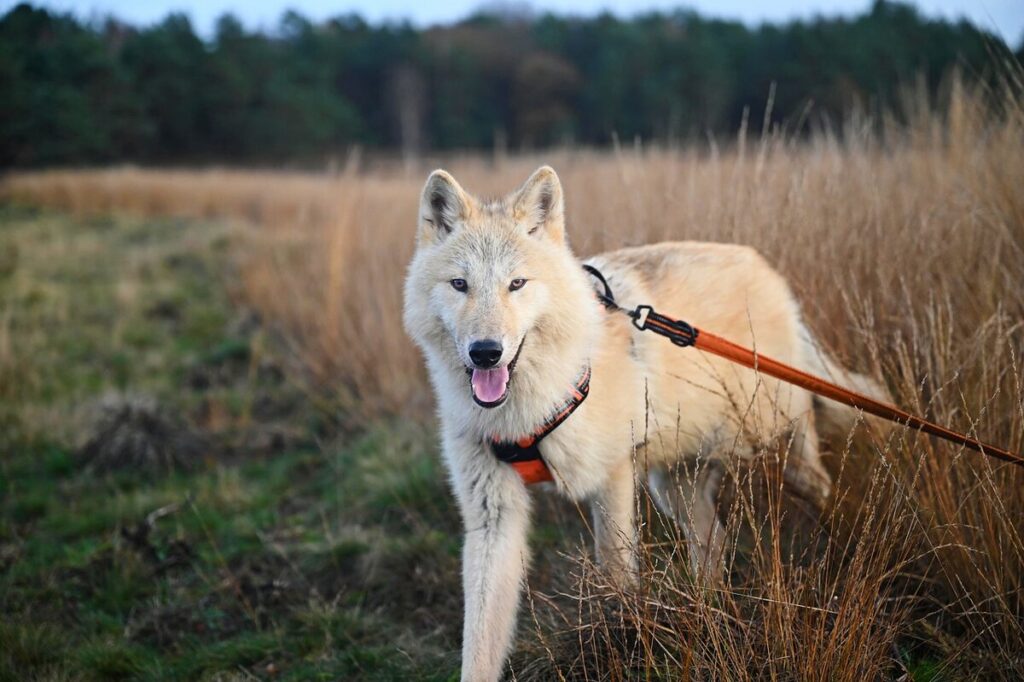
- Two-finger rule: you can slide two fingers flat under every strap.
- No rubbing behind the legs: straps should sit an inch or two behind the front legs, not in the armpits.
- Front strap position: on a Y-front harness, the Y sits on the breastbone, not across the shoulders.
- Stays centered: the harness does not twist to one side when your dog moves.
- Cannot slip over the head: with the harness buckled, gently try to pull it forward. It should not come off.
Signs the Fit Is Wrong
| Too tight | Too loose |
|---|---|
| Red marks or hair loss | Harness slides sideways |
| Short, stiff steps | Dog can back out of it |
| Reluctance to walk | Straps flap or dangle |
| Straps dig into armpits | Chest piece rides up to the throat |
Tips for Puppies and Growing Dogs
Puppies grow quickly, so choose a harness with plenty of adjustment and recheck the fit every week or two. Buying an inexpensive harness for the puppy months and a better one once your dog is fully grown often makes sense.
Harnesses That Are Easy to Fit
1. Ruffwear Front Range Harness — Best Adjustable Fit
Four adjustment points and a clear size chart make the Front Range easy to fit well. It has padding and front and back clips.
- Four adjustment points
- Padded and comfortable
Worth knowing: Measure chest girth carefully against the Ruffwear chart.
2. PetSafe Easy Walk Harness — Best for Training
A front-clip harness that helps with pulling. It comes with a detailed fitting guide and color-coded straps.
- Front clip reduces pulling
- Color-coded buckles
Worth knowing: Getting the chest strap right is key, so follow the fitting guide.
3. Puppia Soft Dog Harness — Best for Small Dogs
A soft mesh vest harness sized by chest girth, popular with small breeds and puppies.
- Soft and breathable
- Easy to put on
Worth knowing: Limited adjustment, so measuring accurately matters.
The Bottom Line
Measure chest girth at the widest point behind the front legs, measure the neck where a collar sits, and compare both to the specific brand’s size chart. Then check the fit with the two-finger rule and watch your dog walk. A few minutes of measuring saves returns and keeps your dog comfortable and secure.
Harness Styles and What to Measure
| Harness style | Key measurements | Notes |
|---|---|---|
| Y-front / overhead | Chest girth, neck | Most adjustable and secure |
| Step-in | Chest girth | Easy to put on, fewer adjustments |
| Vest style | Chest girth, sometimes back length | Comfy for small dogs, warmer |
| Front-clip no-pull | Chest girth | Chest strap position is critical |
| Car safety harness | Chest girth, weight | Follow the maker’s chart closely |
If your dog is an escape artist, choose a style with a second belly strap behind the rib cage, and always double-check the fit before walks in busy places.
Measuring a Nervous Dog
If your dog dislikes being handled, break measuring into short steps. Let them sniff the tape, reward them, then drape it over their back for a second before rewarding again. Measure during a calm moment, such as after a walk, and ask a helper to feed small treats while you wrap the tape. You can also measure a well-fitting harness your dog already owns and compare those numbers to the new brand’s chart.
Related Guides
- 4 Best No-Pull Dog Harnesses in 2026 (and How to Fit One Properly)
- 4 Best Harnesses for Small Dogs (Comfortable and Escape-Resistant)
- 5 Best Harnesses for Large Dogs: Strong, Comfortable and Secure
- Dog Harness vs Collar: Which Is Better for Your Dog?
Frequently Asked Questions
Where do you measure a dog for a harness?
Measure the chest girth at the widest part of the rib cage, just behind the front legs, and the neck at its base where a collar sits.
Should a dog harness be tight or loose?
Snug but not tight. You should fit two fingers under each strap, and it should not slip over the head when buckled.
Is it better to size up or down on a harness?
Follow the brand’s advice. If unsure, choose the size where your dog’s chest measurement falls in the middle of the adjustable range.
Can I measure my dog for a harness by weight?
Weight helps as a cross-check, but chest girth is more reliable because body shapes vary so much.
How often should I check my dog’s harness fit?
Every week or two for growing puppies, and whenever your adult dog gains or loses weight.