
This post contains affiliate links. As an Amazon Associate, PawGuidely earns from qualifying purchases at no extra cost to you. See our affiliate disclosure for details.
If your cat has started going outside the box, or you are bringing home a second cat, the first question to ask is how many litter boxes you have and where they are. Litter box problems are one of the most common reasons cats are given up, and many are solved simply by adding a box or moving one. The standard guideline vets and cat behaviorists use is called the N+1 rule. Below we explain how many litter boxes you need, why the rule works, where to put them, and what to do in small homes.
How Many Litter Boxes Do You Need? The N+1 Rule
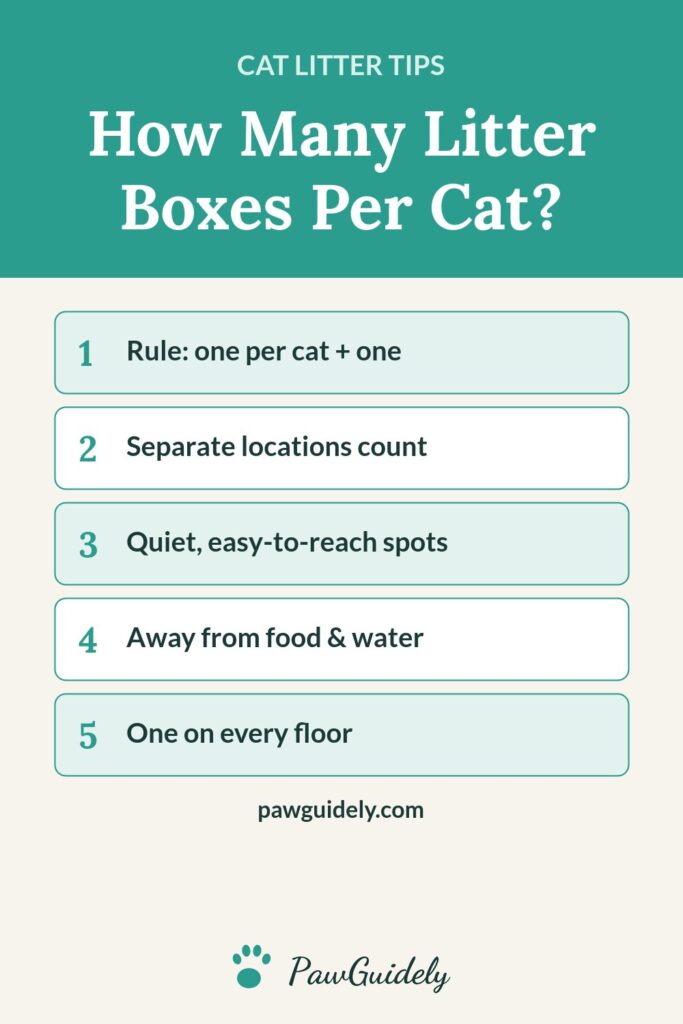
The N+1 rule says you should have one litter box per cat, plus one extra. One cat needs two boxes, two cats need three, three cats need four, and so on. The extra box means there is always a clean option available, and no cat is blocked from a box by another cat.
| Number of Cats | Recommended Litter Boxes | Minimum Different Locations |
|---|---|---|
| 1 | 2 | 2 |
| 2 | 3 | 2-3 |
| 3 | 4 | 3 |
| 4 | 5 | 3-4 |
| 5 | 6 | 4 or more |
Why the N+1 Rule Works
- Cats are clean: many won’t use a box that already has waste in it, especially if you can’t scoop straight away.
- Some cats prefer separate boxes for urine and feces.
- Multi-cat tension: one cat can guard a box or ambush another nearby. More boxes in different places prevent this.
- Backup when life happens: if a box gets missed during a busy day, there is still a clean one.
- Health and age: kittens, seniors and cats with mobility issues need a box nearby.
Where to Put Litter Boxes
- Separate locations: two boxes side by side count as one location to a cat. Spread them around the home.
- Quiet but not hidden: choose low-traffic spots away from loud appliances like washing machines.
- Easy escape routes: cats like to see who is coming and have a way out, especially in multi-cat homes.
- Away from food and water: cats don’t like to eat near their toilet.
- One on every floor in multi-level homes, so no cat has to rush up or down stairs.
- Close for seniors and kittens, with low entry sides.
Box Size and Type Matter Too
Many litter boxes are too small. A good guideline is a box about one and a half times the length of your cat. Most cats prefer large, uncovered boxes with 2 to 3 inches of unscented clumping litter. If you use covered boxes, keep at least one open box so your cat has a choice. For big cats, see our litter boxes for large cats, and for every style, our best cat litter boxes guide.
Tips for Small Apartments
- Put one box in the bathroom and one in a bedroom corner or closet with the door propped open.
- Use a litter mat and a high-sided box to keep mess contained; see our cat litter mats guide.
- A self-cleaning box can count as one of your boxes, but keep a regular box too in case of noise or power issues. See our self-cleaning litter boxes.
- Scoop at least once a day, and more often if you can’t meet the N+1 rule.
Signs You Need More Litter Boxes
- Urine or feces just outside the box.
- A cat waiting or crying near an occupied box.
- One cat blocking another from the box area.
- Your cat going in other rooms, on rugs or in the bath.
- Boxes filling up quickly between scoops.
If your cat suddenly stops using the box, strains, cries in the box or passes blood, contact your vet right away. Urinary problems can be serious, especially in male cats, and no number of boxes will fix a medical issue.
Litter Box Essentials
1. IRIS USA XX-Large High Sided Litter Box — Roomy Main Box
A large, open, high-sided box suits most cats and contains scatter. It is a great main box, especially for big cats and multi-cat homes.
2. Petmate XL Litter Box — Affordable Extra Box
The extra box in the N+1 rule doesn’t need to be fancy. The Petmate XL is an affordable, deep pan that works well as a second or third box.
3. Dr. Elsey’s Ultra Unscented Litter — Cat-Approved Litter
Unscented, hard-clumping litter keeps boxes fresh and appeals to most cats. See our best cat litter for odor control.
The Bottom Line
So, how many litter boxes do you need? Follow the N+1 rule: one per cat plus one, in separate, quiet, easy-to-reach locations. Add large, uncovered boxes, unscented clumping litter and daily scooping, and most litter box problems disappear. New cat? See our new cat checklist.
Introducing Extra Litter Boxes
- Set up the new box with the same litter your cat already uses, so it smells and feels familiar.
- Place it in a different quiet spot rather than next to the existing box.
- Add a small scoop of used litter from the old box to signal that this is a toilet.
- Keep both boxes scooped daily so neither becomes unpleasant.
- Watch which boxes each cat prefers and adjust locations over a week or two.
If you are bringing home a second cat, set up the extra boxes before the new cat arrives, and give the newcomer its own box in its safe room during the introduction period.
How Often to Scoop and Change Litter
Scoop every box at least once a day, and twice a day in multi-cat homes. With clumping litter, top up to keep a depth of 2 to 3 inches and do a full change every two to four weeks, washing the box with mild, unscented soap. Replace plastic boxes once they become heavily scratched, because scratches hold odor that can put cats off.
Related Guides
- 5 Best Cat Litter Boxes in 2026: Open, Covered, High-Sided and Top-Entry
- 5 Best Litter Boxes for Large Cats (Maine Coons and Big Breeds)
- 5 Best Cat Litters for Odor Control (That Actually Work)
- 5 Best Self-Cleaning Litter Boxes in 2026: Compared for Odor, Noise and Big Cats
Frequently Asked Questions
How many litter boxes do I need for one cat?
Two. The N+1 rule means one box per cat plus one extra, placed in different locations.
How many litter boxes for two cats?
Three boxes, ideally in at least two or three separate spots so neither cat can block the other.
Do two litter boxes next to each other count as two?
To your cat they count as one location. Spread boxes around the home.
Can two cats share one litter box?
Some do, but sharing often leads to accidents, stress or one cat avoiding the box. Following the N+1 rule is safer.
Why is my cat peeing outside the litter box?
Common reasons are too few boxes, dirty boxes, boxes that are too small, scented litter, stress or a medical problem. Contact your vet if it starts suddenly.