
This post contains affiliate links. As an Amazon Associate I earn from qualifying purchases. This costs you nothing extra. See our affiliate disclosure for details.
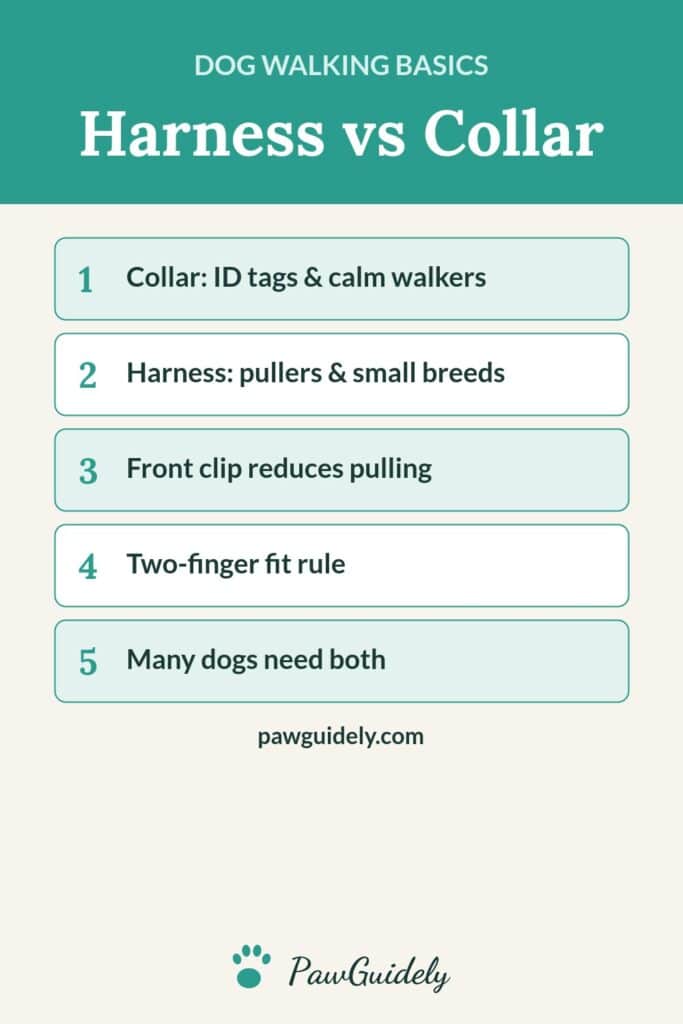
For walks, a harness is better than a collar for most dogs, and essential for dogs that pull, puppies, toy breeds and flat-faced breeds, because it moves leash pressure off the throat and onto the chest. Keep a flat collar on as well, fitted so two fingers slide under it, because it is the best place for ID tags. The usual setup is both: a collar for ID all day and a harness clipped to the leash for walks.
If you already know you need a harness, our guide to the best no-pull dog harnesses compares the main options. Below, we cover which tool suits which dog, how to size each one with numbers, and what to do when the fit goes wrong.
Is a Harness Better Than a Collar?
For leash walking, yes, for most dogs. A harness is the better choice if your dog pulls, is a puppy, is a small or toy breed, has a long back like a Dachshund, or has a flat face like a Pug or French Bulldog. A collar is still better for one job: carrying ID tags all day. A third option, the head halter, suits strong pullers once they are trained to accept it; see head halter vs harness.
Dog Harness vs Collar at a Glance
| Flat Collar | Harness | |
|---|---|---|
| Where pressure goes | Neck and throat | Chest and shoulders |
| Control of pulling | Low | Good, especially front-clip |
| ID tags | Ideal, worn all day | Some have ID pockets, not for all-day wear |
| Best for | Calm walkers, ID, quick potty trips | Pullers, puppies, small and flat-faced breeds |
| Ease of use | Very easy, stays on | Takes a few seconds to put on |
| Escape risk | Can slip over the head if loose | Low when fitted well |
Which Should You Choose?
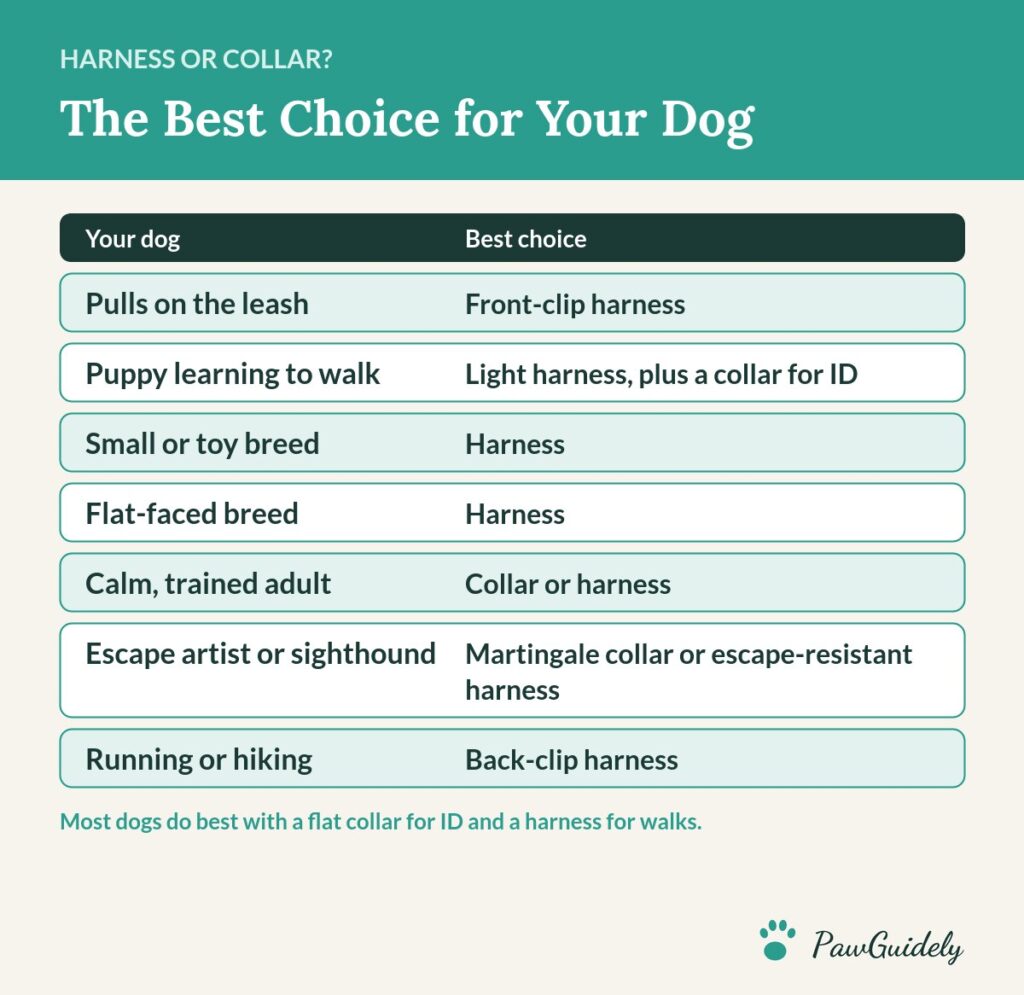
| Your Dog | Best Choice | Why |
|---|---|---|
| Pulls on the leash | Front-clip harness | Reduces pulling and protects the neck |
| Very strong puller, already trained to wear one | Head halter | Steers the head; needs gradual introduction |
| Puppy learning to walk | Lightweight harness plus collar for ID | Protects a growing neck while learning |
| Small or toy breed | Harness | Small tracheas are more sensitive to pressure |
| Flat-faced breed (Pug, Frenchie) | Harness | Avoids pressure on already-restricted airways |
| Calm, trained adult dog | Collar or harness | Either works; choose what your dog prefers |
| Escape artist or sighthound | Martingale collar or escape-resistant harness | Harder to back out of |
| Running or hiking | Back-clip harness | Comfortable for long distances |
If your dog coughs, gags or has a history of neck, back, eye or breathing problems, ask your vet which option is safest before you choose.
Pros and Cons of a Dog Collar
A flat buckle or quick-release collar is simple, light and comfortable for most dogs to wear all day. It holds your dog’s ID and rabies tags, which matters if your dog ever slips out the door. For a dog that already walks on a loose leash, a collar is enough for everyday walks. Our dog collar guide covers everyday options.
- Pros: quick to put on, holds ID all day, light, fine for calm dogs.
- Cons: leash pressure lands on the neck and throat, which can cause coughing in dogs that pull, and it gives little control over a strong dog.
Martingale collars, which tighten a limited amount when pulled, suit narrow-headed breeds such as greyhounds and whippets that can back out of flat collars. Choke chains and prong collars work through discomfort, and most modern positive-reinforcement trainers advise against them.
Pros and Cons of a Dog Harness
A harness wraps around the chest and shoulders, so when the leash goes tight, the force spreads across the body instead of the neck. Front-clip harnesses, with the leash ring at the chest, turn a pulling dog back toward you, which makes loose-leash training easier. Back-clip harnesses are comfortable for calm dogs, small breeds and hiking.
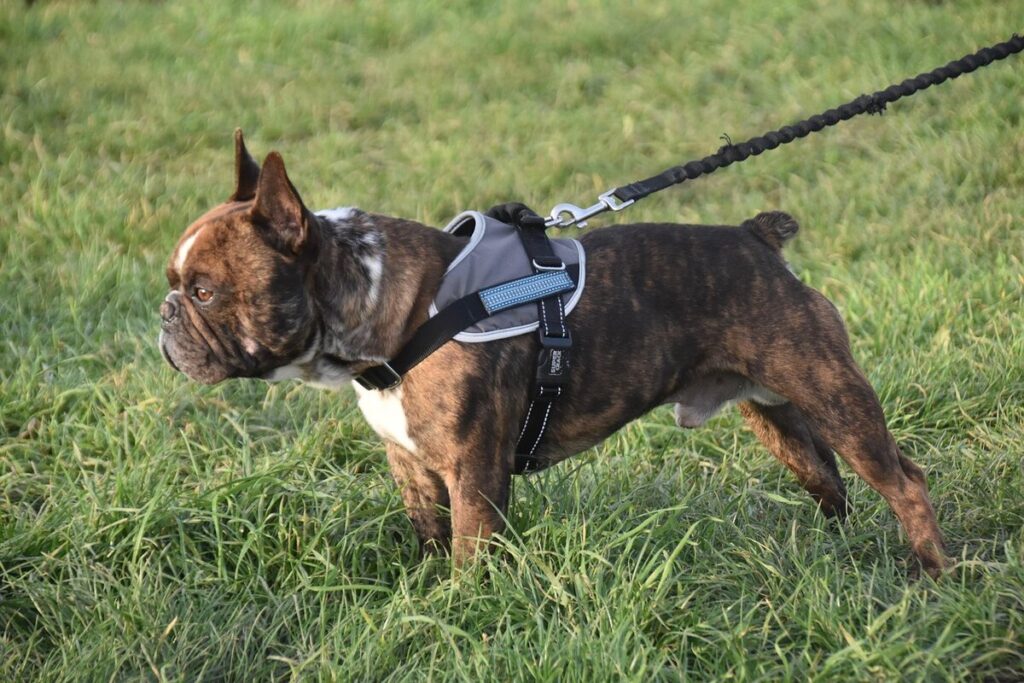
- Pros: no pressure on the throat, better control of pullers, harder to slip out of, good for small and flat-faced breeds.
- Cons: takes a moment to put on, must be fitted carefully to avoid rubbing, and a poorly fitted harness can restrict shoulder movement.
How to Size a Collar and a Harness
Use a soft tape measure and size by measurement, not weight. Our step-by-step guide on how to measure a dog for a harness has more detail.
| Gear | Where to measure | Fit rule |
|---|---|---|
| Flat collar | Around the middle of the neck | Two fingers slide flat underneath; it must not pull over the head |
| Martingale collar | Around the widest part of the head and the neck | When pulled tight, the two rings should not touch |
| Harness | Girth: around the widest part of the rib cage, just behind the front legs | Two fingers under every strap; if between sizes, choose the larger size |
As an example of how harness sizing works by girth, the Easy Walk Medium fits a 22- to 32-inch girth and the Front Range Medium a 27- to 32-inch girth. Two dogs of the same weight can need different sizes.
Two Harnesses Worth Starting With
| Harness | Leash rings | Adjustment points | Girth range | Extras |
|---|---|---|---|---|
| Ruffwear Front Range | Back (aluminum V-ring) and front (reinforced webbing) | 4 | 13 to 42 in (XXS to L/XL) | Foam padding, ID pocket, reflective trim, light loop |
| PetSafe Easy Walk | Front only (martingale chest loop) | 4 | 12 to 49 in (Petite to XL) | Quick-snap shoulder and belly buckles, color-coded belly strap |
1. Ruffwear Front Range Harness — Best Everyday Harness
The Front Range is foam-padded, adjusts at four points and has two leash attachments: an aluminum V-ring on the back for relaxed walks and a reinforced front clip at the chest for dogs still learning not to pull. An ID pocket keeps tags quiet, and reflective trim helps in low light. Sizes run from XXS (13 to 17 in girth) to L/XL (32 to 42 in).
Worth knowing: The front attachment is a webbing loop rather than a metal ring, and slim or deep-chested dogs that back up hard can sometimes wriggle out; for escape artists, look at a harness with a belly strap behind the ribs.
2. PetSafe Easy Walk Harness — Best for Pullers
The Easy Walk is a light, low-coverage front-clip harness. Its martingale loop at the chest tightens gradually across the shoulders when your dog pulls and turns the dog to the side, while the chest strap rests low on the breastbone instead of the throat. Quick-snap buckles sit on the shoulder and belly straps, and the belly strap is a different color so you can tell which way it goes on. It comes in eight sizes from Petite (12 to 17 in girth) to Extra Large (32 to 49 in).
Worth knowing: There is no back ring, so it is a training tool rather than a hiking harness. If the chest strap is too loose it slides down and rubs behind the front legs; adjust it so the strap stays level.
For a side-by-side look at these two, see Easy Walk vs Front Range. These picks come from published manufacturer specs and general owner feedback patterns rather than our own testing. Our editorial policy explains how we choose.
Puppy Harness vs Collar
For a puppy, a lightweight harness is the better choice for walks. Puppies pull, lunge and zigzag while they learn, and a harness protects a growing neck from those sudden jerks. Our guide on how to leash train a puppy covers the first walks.
- Start indoors: let your puppy wear the harness for a few minutes at a time with treats before the first walk.
- Keep a collar on for ID: a light flat collar with a tag means your puppy can be identified if it slips out.
- Recheck the fit every 1 to 2 weeks: puppies grow fast, and a harness that fit last month can rub or pinch now.
- Choose an adjustable harness: four adjustment points let one harness last through more growth.
How to Fit a Harness
- Measure the girth at the widest point, just behind the front legs, and pick the size; between sizes, go up.
- Adjust each strap so two fingers fit under the harness at every point.
- Make sure the chest strap sits on the breastbone, not across the throat, and does not rub behind the front legs.
- Watch your dog walk: the shoulders should move freely and the harness should not twist or slide.
- Take the harness off at home, especially on puppies, to prevent rubbing and chewing.
Collar and Harness Problems and Fixes
- Dog coughs or gags on walks: move the leash from the collar to a harness, and mention it to your vet if it continues.
- Dog backs out of the collar: tighten to the two-finger rule or switch to a martingale collar or an escape-resistant harness.
- Red or bald patches behind the front legs: the harness is too loose or the wrong shape; tighten, or try a style with a different strap position.
- Harness twists to one side: one strap is tighter than the other; even them out and recheck the two-finger gap on both sides.
- Still pulling in a front-clip harness: the harness only helps; pair it with training. See how to stop dog pulling on leash.
Our Verdict
In the dog harness vs collar question, a harness wins for walks with most dogs, especially pullers, puppies, small breeds and flat-faced breeds, because it keeps pressure off the neck and gives you better control. A flat collar still earns its place for ID tags and calm walkers. For most households, the best answer is a comfortable collar for ID plus a well-fitted harness such as the Ruffwear Front Range for everyday walks or the PetSafe Easy Walk for training a puller.
Related Guides
- 4 Best No-Pull Dog Harnesses in 2026 (and How to Fit One Properly)
- How to Measure a Dog for a Harness (With Size Chart)
- Head Halter vs Harness for Dogs That Pull: Which Gives You More Control?
- 3 Best Dog Collars for Everyday Wear, ID and Safety
- 4 Best Martingale Collars for Escape Artists and Sighthounds
- 5 Best Dog Leashes for Everyday Walks, Running and Training
Frequently Asked Questions
Why are harnesses better than collars?
A harness spreads leash pressure across the chest and shoulders instead of the neck, so it avoids strain on the throat and windpipe. It also gives you better control of a pulling dog and is harder to slip out of when fitted well.
Is a harness better than a collar for a dog that pulls?
Yes. A front-clip harness keeps pressure off the throat and turns a pulling dog back toward you, which makes it easier to teach loose-leash walking.
Can a dog wear a harness all the time?
It is best to remove a harness when your dog is resting at home. Wearing it all day can cause rubbing, matting and chewing. Keep a flat collar on for ID instead.
Should a puppy wear a collar or harness?
Most puppies do well with a light harness for walks and a flat collar for ID tags. Let your puppy get used to both indoors with treats before the first walk.
Do I still need a collar if my dog wears a harness?
Usually yes. The collar carries ID and rabies tags around the clock, and some places require dogs to wear identification in public. A harness ID pocket only helps while the harness is on.
How do I know if a harness fits properly?
You should be able to slide two fingers under every strap, the chest strap should sit on the breastbone, and your dog should walk with free shoulder movement and no rubbing.