
This post contains affiliate links. As an Amazon Associate I earn from qualifying purchases. This costs you nothing extra. See our affiliate disclosure for details.
To find your dog’s boot size, stand your dog on a sheet of paper with weight on the paw, mark the widest points on each side, and measure the distance between the marks. That paw width is the number nearly every boot brand sizes by, and some also ask for length from the back of the main pad to the tip of the longest nail. Measure a front paw and a back paw separately, because they are often different sizes.
Below you’ll find a step-by-step method, two real brand charts side by side so you can see how differently they size, and a troubleshooting table for boots that spin, rub or fly off mid-walk.
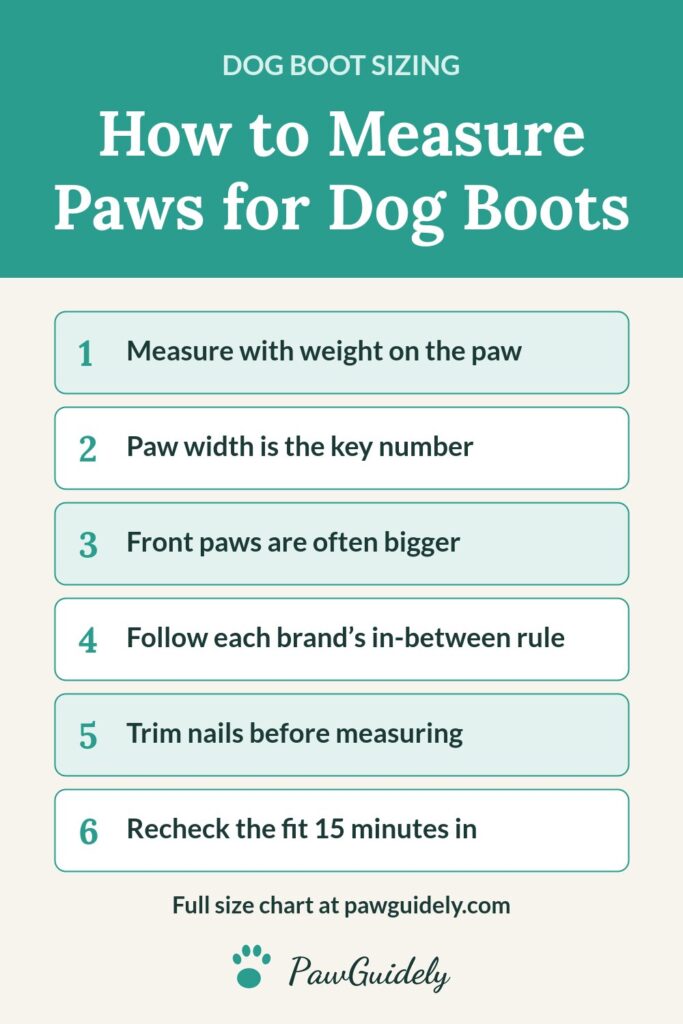
How to Measure Your Dog’s Paws for Boots
You need a sheet of paper, a pencil, a ruler that shows both inches and millimeters, a few treats and, ideally, a helper to hold your dog steady.
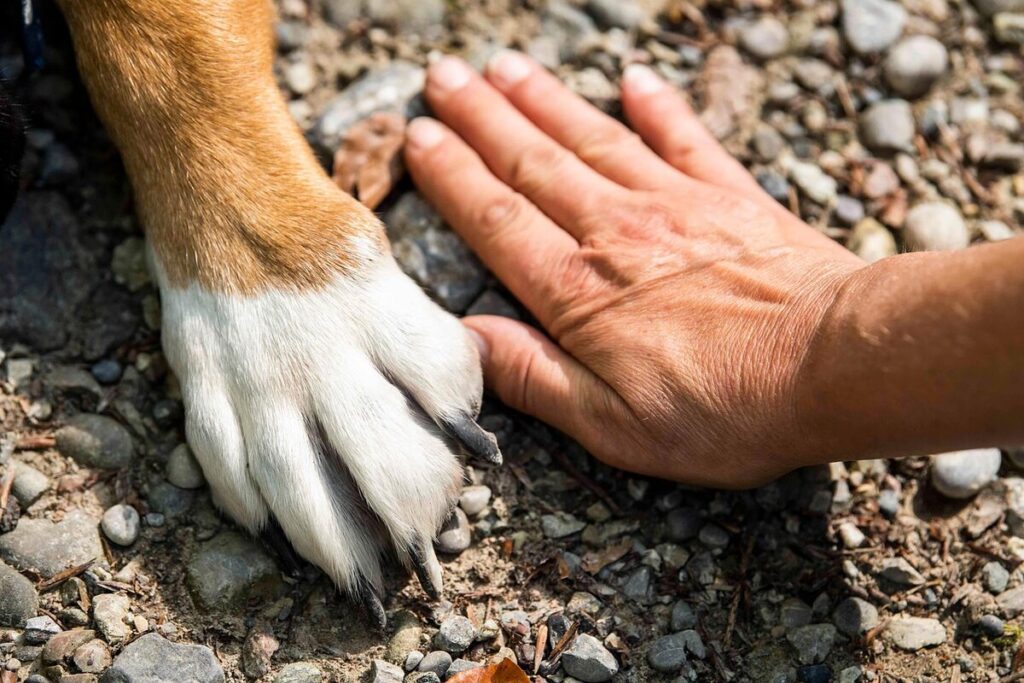
- Trim the nails first if they’re due. Long nails add length and push against the toe of the boot, which can make a correct size feel too small.
- Stand your dog on the paper on a hard floor. Lift the opposite leg gently so the paw you’re measuring takes extra weight. Paws spread when loaded, and that spread is the size the boot has to fit while walking.
- Mark both sides of the widest part of the paw, holding the pencil upright against the toes so you don’t angle under the foot.
- Mark the back of the main pad and the tip of the longest nail if the brand you’re considering also uses length.
- Measure between the marks. Write down width and length in both inches and millimeters, since some charts use one and some the other.
- Repeat on a back paw. If anything looks off, measure again; a pencil line a few millimeters out can move you a size.
Measuring a paw that’s lifted in the air almost always gives a smaller number than the loaded paw, which is the most common reason boots end up too tight across the toes.
Dog Boot Size Chart by Paw Width
There is no universal dog boot size. Below are two published charts lined up by paw width: Ruffwear Grip Trex, which names each size by the width it fits, and Canada Pooch, which uses numbered sizes with width and length ranges.
| Paw width | Ruffwear Grip Trex size | Canada Pooch size (width range) | Canada Pooch paw length |
|---|---|---|---|
| 1.0 to 1.3 in | Smaller than the range | Size 1 (1 to 1.3 in) | 1.5 to 1.8 in |
| 1.5 in / 38 mm | 1.50 in | Size 2 (1.5 to 1.8 in) | 2 to 2.3 in |
| 1.75 in / 44 mm | 1.75 in | Size 2 | 2 to 2.3 in |
| 2.0 in / 51 mm | 2.00 in | Size 3 (2 to 2.5 in) | 2.5 to 2.8 in |
| 2.25 in / 57 mm | 2.25 in | Size 3 | 2.5 to 2.8 in |
| 2.5 in / 64 mm | 2.50 in | Size 3 or 4 (overlap) | Use length to decide |
| 2.75 in / 70 mm | 2.75 in | Size 4 (2.5 to 2.8 in) | 3 to 3.3 in |
| 3.0 in / 76 mm | 3.00 in | Size 5 (3 to 3.3 in) | 3.5 to 3.8 in |
| 3.25 in / 83 mm | 3.25 in | Size 5 | 3.5 to 3.8 in |
| 3.5 to 3.8 in | Larger than the range | Size 6 (3.5 to 3.8 in) | 4 to 4.3 in |
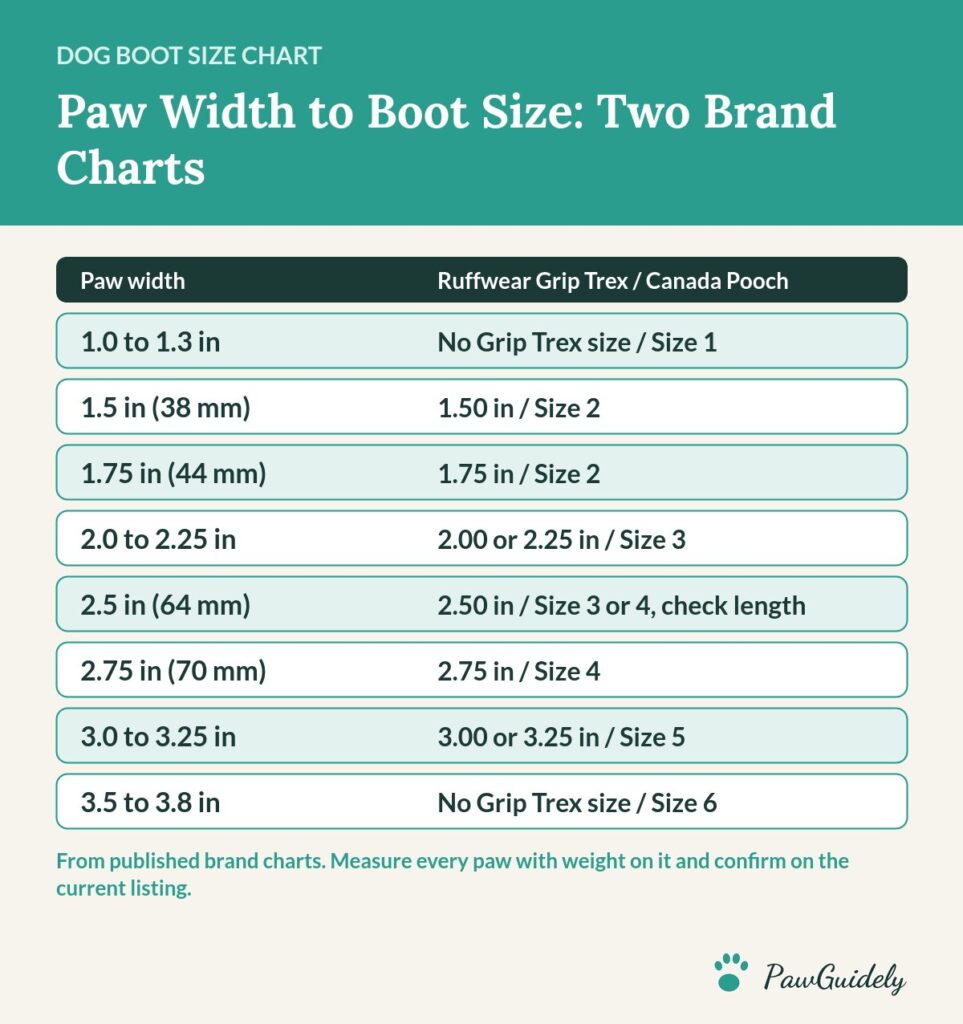
Charts are taken from the brands’ published size guides and can change, so confirm against the current listing before ordering. If your measurement falls in a gap in the Canada Pooch chart (for example 1.9 inches wide), use the paw length column to break the tie.
Why the Same Paw Can Be Two Different Sizes
Brands disagree on more than labels. Three differences catch owners out:
- The in-between rule. Ruffwear tells owners to size down when a paw falls between Grip Trex sizes, because the boot cinches at the leg and a loose shell twists. Other brands tell you to size up. Always follow the rule printed with the chart you’re using, not a general one.
- Width only versus width and length. A dog with long, narrow “hare” feet can match one size on width and the next size on length. Brands with a length column let you catch that; width-only brands assume an average shape.
- Stretch. Thin rubber “balloon” booties stretch over the paw and have their own letter sizes and measuring instructions on the packaging. Don’t convert a fabric-boot size to them.
Front Paws vs Back Paws
Ruffwear notes that front paws are typically larger than rear paws, which matches how dogs carry more weight up front. Use this decision rule when you order:
- Front and back fall in the same size: buy a set of four.
- They’re one size apart: buy two pairs in different sizes. Boots sold in pairs, like Grip Trex, make this easy.
- They’re two sizes apart: re-measure. A gap that large usually means one paw was measured unloaded.
What a Good Fit Looks and Feels Like
- The closure sits around the narrowest part of the leg and stays there when your dog trots.
- You can’t rotate the boot around the paw with your fingers.
- A firm tug at the top doesn’t pull the boot off.
- The toes don’t press against the front of the boot when your dog stands squarely.
- The strap doesn’t sit on top of the dewclaw.
Ruffwear also advises checking and readjusting closures about 15 minutes into an outing, once the boots have settled, and again during longer walks.
Troubleshooting Boots That Don’t Fit
| Problem | Likely cause | What to try |
|---|---|---|
| Boot spins around the paw | Too wide | Size down, or add boot socks to fill space |
| Boot flies off when running | Loose closure or too big | Re-cinch at the narrowest part of the leg; size down if it still slips |
| Red patch near the dewclaw | Strap rubbing | Reposition the strap or use socks under the boot |
| Nails poke the toe fabric | Nails too long or boot too short | Trim nails, then compare paw length to the chart |
| Fronts fit, backs slip | Paws are different sizes | Buy a smaller pair for the back |
| Dog high-steps and freezes | Getting used to the feel, not a fit problem | Short indoor sessions with treats before outdoor walks |
If you notice cracked, bleeding or swollen pads at any point, take the boots off and check with your vet before using them again.
Two Boots With Different Sizing Systems
These two show the two common approaches. Both fit well when you measure the way their chart asks.
1. Ruffwear Grip Trex Boots — Best for Width-Only Sizing
Grip Trex sizes are named after paw width, from 1.50 to 3.25 inches, so once you have a loaded paw measurement there’s no conversion step. The closure cinches around the narrowest part of the leg, and boots come in pairs so front and back can differ.
- Size names match paw width directly
- Sold in pairs for mixed front and back sizes
- Vibram outsole for rough trails and ice
- Closure designed to sit above the paw at the leg
Worth knowing: There’s no size for paws under 1.5 inches or over 3.25 inches, and some owners say the soles need breaking in before they flex well.
2. Canada Pooch Boots — Best for Long or Narrow Paws
Canada Pooch publishes both a width and a length range for each numbered size, from size 1 for toy paws to size 6 for paws around 3.5 to 3.8 inches wide. That second number helps dogs whose feet are longer than average for their width.
- Width and length ranges for each size
- Six sizes covering very small to large paws
- Length column breaks ties when width falls in a gap
- Several styles for snow, rain and pavement
Worth knowing: the size number is not a measurement, so a Canada Pooch size 3 is not a 3-inch paw. Check which style you’re buying, since fit can vary between models.
When to Measure Again
- Puppies: every few weeks while they’re growing.
- Adults: before buying a new brand or style, since charts differ.
- After a noticeable weight change or a long break from nail trims.
- Each winter, if boots have been stored, check the closures and soles before reusing them.
Related Guides
- Dog Bed Size Chart: How to Measure Your Dog for the Right Bed
- Dog Crate Size Chart by Breed and Weight
- How to Trim Dog Nails at Home (Without Cutting the Quick)
- How to Keep Your Dog Cool in Summer: 12 Practical Tips
- 4 Best Dog Raincoats to Keep Walks Dry and Visible
Frequently Asked Questions
What size boots does my dog need?
Measure the width of a loaded paw and match it to the brand’s chart. A paw 2.25 inches wide, for example, is a 2.25 in Ruffwear Grip Trex and a size 3 in Canada Pooch.
Should dog boots be a little bigger than the paw?
Only slightly in length, so the toes aren’t pressed. Width should be close to the paw, because extra width is what lets a boot twist and slip off.
How do I know if my dog’s boots are too big?
The boot rotates when you turn it by hand, slides down when your dog walks, or comes off with a light tug even with the strap tight.
Do dogs need different size boots on the front and back?
Often, yes. Front paws are usually larger, so measure both and buy two pairs if they land in different sizes.
Can I measure my dog’s paw with a tape measure?
You can, but tracing on paper with the paw loaded is more accurate, since a tape tends to compress the toes and read small.