
This post contains affiliate links. As an Amazon Associate I earn from qualifying purchases. This costs you nothing extra. See our affiliate disclosure for details.
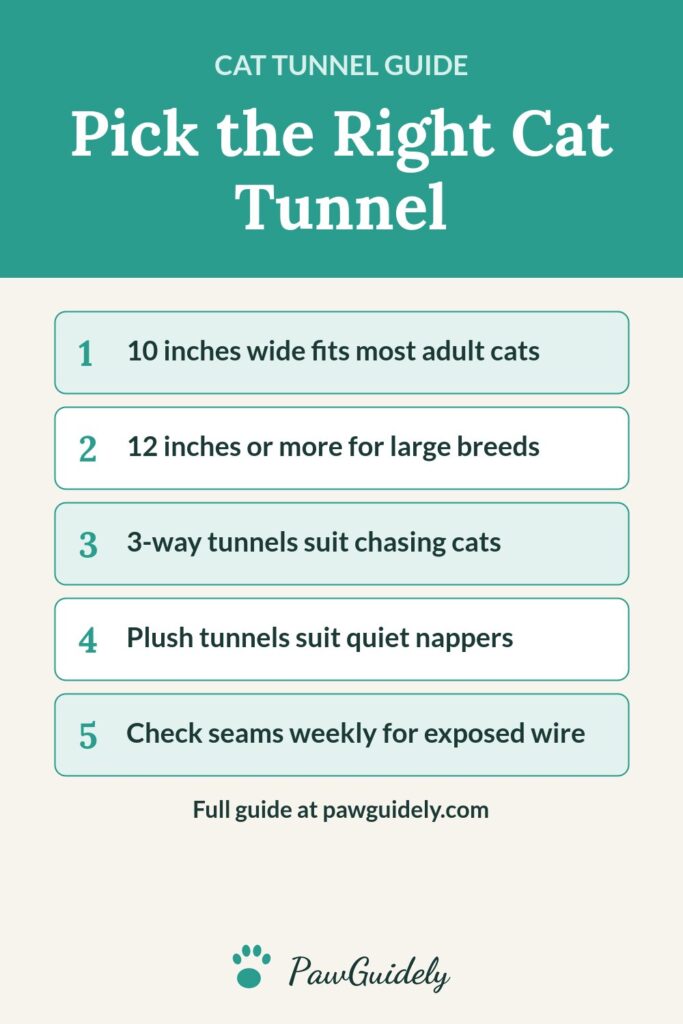
The best cat tunnel is one wide enough for your cat to run through without squeezing: about 10 inches across for most adult cats and 12 inches for big cats or Maine Coon types. A 3-way tunnel adds ambush corners that suit playful cats, while a plush, quieter tunnel works better for cats who would rather nap than sprint. Our four picks cover large cats, tight budgets, small rooms and crinkle-shy cats.
Tunnel Diameter: Measure Your Cat First
Stand your cat on the floor and measure from the floor to the top of the shoulders. Choose a tunnel whose diameter is at least that height, ideally with an inch or two to spare, so your cat can turn around inside and doesn’t brush the sides on every run. Length matters less; 3 to 4 feet is plenty for a dash.
| Your cat | Rough weight | Tunnel diameter to look for |
|---|---|---|
| Kitten or petite adult | Under 8 lb | 9 to 10 inches |
| Average adult cat | 8 to 12 lb | 10 inches |
| Large or long-bodied cat | 12 to 15 lb | 11 to 12 inches |
| Extra-large breeds, Maine Coon types | 15 lb and up | 12 inches or wider; check entry holes too |
| Two cats chasing each other | Any | Wider is better; a 3-way gives an escape route |
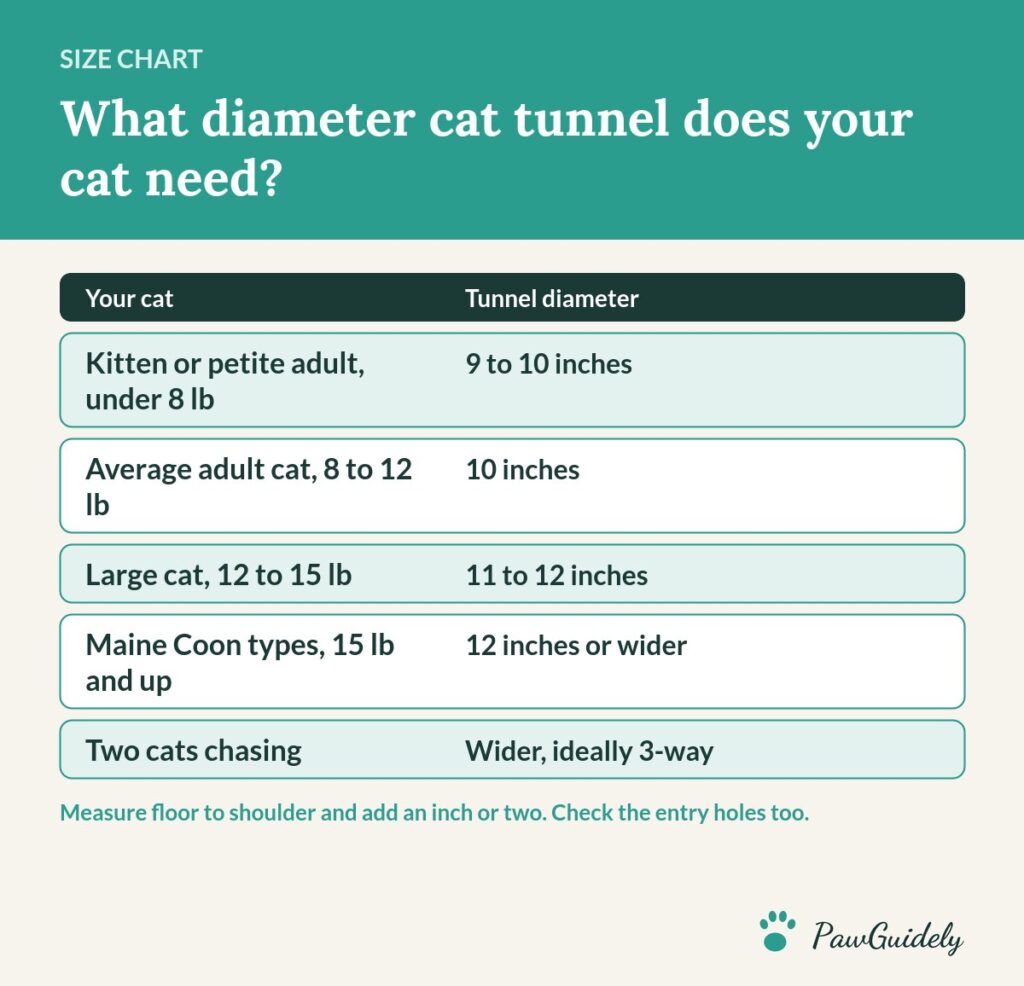
Check the entry holes as well as the tube. Some tunnels advertise a wide body but taper at the ends or the center hole, and that narrow point is what your cat has to fit through.
Straight, Branched or Plush: Real Trade-Offs
- Straight tunnels are the cheapest and easiest to store. They suit cats who like to dash through, but there is only one way in and one way out, which some cats find too exposed.
- 3-way and 4-way tunnels let a cat duck out one side and pounce from another. They need more floor space, roughly a square yard, and slide around more on hard floors.
- Crinkle linings make noise that many cats find exciting. Nervous cats may avoid them at first, and the crinkle layer wears out with heavy clawing.
- Plush or suede exteriors are quieter and double as a nap spot, but they hold fur and are harder to wipe clean than polyester.
The Picks, Based on Specs and Owner Feedback
1. Feline Ruff Premium 3-Way Cat Tunnel — Best for Large Cats
With a 12-inch diameter, this is one of the roomier branched tunnels, and listings put its total length at about 55 inches. It includes a crinkle lining, a hanging jingle ball and a teaser wand, so you can lure a hesitant cat inside on day one.
- 12-inch diameter suits big and long-bodied cats
- Three openings for ambush-style play
- Teaser wand included for getting cats started
- Collapses flat for storage
Worth knowing: It slides on hardwood and tile, and the branched shape takes up a fair amount of floor. A rug or non-slip mat underneath helps.
2. Pawaboo 3-Way Cat Tunnel — Best Budget 3-Way
Pawaboo’s 3-way tunnel measures 25 by 53 centimeters, which works out to roughly a 10-inch opening and arms about 21 inches long. That is a good fit for kittens and average adult cats, and the short arms keep the footprint small enough for an apartment.
- Low cost for a branched design
- Compact footprint for small rooms
- Folds down quickly
- Good size for kittens and average cats
Worth knowing: At about 10 inches across it is tight for large cats, and the thin polyester can snag or tear under heavy claws.
3. SmartyKat Crackle Chute — Best for Small Spaces
A short, straight tunnel at about 35 inches long with roughly 9.5-inch entry holes and an opening in the middle. Its crackling fabric is louder than most, which tends to appeal to play-driven cats and kittens.
- Short enough to fit beside a sofa or under a bed
- Center opening adds a peek-and-pounce spot
- Loud crackle many cats love
- Inexpensive and collapsible
Worth knowing: Colors ship at random, the narrow openings don’t suit large cats, and the string ties at one end can be chewed, so trim or remove them if your cat eats fabric.
4. LUCKITTY Plush Cat Tunnel — Best for Quiet Cats and Nappers
This plush tunnel is about 42.7 inches long in its straight version, with two peepholes on top and a plush ball at each end. It is quieter than crinkle tunnels, and the fabric glows in the dark for a few hours after sitting in strong light, which some owners like for evening play.
- Quiet, soft fabric suits crinkle-shy cats
- Comfortable enough to double as a bed
- Two top peepholes for hide-and-seek
- Glow-in-the-dark fabric for night play
Worth knowing: Plush fabric holds fur and is harder to clean, the glow only works after charging in bright light, and the dangling balls should come off if your cat chews them.
Getting a Reluctant Cat to Use a Tunnel
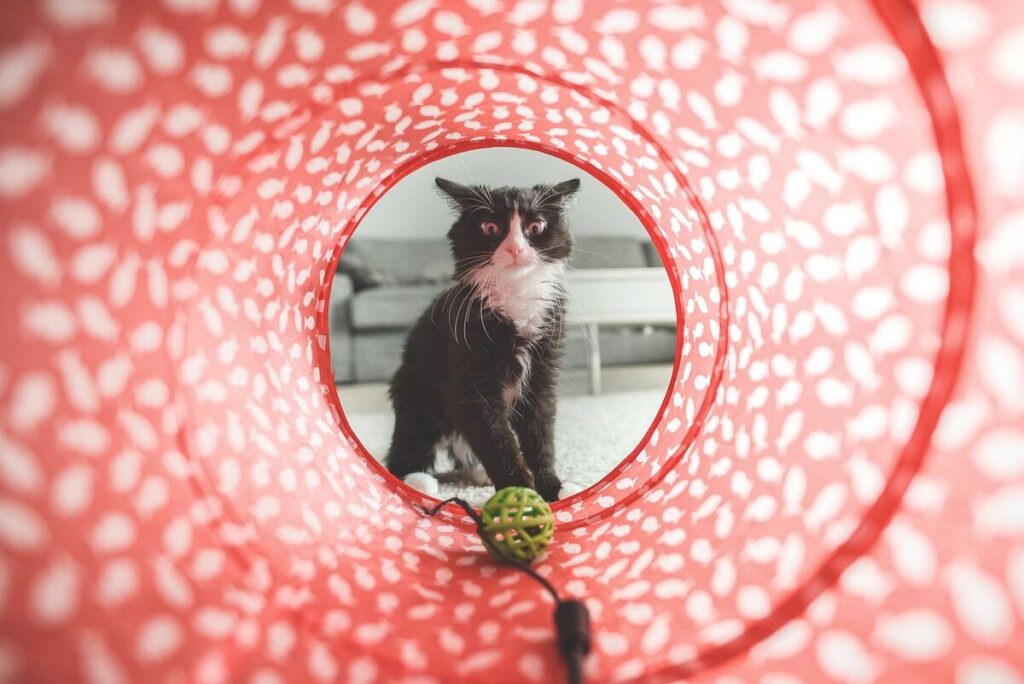
- Open it near a spot your cat already likes, such as beside a sofa or a sunny window, not in the middle of the room.
- Leave it alone for a day. Let your cat sniff it on their own terms before you start any play.
- Drop a few treats or a pinch of catnip at one entrance, then just inside, then halfway through.
- Pull a wand toy slowly through the tunnel so your cat follows it in. Keep the toy moving away from your cat, like prey escaping.
- Stop while it is fun. A few minutes is enough. Many cats start using a tunnel on their own after a few sessions.
Upkeep and Safety Checklist
- Weekly: shake out fur and litter, and check seams for splits where the spring wire could poke through.
- Monthly: wipe polyester tunnels with a damp cloth; vacuum plush ones or follow the maker’s wash instructions.
- Every time you notice chewing: remove dangling balls, strings and loose fabric so they can’t be swallowed.
- Retire it once the wire frame is exposed or bent out of shape, or the fabric has holes a paw can catch in.
- Store it collapsed with the strap fastened. Collapsible frames spring open with force, so release them away from faces.
Buy or Skip?
A tunnel earns its place if your cat already likes hiding in boxes or paper bags, if you have two cats who chase each other, or if you need cheap, foldable enrichment for a small home. Skip it, or try a cardboard box first, if your cat ignores floor-level toys and prefers climbing and window watching; a cat tree or window perch will get more use. Some cats also never warm to crinkle noise, so a quieter plush tunnel is a safer first buy for a timid cat.
Related Guides
- 4 Best Interactive Cat Toys for Bored Indoor Cats
- 3 Best Cat Trees for Small Spaces and Apartments
- 4 Best Cat Trees for Large Cats
- 4 Best Cat Window Perches
- 5 Best Cat Beds Your Cat Will Actually Use
- New Cat Checklist: 20 Essentials
Frequently Asked Questions
What size cat tunnel do I need for a Maine Coon?
Look for a 12-inch diameter or wider and check that the entry holes are just as wide. Many standard tunnels are 10 inches, which is too snug for most Maine Coons.
Are cat tunnels safe to leave out all the time?
Generally yes, as long as there are no loose strings or chewed parts and the fabric hasn’t torn to expose the wire. Remove dangling toys if your cat tends to chew fabric.
Do cat tunnels work for rabbits or small dogs?
Some larger tunnels are marketed for rabbits and small dogs, but check the diameter and fabric strength. Dog claws and chewing wear tunnels out much faster.
Why won’t my cat go in the tunnel?
The crinkle noise, the open-room location or a narrow entry can put cats off. Move it beside furniture, use treats and a wand toy, or try a quieter plush tunnel.