
This post contains affiliate links. As an Amazon Associate I earn from qualifying purchases. This costs you nothing extra. See our affiliate disclosure for details.
For most dogs that pull, a front-clip harness is the better first choice: it fits in a minute, needs no adjustment period and keeps all pressure off the head and neck. A head halter gives more steering power for large, strong or lunging dogs, but it only works well after a few days of careful introduction and gentle leash handling. If a harness alone isn’t giving you enough control, that’s the point to try a halter.
How Each One Steers a Pulling Dog
A head halter (Gentle Leader, Halti and similar) has a loop over the muzzle and a strap high behind the ears. The leash clips under the chin. When the dog surges forward, the tension turns its nose sideways and back toward you, and where the head goes the body follows. It works on the same idea as a horse halter: you control direction, not strength.
A front-clip harness (PetSafe Easy Walk and other no-pull styles) has the leash ring on the chest. Pulling swings the dog’s shoulders sideways, which takes away the forward drive. The effect is gentler than a halter, which is both its strength and its limit with very determined pullers.
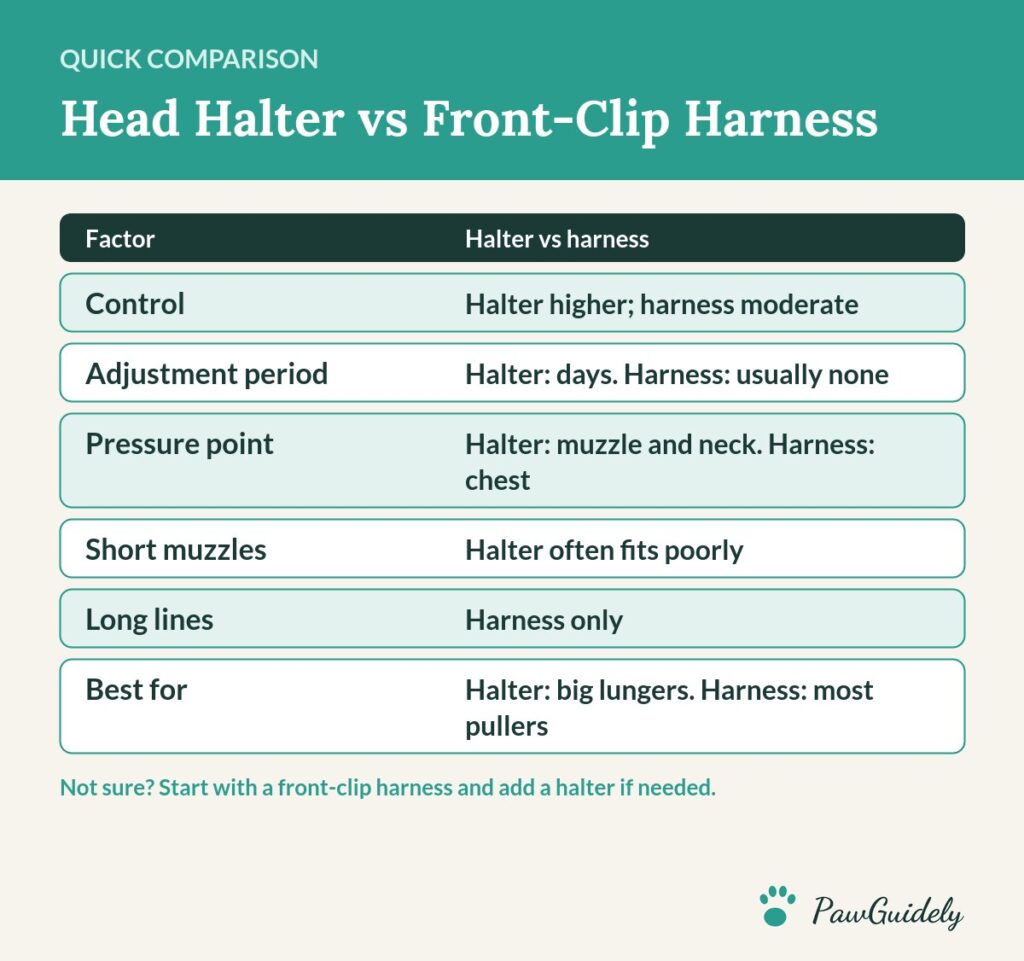
Head Halter vs Harness at a Glance
| Factor | Head halter | Front-clip harness |
|---|---|---|
| Control over a strong puller | High; turns the head | Moderate; turns the shoulders |
| Adjustment period | Several short sessions over days | Usually none |
| Pressure point | Muzzle and back of neck | Chest and shoulders |
| Risk if misused | Neck jerk on sudden lunges | Rubbing or restricted gait if fitted badly |
| Short-muzzled breeds | Often a poor fit | Usually fine |
| Works with long lines or retractables | No | Yes, clipped to the back ring |
| Public perception | Often mistaken for a muzzle | Looks like any harness |
Choose a Head Halter If…
- Your dog is large or very strong and drags you even in a front-clip harness.
- Your dog lunges at other dogs, bikes or wildlife and you need to redirect its attention quickly.
- You walk in busy places where one surge could pull you off balance.
- You are willing to spend a few days conditioning the halter before relying on it.
Choose a Front-Clip Harness If…
- Your dog pulls steadily but doesn’t lunge or spin.
- Your dog is a puppy, a senior, or has any neck or spine concern your vet has mentioned.
- Your dog has a short muzzle (pugs, bulldogs, boxers), where nose loops tend to slip or ride into the eyes.
- You need one piece of gear for walks, hikes and car trips.
- Several people walk the dog, including kids or less experienced handlers.
The Options Worth Considering
1. PetSafe Gentle Leader Headcollar — Best Classic Head Halter
The Gentle Leader is the head halter most trainers recognize. It is a simple design: a nose loop and a neck strap that sits high behind the ears, with the leash ring under the chin. Sizes are chosen mainly by weight, with the maker noting that dogs with unusually broad or narrow muzzles may need to size up or down. When fitted properly the dog can pant, drink, eat and bark; the loop closes the mouth only when the leash pulls.
- Strong steering for large pullers
- Light, minimal design
- Dog can pant and drink normally
- Widely used in training classes
Worth knowing: the unpadded nose loop can rub on some dogs, and owners often find it fiddly to fit at first. It needs a proper introduction or many dogs will paw at it.
2. Halti OptiFit Headcollar — Best Padded Head Halter
The OptiFit adds comfort features to the halter idea. The noseband is padded neoprene, the nose and cheek straps adjust to suit different face shapes, and a safety link clips to the dog’s regular collar so the halter can’t come completely free if it slips off the nose. Reflective cheek straps help in low light.
- Padded neoprene noseband
- Adjusts to suit long and broad muzzles
- Safety link to the dog’s collar
- Reflective trim
Worth knowing: there are more straps to set up than on a Gentle Leader, and the safety link needs a separate collar. Measure the neck carefully, since size charts from different sellers don’t always agree.
3. PetSafe Easy Walk Harness — Best Front-Clip Alternative
If a halter sounds like more than your dog needs, the Easy Walk is a long-standing front-clip choice. The leash clips to a martingale loop on the chest that tightens slightly when the dog pulls and turns it back toward you. It goes on without passing over the head.
- No adjustment period for most dogs
- Nothing on the face or neck
- Quick to put on
- Many sizes, including for small dogs
Worth knowing: it has only a front ring, and the chest strap can rub or limit shoulder movement if it sits too low. Recheck the fit regularly.
How to Introduce a Head Halter (Day by Day)
- Days 1–2: show the halter, reward. Hold the nose loop open and let your dog push its nose through for a treat, then remove it. Repeat a few times per session.
- Days 3–4: fasten the neck strap for a few seconds while feeding treats, then take it off before your dog starts pawing.
- Days 5–6: leave it on indoors for a few minutes during play or a short training session. If your dog paws, keep walking and redirect with a treat rather than removing it mid-protest.
- Day 7 onward: clip on the leash in a quiet spot. Keep the leash loose and use gentle, brief pressure to turn the head, then release.
Some dogs accept a halter in a day; others need two weeks. Move at your dog’s pace.
Halter Problems and Quick Fixes
- Dog paws at its face: go back a step in the introduction and pair the halter with walks and meals so it predicts good things.
- Nose loop rides up toward the eyes: the neck strap is too loose. It should sit snugly high on the neck so the nose loop stays at the base of the muzzle.
- Red or rubbed bridge of the nose: the nose loop is too tight or rubbing; loosen it so it can slide toward the nose tip without coming off, or try a padded model.
- Dog plants and refuses to move: stop applying leash pressure, wait, and reward any step forward.
Safety Rules for Head Halters
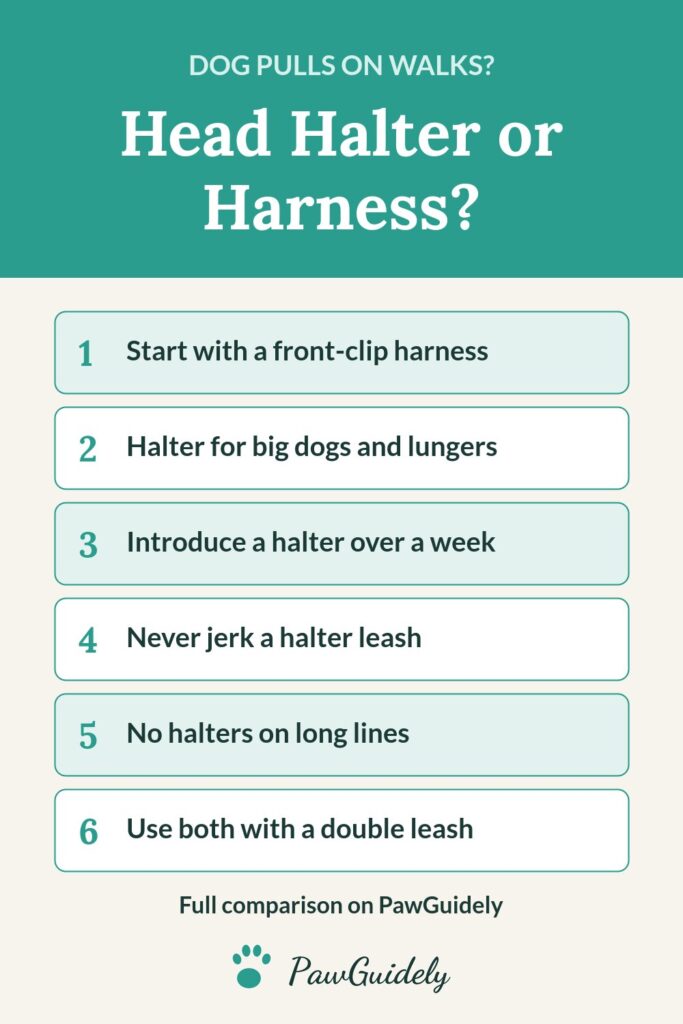
- Never jerk or snap the leash. Sudden force on the head twists the neck.
- Never use a halter with a retractable leash or long line, where the dog can hit the end at speed.
- Don’t leave a halter on an unsupervised dog.
- A head halter is not a muzzle and does not stop biting.
- If your dog has any neck, back or eye problem, ask your vet before using one.
Can You Use Both Together?
Yes, and many trainers suggest it for big pullers. Clip a double-ended leash to the halter and to a harness: use the harness side for normal walking and the halter side only when you need to turn the dog’s head. This lowers the pressure on the halter and gives you a backup if it slips. As loose-leash walking improves, you can usually drop the halter and keep the harness.
Related Guides
- How to Stop Your Dog Pulling on the Leash When Walking (8 Steps)
- 4 Best No-Pull Dog Harnesses in 2026 (and How to Fit One Properly)
- PetSafe Easy Walk vs Ruffwear Front Range: Which Harness Is Better?
- Dog Harness vs Collar: Is a Harness Better for Your Dog?
- 5 Best Dog Leashes for Everyday Walks, Running and Training
- 5 Best Harnesses for Large Dogs: Strong, Comfortable and Secure
Frequently Asked Questions
Are head halters cruel?
A properly fitted head halter used with a loose leash is not cruel, but it can cause discomfort or neck strain if the leash is jerked. Introduce it slowly and pair it with reward-based training.
Is a Gentle Leader better than a harness?
It gives more control over strong pullers, while a front-clip harness is simpler and gentler. Start with a harness and add a halter only if you need more control.
How long does it take a dog to get used to a head halter?
Many dogs adjust within a week of short daily sessions, though some take longer. Pawing usually fades as the dog connects the halter with walks.
Can I use a head halter on a puppy?
Most trainers start puppies on a harness and teach loose-leash walking first. If you’re considering a halter for a young dog, ask your vet or a qualified trainer.