
This post contains affiliate links. As an Amazon Associate I earn from qualifying purchases. This costs you nothing extra. See our affiliate disclosure for details.
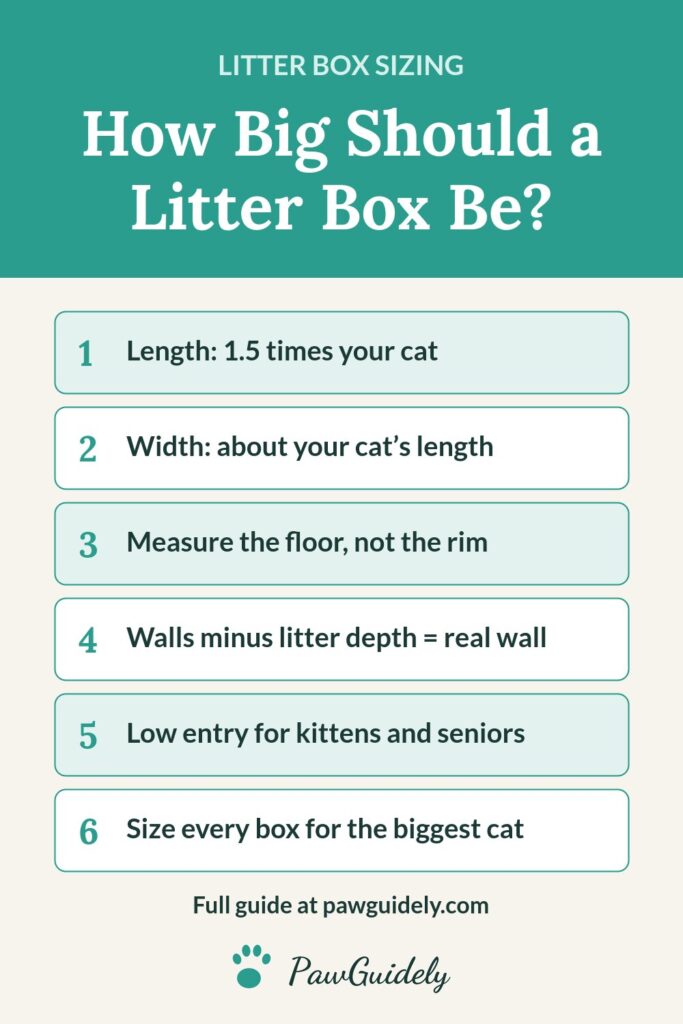
A litter box should be at least one and a half times as long as your cat, measured from nose to the base of the tail, and roughly as wide as your cat is long so it can turn around without stepping out. For an average adult cat of about 18 inches, that means a box floor near 27 by 18 inches, which is bigger than most pans sold as “large.” Compare those numbers to the inside floor of the box, not the outside rim, because most boxes taper toward the bottom.
Litter Box Size by Cat Length
| Cat length (nose to tail base) | Minimum box length | Minimum box width | Typical cat |
|---|---|---|---|
| 12 in | 18 in | 12 in | Young kitten |
| 14 in | 21 in | 14 in | Small adult |
| 16 in | 24 in | 16 in | Average adult |
| 18 in | 27 in | 18 in | Larger adult |
| 20 in | 30 in | 20 in | Large breed |
| 22 in and up | 33 in or more | 22 in or more | Very large breed |
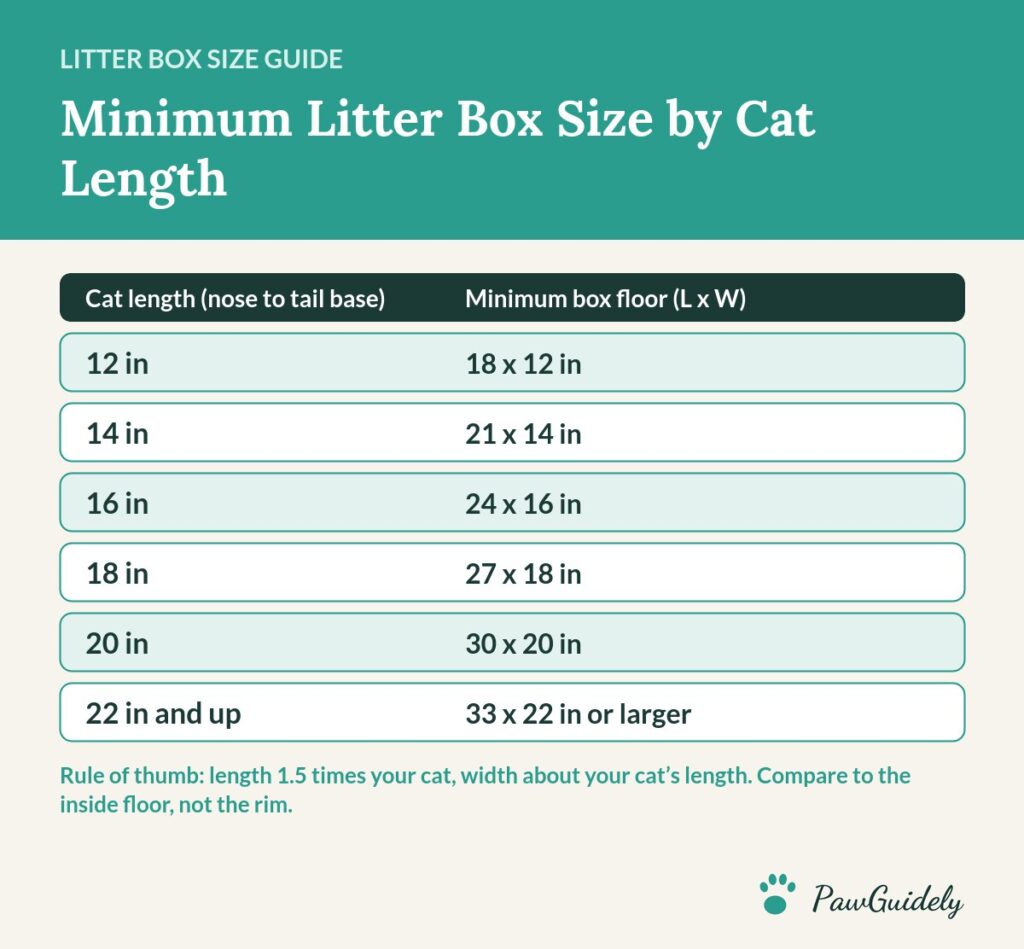
These are minimums. Most cats are happier with more room, not less, and a cat that has to perch on the rim or balance with back feet outside the box is telling you it’s too small.
How to Measure Your Cat and the Box
- Wait until your cat is relaxed and stretched out, lying on its side or standing calmly.
- Run a soft tape from the tip of the nose along the back to the base of the tail. Leave the tail out.
- Multiply by 1.5 for the minimum box length. Use the cat’s length itself as the minimum width.
- Measure the inside floor of the box you own or plan to buy. If the listing only gives outside dimensions, assume the floor is a few inches smaller on each side for a tapered pan.
- Check the height of the lowest point your cat has to step over, and the height of the walls where your cat usually faces when it squats.
Why Listed Box Sizes Are Misleading
Most plastic pans and storage totes have sloped walls, so the rim is bigger than the floor your cat actually stands on. A few real examples show how much space disappears:
| Box | Listed outside size | Usable floor | Suits a cat up to about |
|---|---|---|---|
| Petmate litter pan, Large | 18.5 x 15.3 x 5 in | About 16.5 x 14 in footprint | 11 in long |
| Petmate litter pan, Jumbo | 22 x 16.5 x 6.5 in | About 20 x 15 in footprint | 13 in long |
| Sterilite 66 qt latch box | 23.6 x 16.4 x 13.3 in | About 19.9 x 13.4 in at the bottom | 13 in long |
| IRIS USA XX-Large High Sided | About 30 x 20 x 14 in | Not published; smaller than the rim | 18 to 20 in long |
The storage tote is the surprise. Large totes are often suggested as DIY boxes for big cats, but a 66-quart tote’s inside floor is under 20 inches long, which only meets the 1.5 times rule for a cat of about 13 inches. If you go the DIY route, measure the inside bottom of the tote in the store, and look for longer, flatter containers rather than taller ones.
Wall Height, Entry Height and Litter Depth
Length and width decide whether your cat fits. Height decides whether the litter and urine stay inside. Match it to how your cat behaves:
- Kittens, seniors and stiff-jointed cats: choose an entry they can step over rather than hop. Pans with walls around 5 to 6.5 inches are typical low options.
- Cats that kick hard or stand to pee: choose high walls on three sides with a lower entry cut-out, or a tall-sided open box like the 14-inch IRIS boxes.
- Cats that squat at one end: extra length helps more than extra height, because they aim at the same wall every time.
Litter depth changes all of this. Many owners keep 2 to 3 inches of litter in the box, and every inch of litter takes an inch off the wall. A 5-inch pan filled 3 inches deep leaves only 2 inches of wall above the litter, which is why shallow pans scatter so much. A quick check: wall height minus litter depth should still be taller than the height your cat’s back end sits at when squatting.
Sizing for Kittens, Seniors and Multi-Cat Homes
- Kittens: start with a low-sided pan so they can climb in easily, then move to an adult-size box as they grow. Plan for the adult size by around their first birthday.
- Senior cats: keep the same length rule but lower the entry. If a senior cat starts going just outside the box, check the entry height before anything else, and mention it to your vet.
- Several cats: size every box for the largest cat in the home, not the average. For how many boxes you need, see our litter boxes per cat guide.
Covered and Top-Entry Boxes Need Extra Room
A hood adds a ceiling, so a covered box also has to be tall enough inside for your cat to stand and turn without crouching. Compare the inside height to your cat’s height at the shoulders with some headroom to spare. Top-entry boxes need even more care: your cat lands inside, turns around and jumps out through the lid, so a box that’s barely long enough becomes awkward fast. They suit agile adult cats, not kittens or seniors.
Signs Your Litter Box Is Too Small
- Urine or feces land just over the edge while your cat’s front paws are inside.
- Your cat perches on the rim instead of standing in the litter.
- Litter is kicked out every visit despite normal digging.
- Your cat barely digs or covers, then leaves quickly.
- A large cat turns in circles and can’t find a comfortable spot.
A cat that suddenly stops using the box, strains, or goes more often than usual may have a medical problem rather than a size problem. Call your vet before changing equipment.
Boxes That Meet the Size Rule
These options cover the three most common needs: a big cat, a senior big cat, and a kitten or small adult on a budget. Dimensions are from the manufacturers’ listings.
1. IRIS USA XX-Large High Sided Litter Box — Best for Large Cats
At about 30 by 20 inches with 14-inch walls, this open box meets the 1.5 times rule for cats up to roughly 18 to 20 inches long, measured on the outside rim. The tall shield helps with high kickers and cats that pee standing up.
- One of the longest mainstream plastic boxes
- Tall walls for scatter and spray
- Open top for airflow and easy scooping
- Works for multi-cat homes
Worth knowing: It takes up a lot of floor space, and the high walls make it harder for older cats unless they use the lower front.
2. IRIS USA XX-Large Side Entry Litter Box — Best for Big Senior Cats
The same roughly 30 by 20 by 14 inch footprint with a 6.5-inch curved side entry, so a large cat gets full length without climbing a 14-inch wall.
- Long enough for large breeds
- Lower side entry
- Tall walls elsewhere contain scatter
- Open top, easy to see when it needs scooping
Worth knowing: A 6.5-inch step is lower than the walls but still a step, so cats with severe mobility problems may need an even lower entry.
3. Petmate Litter Pan, Jumbo — Best Budget Box for Kittens and Small Cats
A plain open pan listed at 22 by 16.5 by 6.5 inches, with a footprint of roughly 20 by 15 inches. That suits kittens and small adults, and makes a cheap second box in a multi-cat home.
- Low walls that young cats can step over
- Inexpensive and easy to replace
- Simple shape with nowhere for clumps to hide
- Easy to find in pet stores
Worth knowing: by the 1.5 times rule it’s only big enough for a cat of about 13 inches, so most average adults will outgrow it. Low walls also mean more scatter.
Related Guides
- 5 Best Cat Litter Boxes: Open, Covered, High-Sided and Top-Entry
- 5 Best Litter Boxes for Large Cats (Maine Coons and Big Breeds)
- How Many Litter Boxes Do You Need Per Cat?
- How to Clean a Litter Box: Daily, Weekly and Deep-Clean Routine
- 4 Best Cat Litter Mats to Stop Litter Tracking
- Best Cat Litter: 5 Picks and Every Litter Type Explained
Frequently Asked Questions
How big should a litter box be for one cat?
At least one and a half times your cat’s length from nose to tail base, and about as wide as your cat is long. An 18-inch cat needs a floor near 27 by 18 inches.
Is a storage bin big enough for a litter box?
Only if you measure it. A typical 66-quart tote has an inside floor under 20 inches long, which suits a cat of about 13 inches. Longer, flatter bins work better for big cats.
Can a litter box be too big?
For most cats, no. The limits are your floor space and how much litter it takes to fill. Kittens and seniors care more about a low entry than about extra size.
How deep should the litter be?
Many owners use 2 to 3 inches. Deeper litter makes the walls effectively shorter, so pair deeper litter with taller sides.
What size litter box does a Maine Coon need?
Measure your cat, but many large-breed cats are 20 inches or more from nose to tail base, which points to a box floor of 30 inches or longer.